



Free Shipping All Orders Over $95
The most popular advice about live resin gummies gets the priority backward. You're told to chase a strain name first and check milligrams second, as if fresh frozen extract guarantees a stronger, faster, more authentic high. It doesn't. Live resin names how the extract started. Your dose, your stomach, and the accuracy of the finished gummy decide what happens next.
Judge any live resin product the way you'd judge a distillate product. Compare them at the same measured THC dose, then ask whether a lab report proves the extra claims on the pouch.
A live resin gummy is a chewed edible infused with extract made from cannabis frozen soon after harvest, rather than flower that was dried and cured first. Freezing early gives volatile aroma compounds a better chance to stay in the material. It doesn't change the route THC takes after you swallow it.
Think of dried herbs compared with fresh herbs you freeze right after picking. The frozen batch can smell brighter when you open the bag. Cook both into the same sauce, though, and heat, fat, sugar, and time start closing the gap. The starting herb matters, but it doesn't control the whole meal.
Distillate gummies use a highly refined oil. Refinement usually removes most native aroma compounds, so makers add candy flavor or terpenes back later. That approach can taste flatter, yet it can also be simple to dose if the finished pieces are tested well.
Rosin gummies use oil pressed from cannabis with heat and pressure, without solvent. Solventless describes the extraction method. It doesn't prove that every piece contains the milligrams printed on the label.
Live resin sits between those poles in marketing language, but not in digestion. If you want the deeper distinction, compare cured resin versus live resin before you pay a premium for either name.
Live resin, distillate, and rosin gummies compared
| Feature | Live resin gummies | Distillate gummies | Rosin gummies |
|---|---|---|---|
| Starting material | Fresh-frozen cannabis, not dried first | Dried cannabis refined into a highly purified oil | Cannabis pressed with heat and pressure, no solvent |
| Terpenes and flavor | Native volatiles that can be lost in the gummy cook | Usually removed, then flavor or terpenes added back | Plant compounds pressed with the oil, still changed by heat and the cook |
| What sets the high | Measured THC dose plus oral metabolism, not the live resin name | Measured THC dose, often a narrower cannabinoid mix | Measured THC dose, solventless does not mean accurate milligrams |
| Typical onset and duration | About 30 to 90 minutes to start, peak around 2 to 4 hours, effects about 4 to 12 hours | Same oral timing | Same oral timing |
| Best reason to pick it | You want a fresher aroma claim and a COA that lists terpenes | You want a simple, repeatable THC number and accept flatter flavor | You want a solventless extract and will still verify potency |
| Common label trap | Live resin does not prove a stronger or more authentic high | Full spectrum wording may not match a near-isolate oil | Rosin does not guarantee serving-to-serving uniformity |
Starting material tells you where the oil began, not what survived the gummy cook. A fresh-frozen input can still lose aroma before it reaches you.
Terpenes and flavor explains taste better than it explains strength. Added-back flavor isn't automatically worse, and native flavor isn't automatically preserved.
What sets the high is the row to trust. Swallowed THC follows the same slow path whether the oil started as live resin, distillate, or rosin.
Typical onset and duration stays stubbornly similar across the table because your digestive system sets the clock. A premium extract doesn't make an edible behave like a vape.
Best reason to pick it turns a vague preference into a testable reason. You're paying for aroma, simplicity, or solventless processing, not for a different clock.
Common label trap is where money gets wasted. Words such as live resin, full spectrum, and solventless describe inputs or methods. They don't replace a measured serving.
Compare two pouches only when THC per serving matches. A 5 mg live resin piece and a 10 mg distillate piece aren't a fair test of extract type.
Use the table to strip out marketing words. First match the milligrams. Then check whether anything else on the label is measured in the finished gummy, not just promised from the input oil.
A cultivator harvests the plants and, instead of hanging them to dry, sends them for flash-freezing soon after harvest. That choice is the whole premise. The goal is preservation, not extra potency by magic.
Historical accounts place the method around 2010, when Colorado cultivator William "Kind Bill" Fenger pursued flash-freezing to retain more aroma and flavor, and a first successful batch followed his collaboration with extraction specialist Jason "Giddy Up" Emo, according to Pittsburgh City Paper's history of live resin, which also notes that one university study cited in historical reporting found cannabis can lose nearly 50% of its terpene content during curing.
The diagram below follows that frozen flower through extraction and into the finished candy.
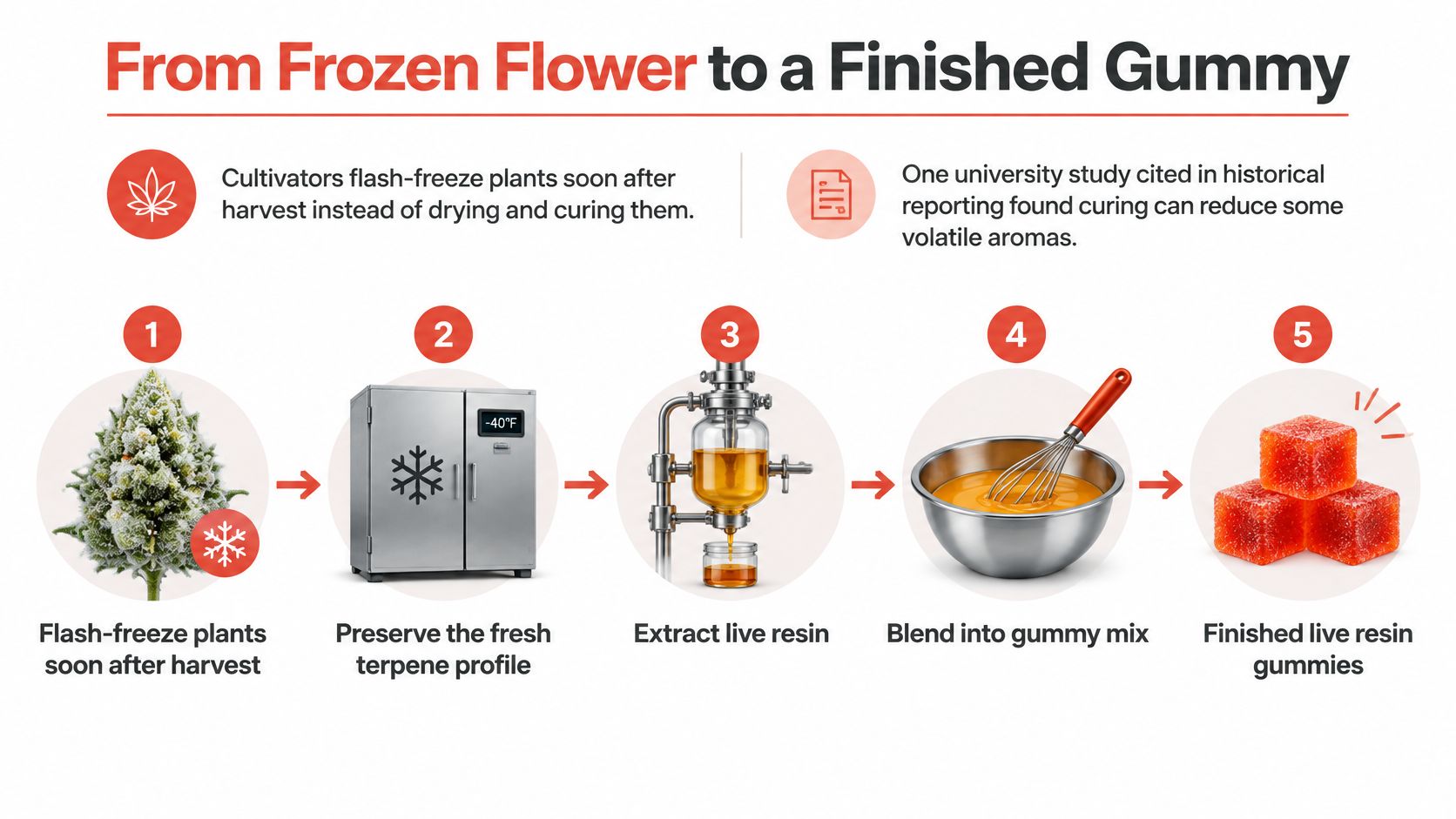
Processors turn the frozen material into a sticky, terpene-rich concentrate. A candy maker then measures that concentrate into a gummy base built from sugar, water, gelatin or pectin, acid, and flavor. The mix is deposited into molds, cooled, and packaged.
That sounds tidy. In practice, three failure points decide whether the pouch deserves its premium.
A maker can calculate how much THC went into a batch and still miss the dose in an individual piece. Say the concentrate assay is correct, but the mix settles before molding. The first trays and the last trays won't match.
That's why quality depends on extraction controls, dosing the finished piece, stability checks, and independent laboratory testing. Testing only the input oil tells you what the candy maker started with. Testing finished gummies from across the batch tells you what you're about to eat.
The words live resin on a pouch describe step one. They say nothing about steps four and five, where heat, mixing, and shelf life can undo the advantage.
The front of a pouch can make a gummy sound precise. The batch number and a matching certificate of analysis (COA) show whether the details apply to the product in your hand.
Check these six label details:
The checklist graphic below keeps those details together.
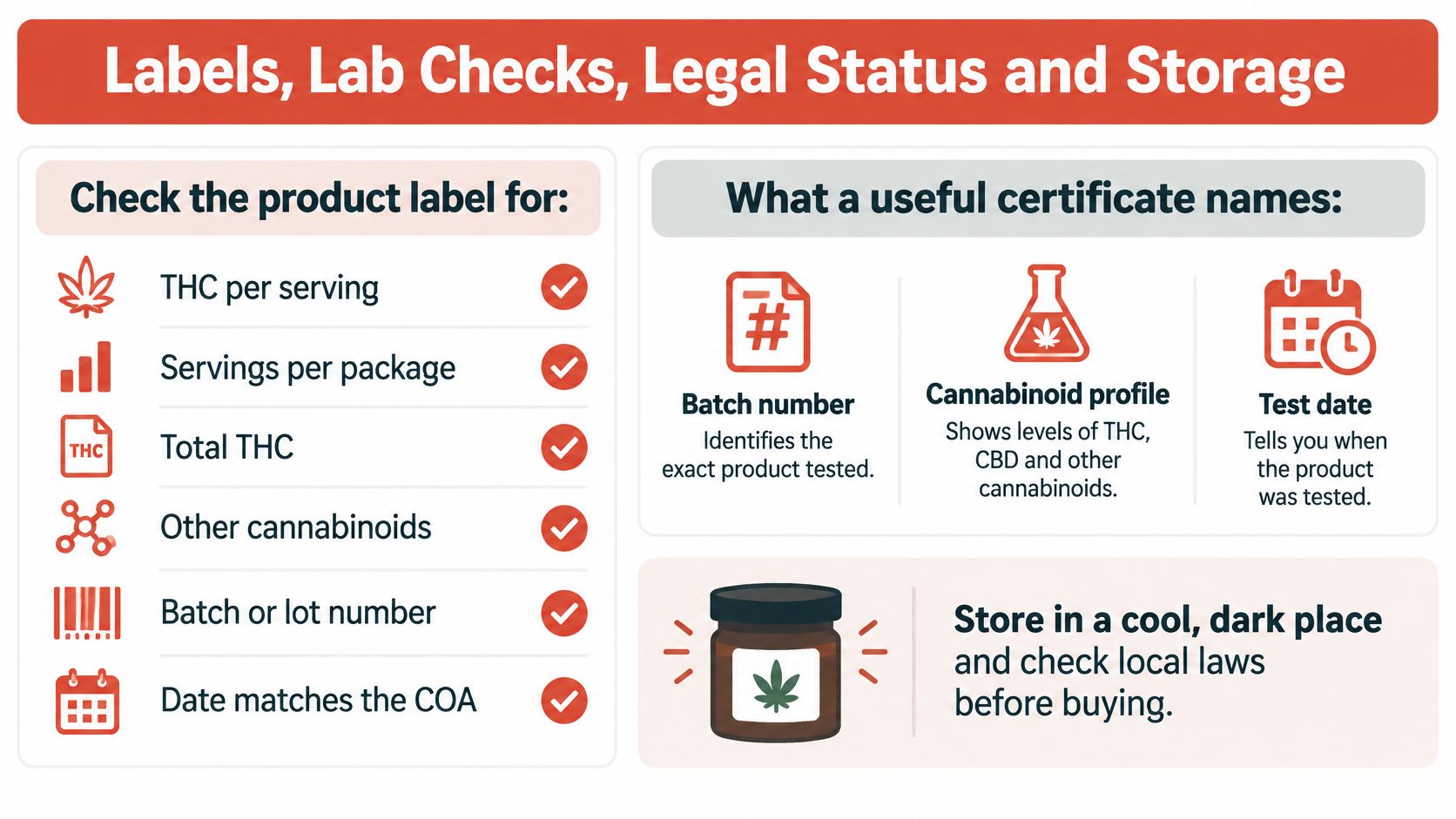
The COA should identify the finished gummy as the tested product, not only the oil used to make it. Check for serving size, cannabinoid amounts per serving, detection limits, and contaminant screens. For help interpreting those details, see this guide to reading a certificate of analysis.
Testing should cover possible contaminants from both the extract and the candy. That can include residual solvents when solvent extraction was used, as well as pesticides, heavy metals, and microbes.
The same standard applies to terpene claims. If a brand charges more for live resin flavor, look for a quantitative terpene panel in the finished-gummy COA. Descriptions such as citrus or gas are flavor language, not measurements. Without cannabinoid and terpene results for the finished gummy, strain and entourage claims remain unproven.
In a JAMA study of 75 cannabis products, only 17% were accurately labeled for THC. 23% were underlabeled, and 60% were overlabeled.
A label that overstates or understates THC makes it harder to know how much a piece contains. If the effects seem slow, taking another gummy before the first has taken effect can make the total dose harder to judge.
Batch rule: Learn your response on one lot. Treat a different lot with the same front label as a new test.
For hemp-derived products, the federal limit is 0.3% delta-9 THC by dry weight. Because that is a percentage of the product's weight, it does not tell you the milligrams of THC in a serving. State rules can also restrict intoxicating hemp edibles or set serving and package limits. Check your state's rules before buying or traveling with a pouch.
Store gummies cool, dark, sealed, and in the original pouch to limit moisture loss and light exposure. Keep them locked away from children and pets, since their candy format can invite accidental eating. Don't freeze them unless the maker says their texture holds up after thawing.
Wait at least two hours, and preferably four, before taking more. That rule comes before any scenario, brand, or strain story. Most edible trouble isn't caused by the first piece. It's caused by the second piece taken while the first is still loading.
The timing graphic below puts that wait rule ahead of everything else.
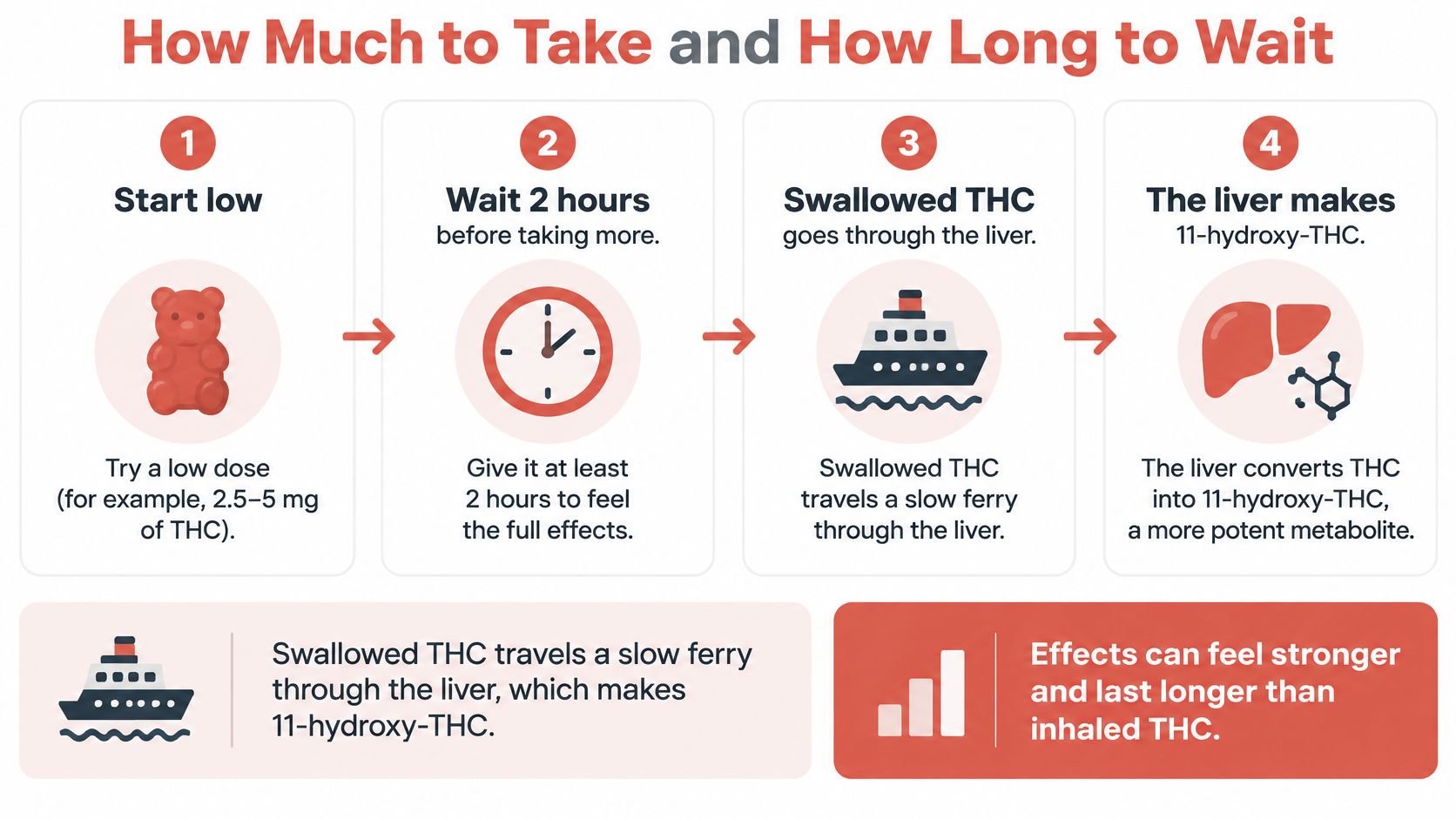
Swallowed THC travels a slow ferry through your liver. On that trip, your liver makes 11-hydroxy-THC, a psychoactive metabolite that can feel stronger and last longer than inhaled THC. In a scientific review of oral cannabinoid pharmacokinetics, edible effects generally begin after approximately 30 to 90 minutes, peak around 2 to 4 hours, and may persist for roughly 4 to 12 hours, with a starting protocol of 2.5 to 5 mg THC for inexperienced consumers.
Food, an empty stomach, metabolism, tolerance, gastrointestinal conditions, and the gummy formula all shift those windows. A fatty meal can delay the start and then make absorption feel heavier. An empty stomach can bring effects on sooner for some people. Neither pattern is a promise.
The short video below reinforces the same low and slow pacing before you look at the dose table.
The quiet 45 minutes. Say a first-time buyer takes a 5 mg piece and feels nothing at 45 minutes. That's inside the normal window, not proof the gummy failed. Eating a second piece now means judging a peak that hasn't arrived.
The late peak after dinner. Say someone takes a 10 mg piece after a fatty meal and feels only a mild lift at 90 minutes. The meal can push the peak later, so the strongest part may land when they expected to be coming down.
The big pouch number. Say a pouch advertises 1000 mg in large type. That figure may describe the whole package or a blend total, while one scored piece is the serving. Read the serving line before the headline number means anything.
A higher price doesn't make the clock faster. Live resin can change aroma. It doesn't cancel digestion.
Starting dose and wait time for live resin gummies
| Experience | Start with | Minimum wait before more | What changes the result |
|---|---|---|---|
| New to THC edibles | 2.5 to 5 mg THC | 2 hours, preferably 4 | Empty stomach can speed absorption; a meal can delay and strengthen it |
| Occasional edible user | 5 to 10 mg or half a labeled serving | 2 hours | Tolerance and recent use over the last few days |
| Regular edible user | One labeled serving of a known batch | 2 hours | Do not assume a new live resin brand matches your usual gummy |
| Any buyer unsure of the label | The smallest scored piece | 4 hours | Under- and overlabeled products make early redosing the main risk |
Terpenes are the aromatic compounds that make a cultivar smell like citrus, pine, or gas. The entourage effect is the idea that those compounds, plus minor cannabinoids, change the THC experience. Both ideas are useful. Neither turns a strain name into a measured dose.
Grant the flavor benefit first. A live resin gummy may taste or smell closer to the plant than a candy-flavored distillate gummy. That can be a real reason to buy it, provided those terpenes survived extraction and the hot cook and a lab measured them in the finished piece.
The concept map below separates aroma from THC itself.
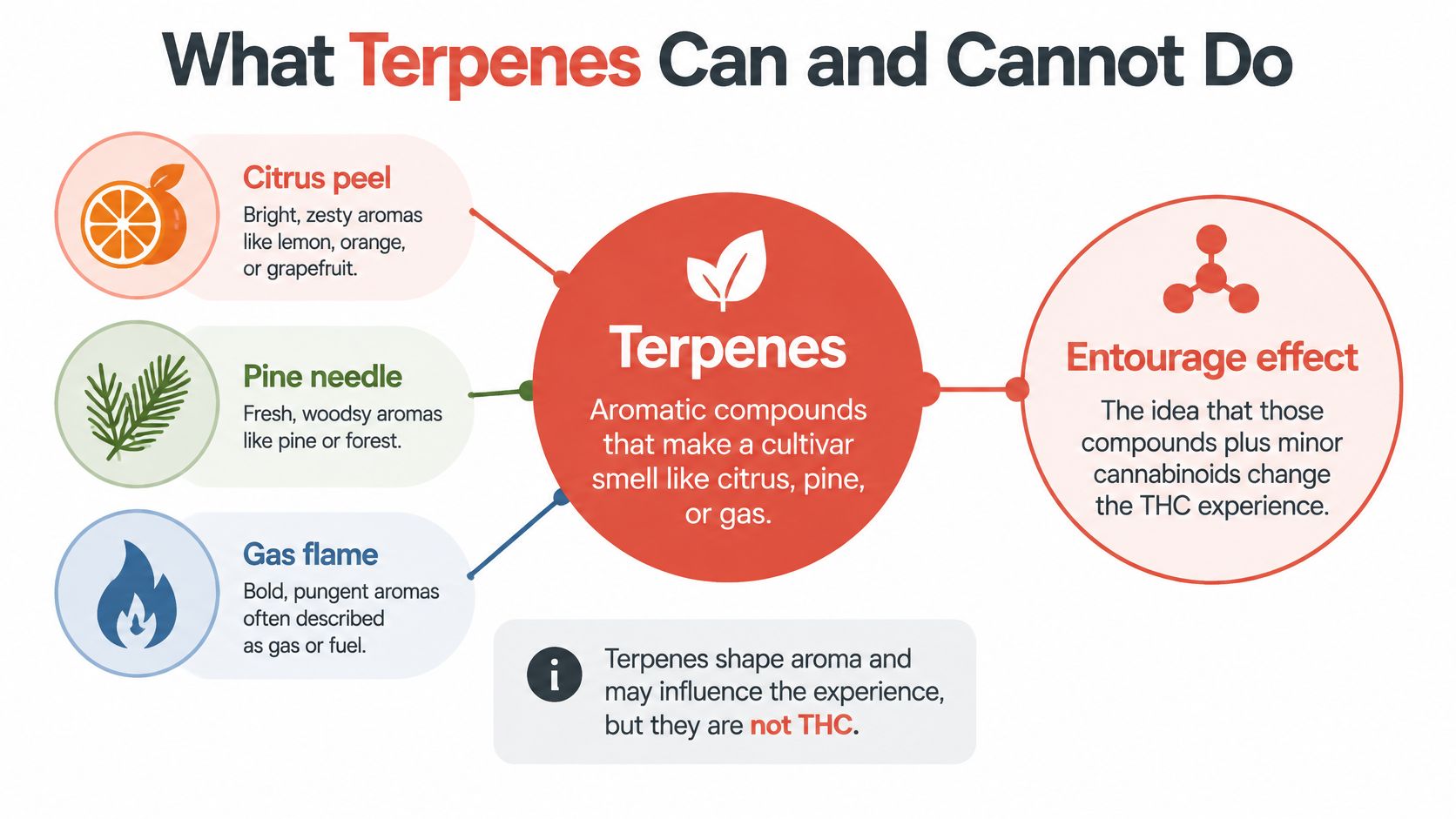
A peer-reviewed content analysis of live resin claims found little scientific evidence that live resin preserves the fresh plant's terpene and flavor profile in an edible, or that an edible can reliably maintain a strain-specific chemical profile. That doesn't mean every live resin gummy tastes identical. It means the claim needs finished-product evidence.
Digestion blurs the inhaled strain character further. Vaping sends compounds through your lungs on a fast timeline. Eating sends THC through first-pass metabolism on a slow one, so the experience is rebuilt around oral absorption and metabolite formation.
Two gummies at the same tested 10 mg THC dose can therefore feel more alike than their strain names suggest. One may smell brighter when you open the pouch. Smell is data about aroma, not proof of a different high.
A strain name is not a dose.
Compare a live resin gummy with a distillate gummy only at the same tested THC dose, on separate days, under similar food conditions. Write down when effects started, when they peaked, and how strong they felt at two and four hours. Without that same-dose test, you're comparing milligrams and calling it terpenes.
Treat full-spectrum, strain-specific, and live resin as formulation claims until the COA lists cannabinoids and, when terpenes are advertised, a quantitative terpene panel. Extract origin is the beginning of the argument. Finished-gummy testing is the evidence.
That standard protects distillate products too. A plain distillate gummy with an accurate 5 mg serving can be the safer buy. A live resin gummy with a vague serving and no terpene numbers asks you to pay for a story.
Buy a live resin gummy when the pouch shows THC per piece in plain type, the COA matches the lot in your hand, and terpene numbers exist if flavor is why you're paying more. Your state must allow the product, and the serving must fit the dose you planned. Under those conditions, the premium has something measurable behind it.
Choose a simpler distillate gummy when you only want a known milligram amount and don't care whether the flavor tastes like cannabis or candy. A repeatable 5 mg distillate piece serves that goal well. Paying extra for fresh-frozen input won't improve a session you judge only by predictable THC.
Wait when the label is technically present but unclear, or when the batch is new to you. Waiting can mean choosing a smaller scored piece, picking a different lot with a matching report, or postponing the session until you have a full evening with nothing to drive to. That patience is part of dosing, not a failure to decide.
Use one low piece from one batch. Eat it under conditions you can repeat, and note whether you'd eaten recently. Don't take a second piece for at least four hours, even if the first hour feels quiet.
Write down how you felt at two hours and four hours, not just whether you eventually felt high. Next time, use the same batch before you change the dose. One variable at a time is how edible notes become useful.
Judge every brand against this same list, by its own COA and label. A familiar logo doesn't transfer trust from one lot to the next.
Don't use live resin gummies if you're under 21, if you're pregnant, or if you must drive or work while an edible could still be active. Effects can last up to 12 hours, and residual grogginess can make an early shift or a school run the wrong place to discover that your serving was larger than you thought.
Check Melt for hemp-derived edibles and other products presented with third-party lab reports you can match to the pouch before you buy. Bring the same standard you'd use anywhere else: confirm THC per serving, verify the lot on the COA, and start with one low piece.
Your cart is currently empty.