



Free Shipping All Orders Over $95
So, what’s the real story behind THCA and THC? It boils down to a simple, yet crucial, difference: THCA is the raw, non-psychoactive compound found in fresh cannabis, while THC is what it becomes after you add heat—delivering the classic “high.”
This shift from inactive to active happens through a process called decarboxylation. It’s the reason eating a raw cannabis bud won’t do much, but smoking or vaping it certainly will.
At its heart, the relationship between THCA (Tetrahydrocannabinolic acid) and THC (Delta-9 Tetrahydrocannabinol) is all about potential. THCA is the precursor, just waiting inside the plant. When you apply heat—whether from a lighter, a vaporizer, or an oven—you knock a carboxyl acid group off the THCA molecule. That simple chemical change converts it into the psychoactive THC that interacts with your body’s endocannabinoid system.
This single distinction is also the key to the legal gray area many products occupy today. For years, this detail didn't really matter because old-school testing methods heated samples as part of the process. This converted all the THCA into THC, so labs only reported a "total THC" number.
It wasn't until modern, heatless testing methods like High-Performance Liquid Chromatography (HPLC) became standard that we could see the true picture. These new tests revealed that fresh cannabis flower is packed with THCA—often 15-25% or more—but contains very little actual Delta-9 THC. We break this down even further in our guide, "What is THCA and How Does it Work?".
This side-by-side infographic gives you a quick visual on this simple but powerful transformation.
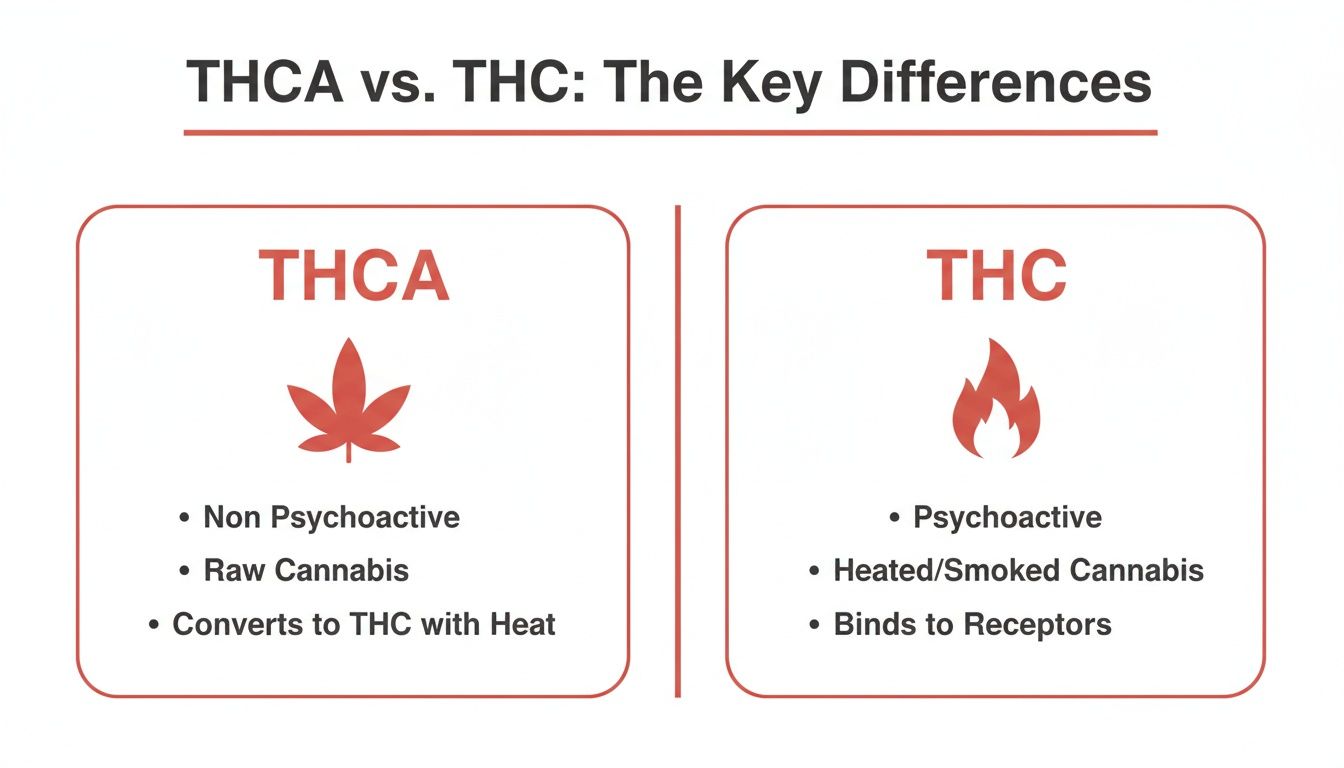
As the image shows, think of THCA as the natural, raw state (the leaf) and THC as the activated, heated state (the fire). To make it even easier to compare, the table below breaks down their most important differences side-by-side.
This table offers a high-level summary, stripping away the complex science to give you the essential distinctions between THCA and THC at a glance.
| Attribute | THCA (Tetrahydrocannabinolic Acid) | THC (Delta-9 Tetrahydrocannabinol) |
|---|---|---|
| Psychoactivity | Non-psychoactive; does not produce a "high." | Psychoactive; responsible for the "high." |
| Chemical Structure | Contains an extra carboxyl acid group. | Carboxyl group is removed by heat. |
| Natural State | Abundant in raw, unheated cannabis flower. | Present in very low amounts in raw cannabis. |
| Legal Standing (U.S.) | Federally compliant as hemp if Δ9 THC is <0.3%. | Schedule I controlled substance federally. |
Essentially, the two compounds offer completely different experiences and exist under very different legal frameworks. Understanding this is key to navigating today’s cannabis market and choosing the right products for your goals.
The real difference between THCA and THC all comes down to a simple chemical reaction: decarboxylation. In its natural, raw state, cannabis is packed with THCA. It's a bulky molecule that, because of its specific shape, just can’t connect with the brain's CB1 receptors. This is exactly why munching on a raw cannabis nug won’t get you high.
Think of your brain's CB1 receptor as a very specific lock. THCA is like a key with a big, clunky piece of metal stuck to it—that extra piece is its carboxyl acid group. No matter how you jiggle it, that key just won't fit.
Heat changes the game entirely. When you light a joint, fire up a vape, or bake some edibles, that heat forces the THCA molecule to drop its extra carboxyl group. The molecule shrinks and fundamentally changes its structure.
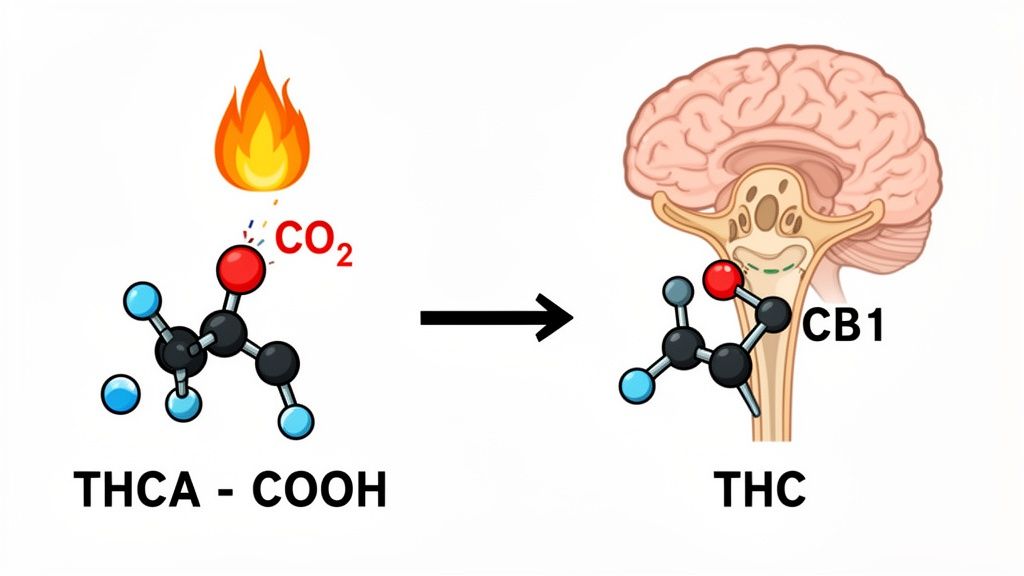
Suddenly, you have THC. This new, sleeker molecule is the perfect shape to slide right into those CB1 receptors, unlocking the classic psychoactive effects everyone associates with cannabis. This single transformation is the foundation of the entire modern THCA flower market.
Decarboxylation isn't just an on/off switch; it’s a delicate balance of time and temperature. If you don't use enough heat, you won't convert much THCA. But if you use too much heat for too long, you can actually destroy the THC and convert it into other cannabinoids like CBN, which can alter the high.
The conversion process kicks off at around 220°F (104°C), but how well it works depends entirely on your method.
Nailing these temperatures is key to getting the most from your product. If you're into concentrates and want ultimate precision, learning the best temp to dab can completely change your experience, giving you the perfect mix of flavor and potency.
The magic here is that decarboxylation turns a federally compliant hemp product into something that feels identical to traditional cannabis. It's all thanks to the simple application of heat—a chemical loophole that defines the entire market.
So, what’s the real potential of that THCA flower you just bought? A lab report might show 25% THCA and only 0.2% Delta-9 THC, keeping it perfectly legal. But that doesn’t tell you how strong it will be once you heat it.
To figure that out, you need a quick calculation. The carboxyl group that gets burned off makes up about 12.3% of the THCA molecule's total weight.
The formula for total potential THC is:
Total THC = (THCA % x 0.877) + Δ9 THC %
Let’s run the numbers with a real-world example. Say your flower’s lab report shows:
Here’s the math:
(0.28 x 0.877) + 0.0025 = 0.24556 + 0.0025 = 0.24806
After heating, that flower has a potential THC content of roughly 24.8%. This simple formula is crucial for understanding what you're actually buying. It explains how something sold as "hemp" can deliver an experience that’s anything but.
The biggest fork in the road between THCA and THC comes down to how they affect your mind and body. The choice is actually pretty simple: are you looking for a psychoactive experience, or are you more interested in the non-intoxicating benefits? This isn't just a small detail—it's the fundamental difference that defines how you'll use each one.
THC is the cannabinoid that put cannabis on the map. It's the compound behind the classic "high." When THC binds to the brain's CB1 receptors, it kicks off a whole range of effects, from euphoria and sensory enhancement to deep relaxation. But with that comes the risk of less desirable side effects like anxiety or paranoia, especially if you overdo it.
On the flip side, raw, unheated THCA is completely non-psychoactive. Its molecular shape is just too clunky to fit into those CB1 receptors, so it can't get you high. This is what makes raw THCA such a fascinating option for people exploring wellness benefits without the head-change that comes with THC.
Let's be real—for most people, the goal is to feel the effects of THC. The experience is a blend of cerebral and physical sensations that can change depending on the strain, your dose, and even your own body chemistry.
Here's what people typically feel with THC:
Of course, it’s not always a perfect ride. For some, particularly newcomers, THC can bring on anxiety. That's why the golden rule is always to start low and go slow. A safe session is a good session.
While the research is still catching up, raw THCA is getting a lot of buzz for its therapeutic potential—all without any psychoactive effects. When you consume THCA in its raw form, like adding fresh flower to a smoothie or using a specially made tincture, you get the compound straight-up, before heat can turn it into THC.
Here’s the key takeaway: THC is mostly for recreational and psychoactive use, while raw THCA is being explored for wellness. Think of it as choosing between a party favor and a daily supplement.
Early studies and user stories point to a few key benefits of raw THCA:
This table really simplifies the core differences.
| Feature | THC (Heated) | Raw THCA (Unheated) |
|---|---|---|
| Primary Effect | Psychoactive ("High") | Non-Psychoactive (No "High") |
| Common Use Case | Recreation, mood elevation, relaxation | Wellness, anti-inflammation, neuroprotection |
| Interaction with CB1 Receptor | Binds strongly | Barely binds at all |
| Potential Side Effects | Anxiety, paranoia, dry mouth | Minimal known side effects |
Ultimately, choosing between THCA and THC is all about your personal goals. If you want that traditional cannabis experience, heating a THCA-rich product like Melt's craft THCA flower will give you the potent THC effects you're after. But if you're curious about the non-intoxicating wellness side of cannabis, raw THCA is definitely the path to explore. It's this simple difference that lets you dial in your experience to get exactly what you want.
Trying to make sense of the legal differences between THCA and THC can be a headache. But it all boils down to one game-changing piece of legislation: the 2018 Farm Bill. This federal law created a legal category for "hemp," defining it as any cannabis plant with less than 0.3% delta-9 THC by dry weight.
That single definition created a massive legal opening. The law is laser-focused on delta-9 THC—the cannabinoid that's already psychoactive. It completely sidesteps THCA, its non-psychoactive precursor. The result? Cannabis flower that’s loaded with THCA (often over 20%) can be legally grown and sold as hemp, as long as its delta-9 THC level stays under that 0.3% line.
This is exactly why you can buy potent THCA products online and get them shipped right to your door in many states. It’s federally compliant right up until the moment you light it up and convert that THCA into THC.
While THCA found its legal lane through the hemp definition, delta-9 THC is in a totally different boat at the federal level. Even with states legalizing it left and right for medical and recreational use, the DEA still classifies delta-9 THC as a Schedule I controlled substance. This puts it in the same category as drugs like heroin and LSD, creating a major clash between federal and state laws.
This federal scheduling is the reason traditional cannabis dispensaries are locked into strict state-by-state rules and can’t ship products across state lines. The difference between THCA and THC isn't just chemical—it's the basis for two completely separate legal and commercial markets.
The market's reaction has been explosive. The rise of THCA is a story of legal workarounds and smart consumers reshaping the entire U.S. cannabis scene. While THC used to dominate, THCA took off after the 2018 Farm Bill by using that 0.3% delta-9 THC rule to its advantage. The growth is staggering: THCA went from less than 2% of cannabinoid sales in 2020 to a projected 15% market share by 2025—a jump of over 300% in just a few years. You can explore more insights into how this cannabinoid became so popular among U.S. cannabis users.
The legal ground is always shifting, though. As high-THCA hemp products became more popular, some states started closing this loophole with their own, tougher regulations. Instead of just looking at the delta-9 THC content, these states now require "total THC" testing.
This calculation accounts for all the potential THC that gets created when THCA is heated. Using the formula we covered earlier—(THCA x 0.877) + delta-9 THC—these states figure out a product's true potential potency. If that final number is over 0.3%, the product is legally considered marijuana, no matter how low its initial delta-9 THC was.
States with total THC laws include:
The core legal distinction underpinning the entire THCA market is simple: Federal law cares about what a product is (low delta-9 THC), while some state laws are starting to care about what it can become (total potential THC after heating).
This changing regulatory scene means a THCA product might be federally compliant but illegal in certain states. It's absolutely crucial for you to check your local and state laws before buying or possessing THCA products. The legal line between THCA and THC is a moving target, so staying informed about the rules where you live is non-negotiable.
In today's cannabis market, knowing exactly what's in your product isn't just a good idea—it's essential. The key to that knowledge is the Certificate of Analysis (COA), a detailed lab report that breaks down everything from potency to purity.
It might look like a wall of numbers at first, but a COA is the best tool you have to verify the difference between THCA and THC in a product and confirm it's clean. For us at Melt, giving you easy access to these reports is a non-negotiable part of our commitment to transparency and your safety.
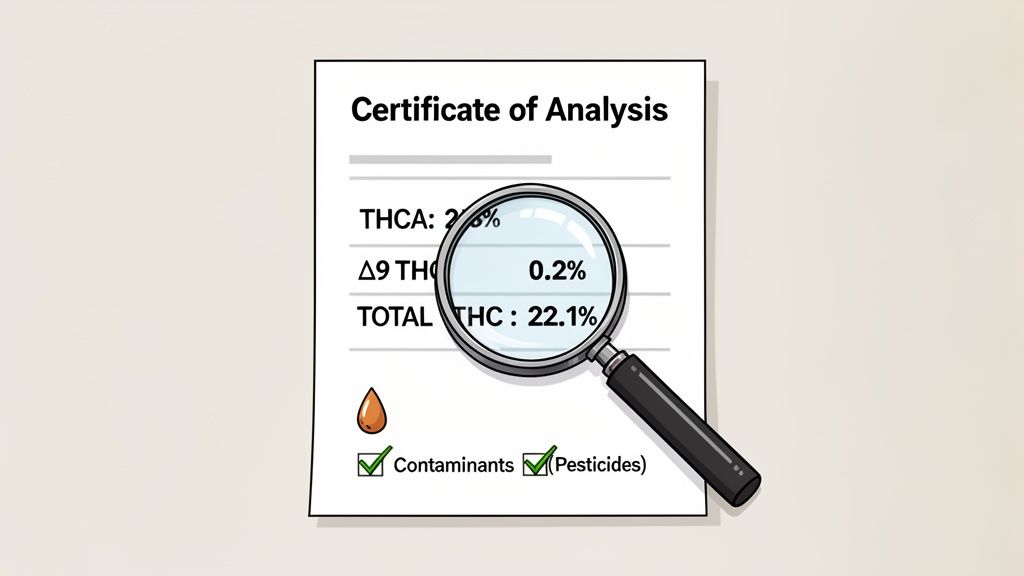
Think of a COA as a product's report card. It's an unbiased, third-party document that tells you everything you need to know before you buy. This table breaks down what to look for on any lab report for a THCA product to make sure it's potent, legal, and safe.
| Metric to Check | What It Means | What to Look For (Ideal Range) |
|---|---|---|
| THCA Percentage | The concentration of raw, non-psychoactive THCA in the product. This indicates the flower's potential strength once it's heated. | High-quality flower often tests at 20% or higher. |
| Delta-9 THC Percentage | The amount of active, psychoactive THC. This is the number that determines federal legality. | Must be below 0.3% Delta-9 THC by dry weight to be compliant as hemp. |
| Total Cannabinoids | The combined percentage of all cannabinoids present, giving you a full picture of the product's profile. | High percentages suggest a rich, full-spectrum experience. |
| Pesticides | Screens for harmful agricultural chemicals used during cultivation. | A clean report should show "Not Detected" (ND) or "Pass." |
| Heavy Metals | Tests for contaminants like lead, mercury, and arsenic that the plant can absorb from the soil. | Should show "Pass" or ND for all tested metals. |
| Microbials & Mycotoxins | Looks for harmful bacteria, yeast, mold, and the toxins they can produce. | A "Pass" result is the only acceptable outcome. |
| Terpene Profile | Lists the aromatic compounds responsible for the strain's unique scent, flavor, and potential effects. | Look for dominant terpenes that align with your desired experience (e.g., myrcene for relaxation). |
Ultimately, a COA empowers you. It lets you confirm that a product with high THCA also has a compliant, low Delta-9 THC level. This is the ideal scenario: a potent product that stays on the right side of federal law.
Potency is just half the story. A complete COA provides critical safety information that ensures your product is clean and safe to consume, especially if you plan to inhale it.
A trustworthy lab report will always include screenings for:
A product without a full-panel COA is a blind purchase. The cannabinoid profile tells you what you want in the product; the safety panel tells you what you don't.
Often overlooked but incredibly valuable, the terpene analysis tells you about the aromatic compounds that give each strain its unique smell and flavor. Think citrusy, piney, or earthy notes. More than that, terpenes are believed to work with cannabinoids to create a more nuanced experience through the "entourage effect."
Keep an eye out for dominant terpenes like:
Understanding a strain's terpene profile helps you predict how it might make you feel, so you can pick products that perfectly match what you're looking for. You can see great examples by exploring the Melt Official lab reports, which clearly show the potency and purity of every batch. Learning to read these documents is the best way to shop with total confidence.
Knowing the science behind THCA and THC is one thing, but how you actually use it is what really counts. The way you consume a product changes everything—from how fast the effects hit to how long they stick around. Your entire experience is shaped by the method you choose.
This all comes down to how each method handles decarboxylation. Some methods, like smoking, instantly trigger that heat conversion. Others bypass it entirely. The real difference between THCA and THC truly comes to life when you look at how they’re delivered into your system.
If you're after that classic THC high, smoking or vaping high-THCA flower is the most direct path. The intense heat from a lighter or vaporizer instantly converts non-psychoactive THCA into psychoactive THC right as you inhale.
This is the fastest way to feel the effects, usually within minutes. The experience is often strong but doesn't last as long—typically around one to three hours. It’s perfect for anyone who wants immediate relief or wants to carefully control their high, since you can adjust your dose puff by puff.
Edibles like gummies and baked goods are a whole different ballgame because the THCA-to-THC conversion has already been done for you. The cannabis is decarboxylated during the cooking process, meaning the product you eat already contains active THC.
Because edibles work through your digestive system, the effects come on much slower, often taking 30 to 90 minutes to fully kick in. But when they do, the experience is typically much longer and more intense, sometimes lasting for six hours or more. This method is ideal for anyone seeking a sustained, full-body effect without having to smoke or vape.
Choosing a consumption method is about matching the product to your desired outcome. Do you need fast-acting effects for a short period (vaping THCA) or a prolonged, potent experience (THC edibles)? Your answer points you to the right choice.
What if you want the potential benefits of cannabis without any high at all? That's where raw, unheated THCA comes in. By avoiding heat, you prevent the conversion to THC and can explore THCA’s reported anti-inflammatory and neuroprotective properties without any psychoactivity.
Common ways to consume raw THCA include:
This approach is best for wellness-focused users who want to steer clear of THC's intoxicating effects. As research into raw cannabinoids grows, this method is gaining traction for its unique properties. In the end, it all comes down to your goals—instant psychoactive effects, long-lasting body highs, or non-intoxicating wellness support.
The world of cannabinoids can get confusing fast. Let's clear things up with some straight answers to the most common questions about THCA and THC, so you can make choices that are right for you.
Not exactly. While high-THCA flower is federally compliant thanks to the 2018 Farm Bill, its legal status gets tricky at the state level. Federal law only cares about the delta-9 THC content, but some states have passed their own "total THC" laws.
These stricter rules look at a product's potential THC potency after it's heated. So, a product that's perfectly legal on a federal level could be a no-go in a state with total THC regulations. It's always smart to double-check your local laws before you buy.
Yes, it almost certainly will. Even though you're starting with THCA, the moment you apply heat—whether you're smoking or vaping—it converts directly into THC. Standard drug tests are designed to find THC metabolites in your system.
Once that conversion happens, your body processes it exactly like traditional THC. If you've got a drug test coming up, the safest bet is to steer clear of all THCA products.
The bottom line is simple: your body doesn't differentiate between THC that came from federally compliant THCA flower or state-licensed marijuana once it's metabolized. Drug tests look for the end result, which is THC.
Absolutely, but you have to consume it without any heat. If you want to tap into THCA's potential non-psychoactive properties, it needs to stay in its raw, acidic form. This means avoiding any kind of heat that would kick off decarboxylation.
Popular ways to consume raw THCA include:
Just keep in mind, the science on raw THCA's benefits is still growing, but these methods ensure you're getting it in its non-intoxicating state.
The line between them is both chemical and legal. Chemically, THCA flower is packed with Tetrahydrocannabinolic acid but contains very little delta-9 THC—specifically, under the 0.3% federal limit. Marijuana, on the other hand, is defined as cannabis with delta-9 THC levels above that threshold.
Legally, this small difference is what allows THCA flower to be sold as hemp. But once you light it up, that high-THCA flower delivers psychoactive effects that are virtually identical to traditional marijuana. Functionally, the user experience is the same after heat is applied.
Ready to experience the best of federally compliant cannabis? Melt delivers premium, California-grown THCA flower and high-potency edibles right to your door. Explore our curated collection and discover why connoisseurs choose us for clean, potent, and flavorful sessions.
Your cart is currently empty.