



Free Shipping All Orders Over $95
Ever wondered how much THC is actually in a single hit? The answer isn’t as simple as you might think. A single puff can deliver anywhere from less than 1 mg to over 5 mg of THC, and the exact dose comes down to what you’re using and how you’re inhaling.
Think of it like taking a sip of a drink—the effect depends entirely on what’s in the cup and how big of a gulp you take.
Before we can even start to estimate the THC in a hit, we have to get one thing straight: a "hit" is not a standard unit of measurement. It’s a completely personal action, and the amount of THC you absorb is a result of a few key factors all working together.
Getting a handle on these variables is the first step to controlling your experience. The main things that determine your dose per puff are:
A "hit" isn't a fixed quantity—it's more like your personal signature. It’s the unique blend of your product, your device, and your breathing that creates the final dose.
Ultimately, understanding these concepts is the key to having predictable and enjoyable sessions. With lab-tested products like Melt’s THCA flower and disposables, you have the exact potency numbers you need to take the guesswork out of it. This lets you manage your intake from the very first puff, making sure your experience is exactly what you wanted. By breaking down each hit, you can stop hoping for the right effect and start calculating it instead.
Figuring out "how much THC is in a hit" isn't as simple as it sounds. It’s less like a fixed measurement and more like a recipe with a few key ingredients. How you combine them completely changes the outcome.
Getting a handle on these five variables is the secret to moving from guessing games to predictable results. Once you know what they are, you gain total control over your experience.
This diagram breaks down the three main pillars that shape your dose: the potency of your product, the device you use, and your personal technique.
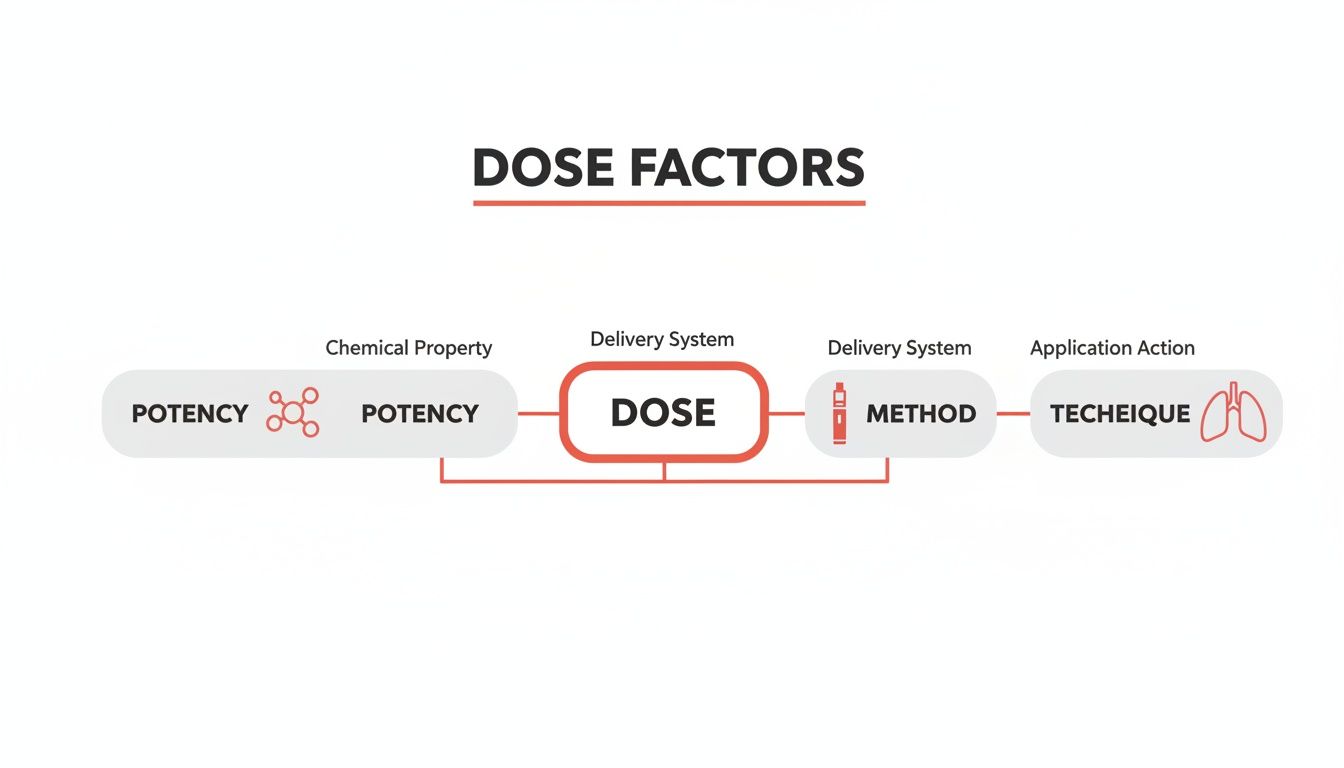
As you can see, the final dose is a direct result of what you’re using, how you’re using it, and the physical action you take with every puff.
Everything starts with the potency of your material. This is the THCA or THC percentage you see on a product’s lab report. A flower with 15% THCA has half the raw potential of one testing at 30% THCA. Simple as that.
This number is your starting line. Without it, any other calculation is just a shot in the dark. It’s the single most important piece of info for knowing how much THC is available in the first place.
Next up is your device. How you heat and inhale cannabis makes a huge difference in how much THC actually makes it into your system. Every method has its own efficiency level.
Your own breathing style is a massive factor. There’s a world of difference between a quick, shallow sip and a long, deep draw from your device.
A bigger, deeper inhale pulls more vapor or smoke into your lungs, which gives it more surface area to be absorbed. And while the old myth about holding your hit in forever has been debunked, the initial volume of your breath directly impacts how much THC your body can actually use.
The real secret to dosing isn't in complex formulas, but in understanding how the product's strength, the device's efficiency, and your own breathing patterns combine to create a unique result every time.
If you’re using a vaporizer, temperature is your control dial. Different cannabinoids and terpenes turn to vapor at different heat levels.
Lower temperatures (around 320-350°F) are great for preserving flavor and delivering a milder, more clear-headed effect. Cranking it up to 380-420°F produces thicker clouds and unlocks more THC for a much stronger experience. This gives you another powerful layer of control.
Finally, there’s bioavailability—the science-y term for how much of a substance actually gets into your bloodstream to produce an effect. Just because you inhale a milligram of THC doesn't mean your body uses all of it.
For smoking, the bioavailability is estimated to be around 20-30%. Vaping is far more efficient, with a bioavailability often landing between 40-60%. This is exactly why a vape hit can feel so much stronger than a puff from a joint, even if you’re using the exact same flower.
Let’s break down the math behind a joint to figure out exactly what you’re getting with each puff. It might seem complicated, but a simple step-by-step walkthrough can turn a confusing question into an easy answer.
For this example, we’ll use a pretty standard scenario: a 0.5-gram pre-roll with high-quality, lab-tested flower that clocks in at 20% THCA. Starting with an accurate potency is the key, since it’s the foundation for the entire calculation.
First things first, we need to know the maximum amount of THC available in the entire joint. To get this, just multiply the flower's weight by its THCA percentage.
This 100 mg is the total THC that could be activated and inhaled if you managed to smoke the whole joint with perfect efficiency.
Next, think about how many hits you usually get from a half-gram joint. This number is all over the place depending on your smoking style, but a good ballpark estimate is about 25 puffs.
This number helps us divide the total THC into individual doses. More puffs mean less THC per hit; fewer, bigger rips mean each one is more potent.
Now, we can find out how much THC is in the smoke of each puff before it even hits your lungs. Just divide the total THC by your estimated number of puffs.
This is the amount of THC released into the smoke with every inhalation. But hold on, that’s not the final number your body actually absorbs.
A typical joint in the U.S. contains about 0.32 grams of cannabis. With a standard 20% THC potency, that's roughly 64 mg total. Spread across 20 to 25 puffs, you're inhaling around 3 to 4 mg of THC per hit. You can explore more data about joint THC content to see how these numbers stack up.
This last step is the most important: accounting for bioavailability. Like we covered earlier, smoking isn't 100% efficient. Your body only absorbs a fraction of the THC you inhale—for smoking, that rate is roughly 20-30%.
Let's use a conservative 25% for our math.
So, after all that, we can see that from a half-gram, 20% THCA joint, you can expect to absorb about 1 mg of THC with each average puff. Pretty straightforward when you break it down, right?
When you swap flower for a vape, the dosing math gets way more efficient. Vaping is known for delivering a cleaner, more consistent experience, and the numbers back it up. Let's walk through the simple math for a super common product: a 1-gram vape cartridge with 85% THC oil.
This quick breakdown will show you exactly how to figure out the THC in every hit from your vape.
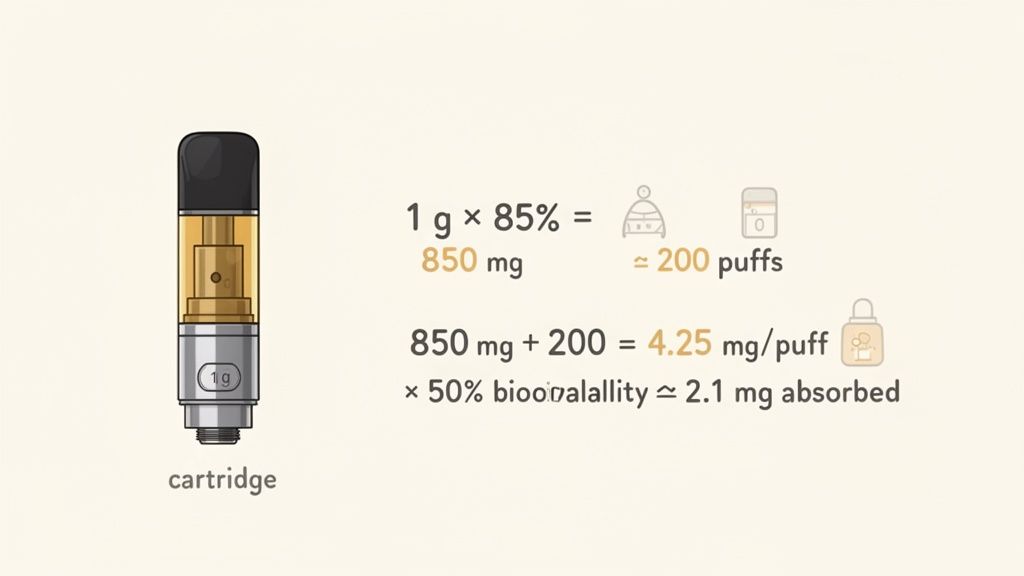
First thing's first: you need to know how much total THC is packed into the entire cart. It's just a quick multiplication of the oil volume by its potency. Since 1 gram is the same as 1,000 milligrams, the math is a breeze.
This 850 mg is the total potential THC you can get from this vape, from the first puff to the last.
Next, you need a ballpark idea of how many hits your cart will give you. This can change depending on the device and how you inhale, but a standard 1-gram cart usually offers around 200 puffs.
This number is the key to breaking down the total THC into single-dose hits.
Now that you have the total THC and your puff count, you can figure out how much THC is vaporized with each draw. Just divide the total milligrams of THC by the estimated number of puffs.
That 4.25 mg is what's in the vapor you're inhaling. But just like with smoking, your body doesn't actually absorb all of it.
Finally, we bring in the bioavailability factor. Vaping is much more efficient than smoking, with your body absorbing somewhere between 40% and 60% of the THC. We'll use an average of 50% for this example to lock in the final absorbed dose.
So, each hit from this vape delivers about 2.1 mg of THC directly into your system—that’s more than double what an average puff from a joint gives you. This awesome efficiency is a big reason why so many people prefer modern all-in-one devices for a predictable and flavorful session. You can learn more about how to vape weed properly in our detailed guide to get the most out of your experience.
In a market flooded with options, third-party lab reports are the only way to know exactly what you’re buying. Think of them as a product’s report card, giving you a totally transparent look at its potency and purity.
When you want to calculate how much THC is in a hit with real confidence, this document is your most powerful tool.
A Certificate of Analysis (COA) is an official document from an independent lab that verifies what's inside a product. It hands you the precise numbers you need for accurate dose calculations, taking all the guesswork out of the equation.
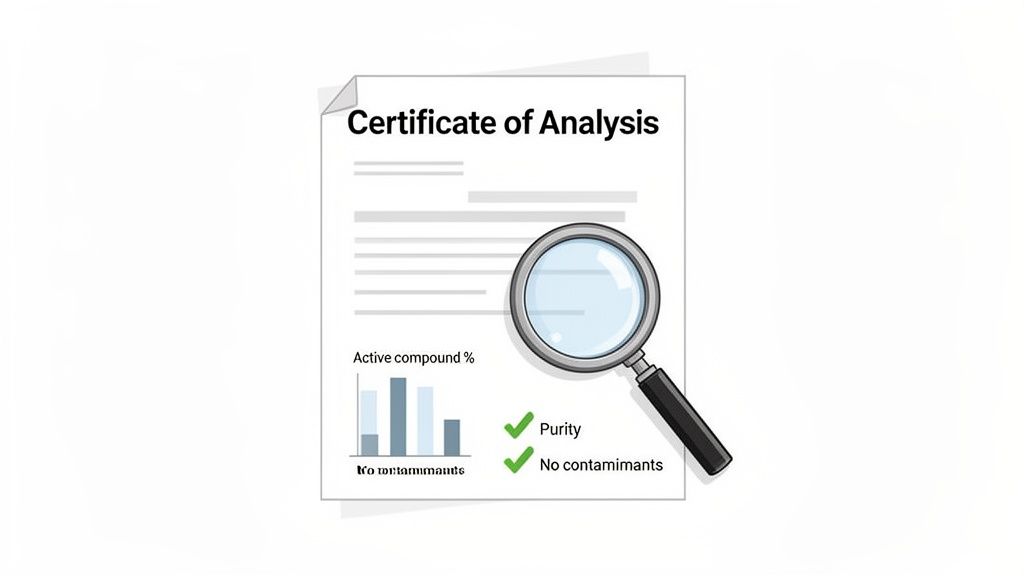
When you're scanning a COA, you’re really looking for two main things: the cannabinoid profile and the safety screening results. These sections give you the complete picture.
The cannabinoid profile is where you find the all-important potency numbers. It breaks down the concentration of major cannabinoids, including:
Beyond potency, a comprehensive lab report also confirms a product is clean and free from harmful contaminants. This includes checks for pesticides, heavy metals, residual solvents, and microbials like mold or bacteria.
For anyone who actually cares about what they’re consuming, the lab report is the ultimate tool. It empowers you to verify quality, confirm safety, and make truly informed decisions about your dose.
Reputable brands see this transparency as non-negotiable. It's a clear signal of their commitment to providing safe, high-quality products you can trust.
By making these reports easy to find, companies show they stand behind their claims. You can explore a full library of Melt’s official lab reports to see exactly what this commitment to quality and transparency looks like in practice. For anyone serious about dosing, the COA is your single source of truth.
Forget all the complicated math for a second. The absolute best way to manage your dose comes down to a simple, mindful approach. While the numbers are a great starting point, they can’t account for everything—your personal metabolism, tolerance, or even what you had for lunch can completely change how you feel.
The golden rule of cannabis has always been start low and go slow. With today's high-potency products, this advice is more critical than ever. It’s the single best way to stay in control and sidestep an overwhelming experience.
The most reliable way to dial in your perfect dose is to be methodical. Don’t rush it. Think of it as a deliberate ritual that puts you firmly in the driver's seat of your experience.
This patient "wait and assess" approach takes the guesswork out of dosing. It empowers you to find your ideal threshold for any product, ensuring every session is a good one.
This strategy respects both the plant and your own unique biology. To see how these habits can affect how long your products last, check out our guide on how long a 1g vape cart should last.
Even with all the math sorted out, you’ve probably still got some questions about what all this means in the real world. Let's tackle a few of the most common ones to help you dial in your experience.
This is one of the oldest myths in cannabis culture, but the science is pretty clear: not really. Your lungs are incredibly efficient and absorb the vast majority of cannabinoids like THC within the first few seconds of inhaling.
So, holding your breath longer doesn't really boost THC absorption. That lightheaded, dizzy feeling some people chase is just a temporary lack of oxygen. A normal, comfortable inhale is all you need to get the job done.
This is a tough one because there's no single answer—it’s entirely personal. A new user might feel pretty significant effects from a single 1-2 mg puff of a potent vape. On the other hand, a seasoned user with a higher tolerance might need several hits to get to that same place.
The best advice is universal: start with one small puff. Give it at least 15-20 minutes to see how you really feel, and then decide if you want another. This slow-and-steady approach is the best way to avoid overdoing it and stay in control of your experience.
In most cases, yes. A bong hit often feels much more powerful because it lets you inhale a huge volume of smoke in a single breath. The water cools the smoke, making it less harsh on your throat and lungs, which naturally encourages a deeper, fuller inhalation.
This combo of massive volume and deep inhalation means your body can absorb a much larger dose of THC all at once compared to a smaller, more casual puff from a joint.
Understanding this difference is everything when it comes to reading lab reports. THCA (Tetrahydrocannabinolic acid) is the non-psychoactive compound found in raw, unheated cannabis. It won't get you high by itself.
It only converts into the psychoactive Delta-9 THC you're familiar with when you add heat—a process called decarboxylation. This happens when you smoke, vape, or cook it. That's why the THCA percentage on a flower's lab report is the truest indicator of its psychoactive potential. That number tells you exactly how much THC will be available once you light up.
At Melt, we believe a great experience starts with premium, transparently tested products. Check out our collection of high-potency THCA flower and all-in-one vapes to take control of your dose with total confidence.
Your cart is currently empty.