



Free Shipping All Orders Over $95
The usual advice about choosing THC gummies starts with flavor, strain names, or finding the strongest bag for your money. That's the wrong order if you want a session you can reasonably anticipate. Treat advertised milligrams as a claim to verify, then choose a serving you can evaluate without guessing.
Learning how to choose THC gummies comes down to separating three questions: What does the package claim? Does the batch's lab report support it? And can you take a suitably small serving? A bigger number answers none of those questions by itself.
Your edible experience matters more than your familiarity with smoking or vaping. Use this table to choose a conservative approach, not to assign yourself a higher dose because you shop cannabis regularly.
Starting THC per gummy by experience
| Experience | THC per piece | Usual onset | Usual peak | Before another piece |
|---|---|---|---|---|
| New or infrequent | Choose a low-dose piece using the starting benchmark below | Delayed, not immediate | Later than the first noticeable effects | Don't redose during the first trial |
| Occasional, known low tolerance | Use a previously tolerated low serving | Allow the full onset window | Wait through the expected peak | Evaluate before changing the dose |
| Regular edible user | Choose a clearly measured, previously tolerated serving | Don't assume regular use means faster onset | Judge the full effect, not the beginning | Increase only on a later day |
| Experienced, known response | Stay within your established edible response | Familiarity doesn't remove the delay | Don't take more while effects are building | Avoid stacking servings |
| First try of a new brand | Choose the smallest clearly measured serving appropriate for you | Treat timing as untested | Allow the complete peak window | Record the batch, dose, food, and outcome |
For new or infrequent consumers, 2.5 mg THC or less is the conservative starting benchmark in Health Canada's edible cannabis consumer information sheet, which also warns that higher THC content increases the likelihood of impairment and adverse effects. There isn't a supported universal dose ladder that automatically moves occasional or experienced consumers into stronger servings.
Start with THC per piece, then confirm how many pieces make a labeled serving. A package total tells you how much the whole bag contains, not what you'll consume when you eat a gummy.
Don't assume a belt, worm, or oversized chew is a single serving. If reaching your intended dose requires estimating a tiny bite from an unmarked piece, choose another format. Cutting a gummy into visually equal parts doesn't, by itself, verify the cannabinoid content of each part.
Also identify the cannabinoid. A label that names delta-9 THC provides different information from one that lists delta-8 THC or a cannabinoid blend. Don't treat those identities as interchangeable because the front panel says THC.
A peer-reviewed review available through PubMed Central describes noticeable edible effects after approximately 30–90 minutes, with peak effects around 2–4 hours. Those are different stages: feeling something begin doesn't mean you've experienced the full dose.
The common mistake is dose stacking. A shopper notices little at first, eats another gummy, and later experiences overlapping effects from both servings. The second serving wasn't a correction to a failed product, it was an additional dose taken before the first could be evaluated.
Practical rule: For an unfamiliar gummy, make the first session an observation session, not an escalation session.
Food intake, tolerance, medicines, and prior cannabis exposure can change your response. CBD on the label doesn't guarantee protection from THC intoxication, either. Keep those variables in your notes rather than assuming the same label always produces the same experience.
Use our guide to how long gummies take to kick in when planning your session. Don't drive after taking THC, and don't schedule a first trial before responsibilities that require clear judgment.
Make the purchase a sequence of checks, rather than a decision based on whichever front panel catches your eye. A product should earn your attention through usable information before flavor becomes the deciding factor.
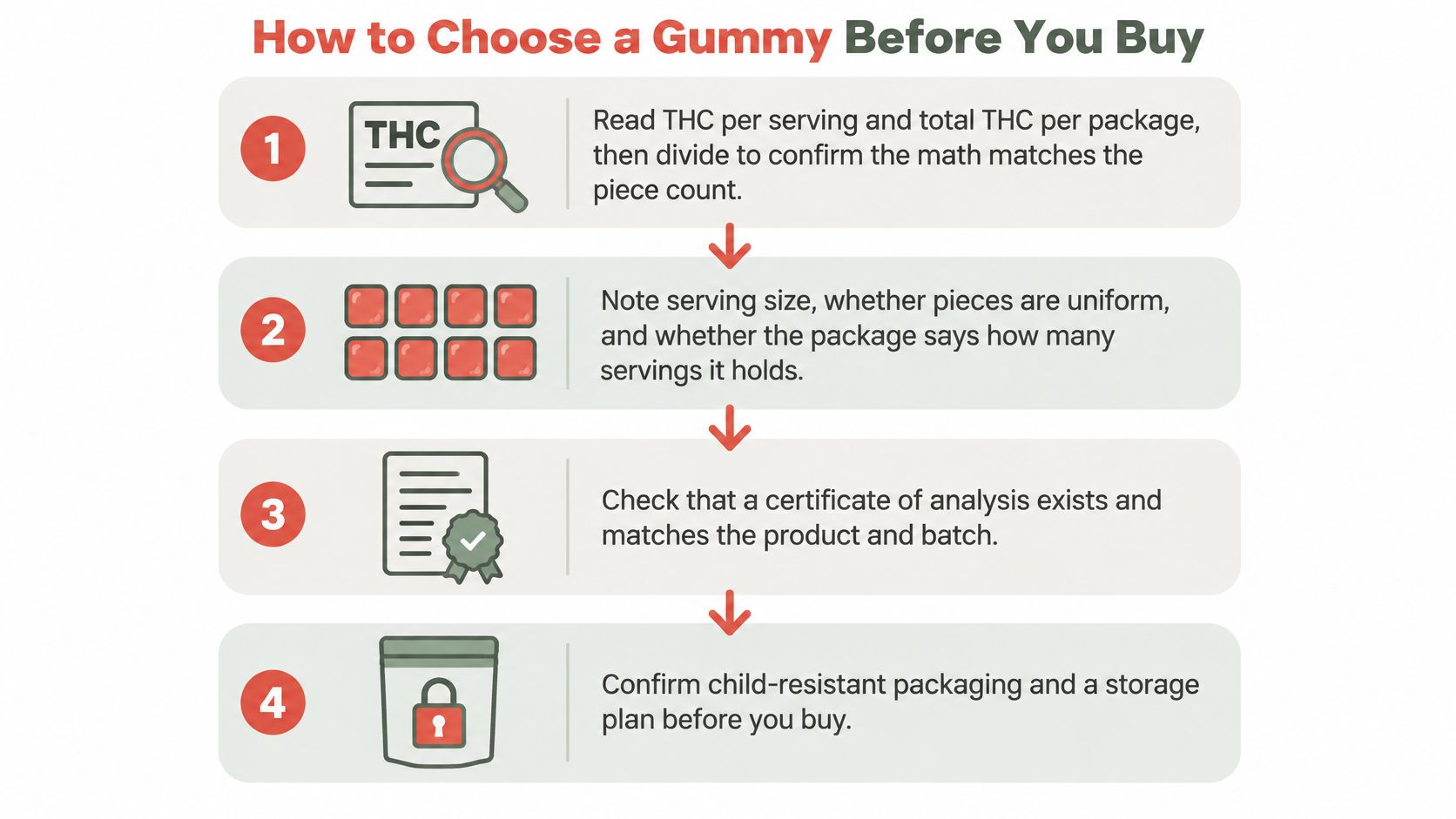
A useful first purchase is one you can measure and learn from, not one that forces you to guess how little to eat.
In Oregon testing of hemp edibles, only 25% of evaluated potency claims were within ±10% of laboratory-detected potency, according to a Scientific Reports study. Separately, a 2025 analysis of 74 licensed Colorado cannabis samples found that label THC values were generally higher than independently observed values in flower and edible products.
Those findings don't establish that every gummy is mislabeled. They do establish why a printed potency claim isn't enough to evaluate a purchase.
A certificate of analysis, or COA, is useful only when you can connect its results to the product in your hand. A polished testing badge or a generic report for the brand doesn't make that connection.
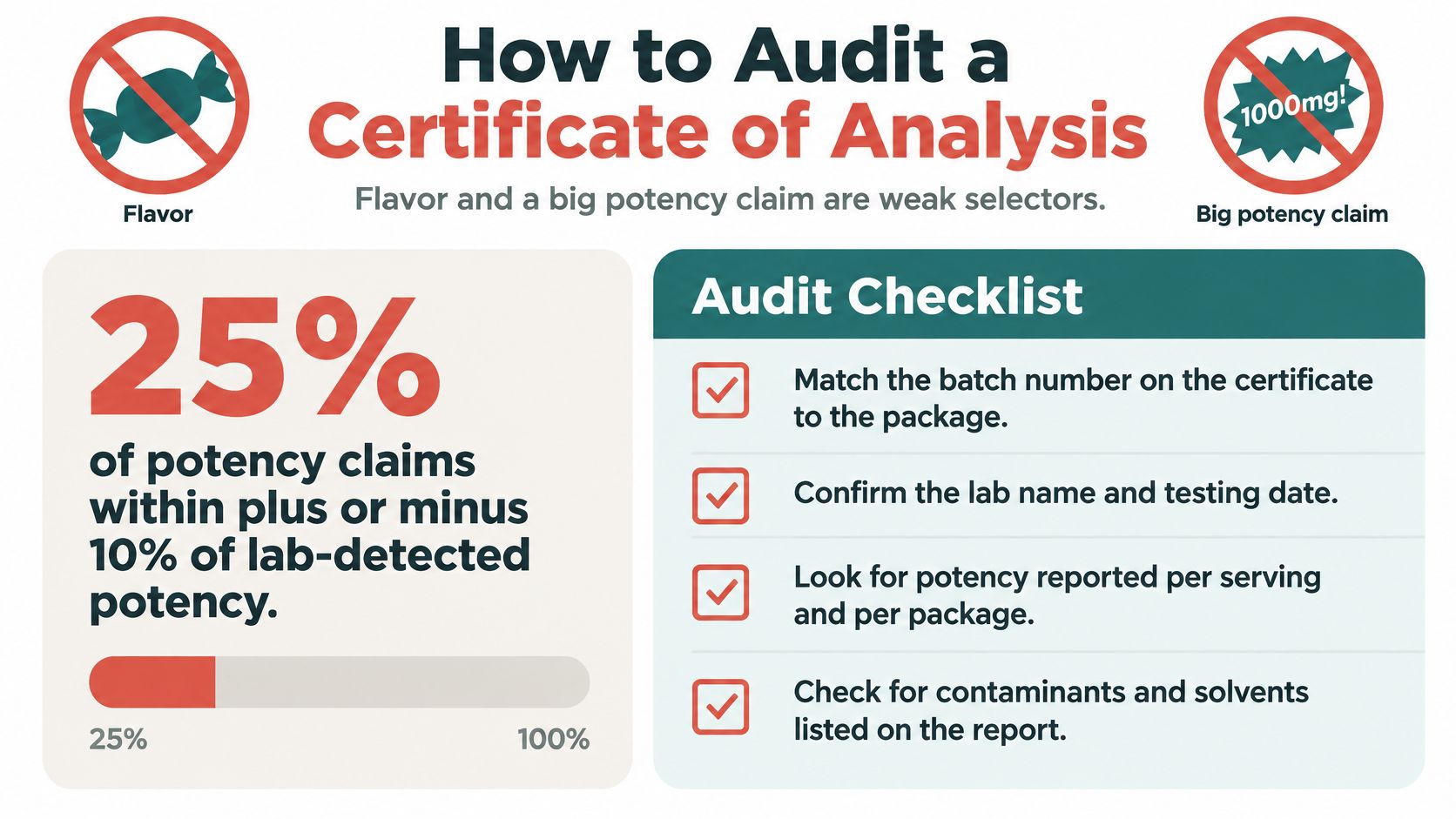
COA checks versus buying red flags
| Check | Accept when | Red flag |
|---|---|---|
| Product identity | The COA names this exact gummy | Report is for another SKU or a generic blend |
| Batch match | Lot on the bag equals lot on the COA | No lot, or the numbers don't match |
| Cannabinoid | Delta-9 or the advertised cannabinoid is quantified | Only a marketing name or an unidentified cannabinoid total appears |
| Serving math | Lab results can be reconciled with label amounts per piece and package | Only a package total appears, without a usable serving basis |
| Result type | Potency is numerical, with clear units | A pass result appears without measured potency |
| Test date | Report is traceable to the current batch | Report is undated or reused across unrelated batches |
Read the units before comparing numbers. A result expressed as concentration by weight isn't automatically milligrams per gummy. If the report and label use different units, you need the relevant serving weight or a clearly documented conversion before calling them a match.
Check the laboratory's identity and the report's testing scope, too. A potency page answers a concentration question, not every product-quality question. Look for applicable testing covering pesticides, heavy metals, microbial contamination, and residual solvents rather than assuming all of those were included.
A missing report, mismatched batch, or unexplained label discrepancy is a reason to pause the purchase. Ask for the correct document, and skip the product if you can't resolve the mismatch. Don't substitute the seller's confidence for a readable result.
Our guide to how to read a certificate of analysis can help you work through the document's fields. Save the report alongside your product notes so you can distinguish a repeat purchase from a new batch.
Buying standard: Prefer a modest, measurable serving with traceable testing over a larger advertised dose with vague paperwork.
Even a matching COA doesn't promise an identical high. It supports the product's measured composition; it doesn't measure your tolerance, meal, medicines, or response that day. Think of testing as reducing product uncertainty, not eliminating personal variability.
A gummy named for a familiar strain may feel easier to choose than a package covered in laboratory terminology. But the name doesn't tell you the serving's measured cannabinoid content, and it can't guarantee how you'll feel after eating it.
The same limitation applies to flavor. Sour watermelon tells you something about the intended taste, not whether the serving is appropriate for you. A colorful wrapper and a familiar candy shape don't establish dose accuracy.
Read front-panel language according to what it answers.
A label such as mellow can sound reassuring while leaving the important questions unanswered. Mellow at what serving? With which cannabinoids? Supported by which batch report?
Likewise, a fast-acting claim shouldn't become permission to take more when you don't immediately notice effects. Without product-specific evidence, it's not a reliable personal deadline.
Suppose you're choosing between a plainly packaged gummy with a defined serving and a tropical blend with an impressive package total. The plain product gives you a better basis for comparison if its documentation identifies the serving and separates the cannabinoids. That doesn't make it guaranteed to feel better, but it makes the decision less dependent on assumptions.
For blends, look beyond the combined total. If a report lists several cannabinoids, assess each listed amount rather than treating their sum as though it describes a single ingredient. Don't assume added CBD or a minor cannabinoid makes the product non-intoxicating or automatically suitable for your first trial.
Choose flavor after the product passes the measurement checks, not instead of them.
Once comparable products meet your dose, documentation, and packaging requirements, taste is a reasonable tiebreaker. There's nothing wrong with preferring a sour belt or fruit chew. The mistake is asking that preference to answer a dosing question.
From January 1, 2021, through May 31, 2022, U.S. poison-control centers recorded 10,448 single-substance exposure cases involving edible THC products, and 77% involved people aged 19 or younger, according to the FDA's warning about accidental ingestion of THC-containing foods. These aren't reasons to treat gummies casually because they resemble candy. They're reasons to treat packaging as part of the product's suitability.
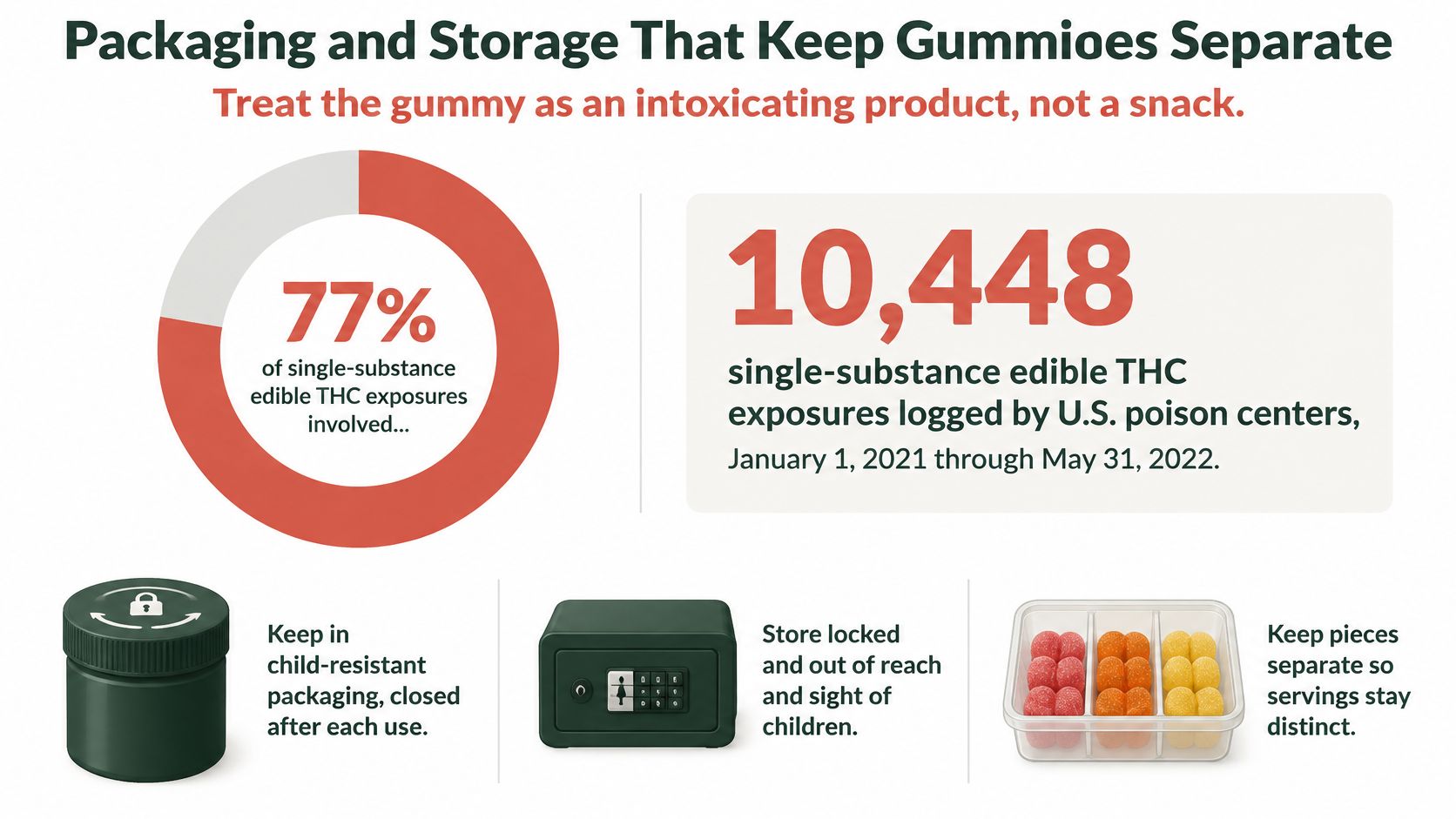
Choose child-resistant, resealable packaging with legible THC information and a visible batch identifier. Avoid presentations that closely imitate ordinary children's snacks. If someone could easily mistake the package for regular candy, consider that a purchasing drawback, not a clever design feature.
Child-resistant doesn't mean child-proof. You still need to close the container correctly and place it somewhere children and pets can't access.
An unlabeled jar may look tidier than a pouch, but it removes the information another person would need to identify the contents. A snack bag creates the same problem. Keep the package intact rather than decanting gummies into something that suggests ordinary food.
Check the printed expiration date and storage directions when deciding where to keep the bag. Our guide to whether gummies expire addresses the separate question of product age and condition.
If accidental ingestion occurs, contact a poison center for guidance rather than waiting to see whether symptoms develop. For breathing difficulty, seizure, severe confusion, hallucinations, or serious illness, contact emergency services. Keep the original package available so responders can identify what may have been consumed.
Make your next purchase a controlled comparison rather than a search for the strongest available option. Choose a format with an appropriate, clearly measured serving and documentation you can match to the actual bag. If you can't establish those basics, leave it out of your first trial.
Our Melt Bites sour THC gummies are sold in 1000mg bags, including Watermelon Sour and Sour Gummy Worms THC Crawlers. That package total describes the bag, not a recommendation to consume a particular piece or portion. Apply the same serving and batch checks you would use with any brand.
Don't assume every format within a brand has the same piece count, serving geometry, or cannabinoid composition. Read the specific product's label before deciding whether it fits your intended trial. If the serving you need isn't practical to measure, choose a different product instead of improvising.
Before opening the package, save its matching lab report and decide what you'll record. Set the bag back in secure storage after measuring your serving. That small routine keeps the remaining product out of reach and removes the temptation to eat another piece casually.
The goal isn't perfect predictability, because no label or laboratory report can promise that. It's a better-informed purchase with fewer avoidable uncertainties and a serving you can assess responsibly.
We offer Melt Bites sour gummies and Zour Belts in several fruit flavors, but flavor should come after serving clarity and batch verification. Visit Melt to compare edible formats and review the available lab reports against the specific product and lot before choosing your bag.
Your cart is currently empty.