



Free Shipping All Orders Over $95
You walk into a familiar neighborhood shop for a quick purchase and notice a rack of branded vapes beside the register. You recognize the packaging immediately. You've seen that product line at a downtown dispensary, but now it's sitting inside a store that sells everyday essentials. The logo is familiar, the products look the same, yet the storefront is completely different.
That small moment raises a practical question: how did a brand from one retail location end up inside another? The answer is usually a partnership store, but that phrase covers more than one arrangement. The details determine who owns the inventory, who controls the customer experience, how pricing works, and whether cannabis licensing rules allow the setup at all.
A partnership store often reveals itself through a familiar display in an unfamiliar setting. A shopper may recognize Melt products from an online order or dispensary visit, then find the same brand in a local retailer closer to home. The host store still has its own name, staff, till, and product mix. The branded display gives customers another way to access a product they already know.
That arrangement can look casual from the customer side, but it usually rests on a formal agreement. The brand and retailer decide what products the store will carry, how those products will be presented, how orders and reorders will work, and which party handles specific compliance tasks. The display might be a single shelf, a dedicated counter, or a more involved branded area.
The useful question isn't “Is this the same store?” It's “Which parts of the retail experience belong to the host, and which belong to the partner brand?”
Partnership-style retail has a long history outside cannabis. The modern cooperative retail model behind partnership stores in Britain was formalized in 1929, when John Spedan Lewis transferred ownership of John Lewis & Co. Limited and Peter Jones Limited into a trust for employees. The business itself began when John Lewis opened a drapery shop on Oxford Street in 1864. John Lewis Partnership history shows how the model later expanded into department stores and grocery retail.
The same basic idea now appears in many forms. A shopper might encounter a wholesale arrangement without seeing a formal branded area, a dedicated shop-in-shop counter, or a partner-managed display inside a host location. The rest of this guide separates those structures, explains why each side agrees to them, and shows how cannabis licensing changes the conversation.
You'll also see how a brand such as Melt can evaluate retail partners, what shoppers can do to find an approved location, and what a retailer should prepare before applying to carry products.
A partnership store is a retail location that carries another company's branded products under a formal agreement. The host retailer remains responsible for its own business, while the partner brand gains access to a new sales channel.
A simple analogy is a neighborhood cafe that roasts and serves its own coffee but also stocks bags from a separate roaster. The cafe controls its staff, register, opening hours, and general pricing policy. The roaster supplies its own product and may provide packaging, product information, or display guidance. Customers see two businesses working together, not one company pretending to be another.
The first structure is a wholesale partnership. The host retailer buys products from the brand, takes possession of the inventory, and resells those products through its normal operation. The brand may offer wholesale terms, product information, and marketing materials, but the host generally controls shelf placement and the customer transaction.
The second is a branded retail partnership. The host dedicates a defined area, such as a counter, shelf, cabinet, or display, to the partner brand. The retailer still operates the location, but the brand receives more visibility and may provide fixtures, signage, merchandising guidance, or staff education.
The third is a fully managed partnership. The partner brand supplies more of the retail support, potentially including fixtures, training, product specialists, or display maintenance. The host store still matters because it controls the premises, licensed operation, and point of sale. The brand gets more influence over execution, but it doesn't automatically become the legal retailer.
Industry analysis describes shop-in-shop and retailer-in-retailer arrangements as flexible structures that can share foot traffic, back-of-house services, and an existing lease rather than requiring a brand to build a standalone network. L.E.K. Consulting's retail partnership analysis also highlights the central trade-off: more brand control usually requires more operating involvement, while deeper host integration can reduce overhead and speed expansion.
Two stores can look identical to a shopper but operate under very different contracts. One host may own and price all inventory, while another may use brand-supplied fixtures and training. Revenue sharing, staffing, returns, product rotation, reporting, and exit rights should be written down rather than left to assumptions.
A partnership store isn't “two brands in one building.” It's a defined commercial relationship with boundaries. Those boundaries become especially important in regulated categories such as cannabis.
Partnership stores work when each party solves a problem for the other. The brand wants reliable access to customers without opening every location itself. The retailer wants differentiated products and support without developing an entire product line internally.
For shoppers, the most visible benefit is convenient access to recognizable products. A trusted brand can appear in a neighborhood store that a customer already visits, rather than requiring a trip to a distant specialty retailer. Consistent packaging also helps customers identify the intended product quickly, although packaging alone shouldn't replace checking the label, testing information, age requirements, or local rules.
A partner location may also carry products that aren't available at every nearby retailer. That gives customers more choice, but it creates a practical limitation: stock can change as products sell, deliveries arrive, or the host adjusts its assortment. A familiar brand on a display doesn't guarantee that a particular flavor, strain, device, or edible is available that day.
Approved retail relationships can offer another layer of confidence. The brand has chosen to attach its name to the retailer, and the retailer has agreed to carry products within the arrangement's requirements. That doesn't eliminate the shopper's responsibility to buy from a lawful source, but it can make the purchasing path easier to understand.
Retailers often use partnership stores to add products with existing consumer recognition. A host can avoid building a new product concept from scratch and may receive product education, point-of-sale materials, merchandising guidance, and coordinated marketing support.
The arrangement can also help a retailer test demand. Instead of committing immediately to a large standalone expansion, the host can assess how customers respond to a curated selection within an existing store. A retailer evaluating this route should compare wholesale terms, reorder expectations, storage needs, staff time, and compliance responsibilities before focusing on the display itself.
For practical planning, retailers can review this guide on how to start a wholesale business while building their purchasing and operating checklist.
The host store doesn't hand responsibility to the brand because the products arrive with branded materials. Employees still interact with customers, handle inventory, answer questions, and follow local rules. Poor storage, weak product knowledge, or unclear age-verification practices can damage both businesses.
Brands face a matching risk. A retailer with strong sales may still be a poor fit if its staff can't explain products accurately or if its operating standards don't match the brand's expectations. Vetting protects the customer relationship on both sides, which is why a partnership should be treated as an operating system, not a shelf-space transaction.
These models can look similar from the sales floor, but their legal and commercial relationships differ. The fastest way to understand them is to ask three questions: who owns the storefront and inventory, who controls pricing and promotions, and what happens when one side wants to leave?
| Dimension | Partnership Store | Franchise | Shop-in-Shop |
|---|---|---|---|
| Storefront and inventory | The host usually owns or operates the storefront, while inventory ownership depends on the agreement | The franchisee operates the location under the franchisor's system, with ownership and inventory terms set by the franchise contract | The host and partner usually keep their business operations and inventory responsibilities separate |
| Pricing and promotions | The host commonly sets retail prices, subject to any agreed brand rules or legal limits | The franchisor usually sets or strongly influences branding, promotions, and operating standards | Pricing may be coordinated, but the host often controls the transaction and final retail price |
| Customer relationship | Usually sits primarily with the host, although the brand may support marketing and product education | The franchise system presents one branded customer experience | The host owns the broader visit, while the partner brand receives a defined area and presence |
| Exit | Agreement terms govern notice, remaining inventory, displays, and final orders | Franchise termination rules, fees, defaults, and transfer conditions apply | The parties follow the shop-in-shop agreement for removal, inventory, and space restoration |
In a partnership store, each business can retain its own identity. The retailer remains a retailer, and the product company remains a product company. The brand may influence merchandising or supply, but the relationship doesn't necessarily require the host to adopt the partner's entire business system.
A franchise is more integrated. The franchisee operates under the franchisor's brand, procedures, signage, training requirements, and continuing support structure. That arrangement can create a consistent customer experience, but it also gives the franchisor more control and places more obligations on the franchisee.
A shop-in-shop is a defined physical footprint inside a larger host store. It sits between a simple wholesale purchase and a full franchise. The partner may receive a branded counter or section, while inventory, staffing, checkout, and compliance remain divided according to the contract.
Cannabis businesses can't assume that a normal franchise template will work. Licensing rules may restrict who can operate, control, or profit from a licensed retail activity. In Ontario, a person or partnership other than the licensed operator can't be entitled to profits from cannabis sales or liabilities incurred at a retail store under that operator's authorization, according to the AGCO cannabis retail licensing guidance.
That same source describes additional provincial limits. Manitoba requires a licence for each cannabis store location and restricts direct or indirect ownership or control of more than 15% of operating cannabis retail stores. British Columbia caps a licensee or interested party at eight cannabis retail store licences. These rules mean a partnership must be designed around the applicable province's ownership, control, and licence aggregation requirements.
A responsible cannabis partnership starts with compliance, not with a display mockup. A retailer can use the following checklist to self-audit before applying, while a brand can use it to decide whether its name belongs on the store floor.
The first question is whether the applicant holds a valid cannabis retail licence in the jurisdiction where the store operates. The retailer should be ready to provide licence documentation, legal business details, and evidence of good standing. A brand should verify those details against the relevant regulator's records instead of relying only on a PDF sent by email.
The review should also identify who legally operates the store. A polished storefront doesn't answer whether the applicant controls the licensed premises, whether ownership has changed, or whether another party has an undisclosed interest. Those details can affect whether the proposed arrangement is lawful.
A store visit or virtual walkthrough should cover more than cleanliness. Review security procedures, restricted-access areas, product storage, display conditions, inventory handling, and the way staff answer customer questions. The brand is evaluating whether the retailer can protect product quality and represent the product accurately.
Staff readiness matters just as much. Employees should understand the products they sell, know what claims they can and can't make, and follow age-verification and local compliance procedures. A brand shouldn't treat training as a one-time presentation. New employees and product updates create an ongoing need for clear information.
Product documentation should include required third-party laboratory testing, child-resistant packaging where applicable, and traceability through the lawful supply chain. Retailers should know how to receive, store, rotate, and remove products when a complaint or recall occurs.
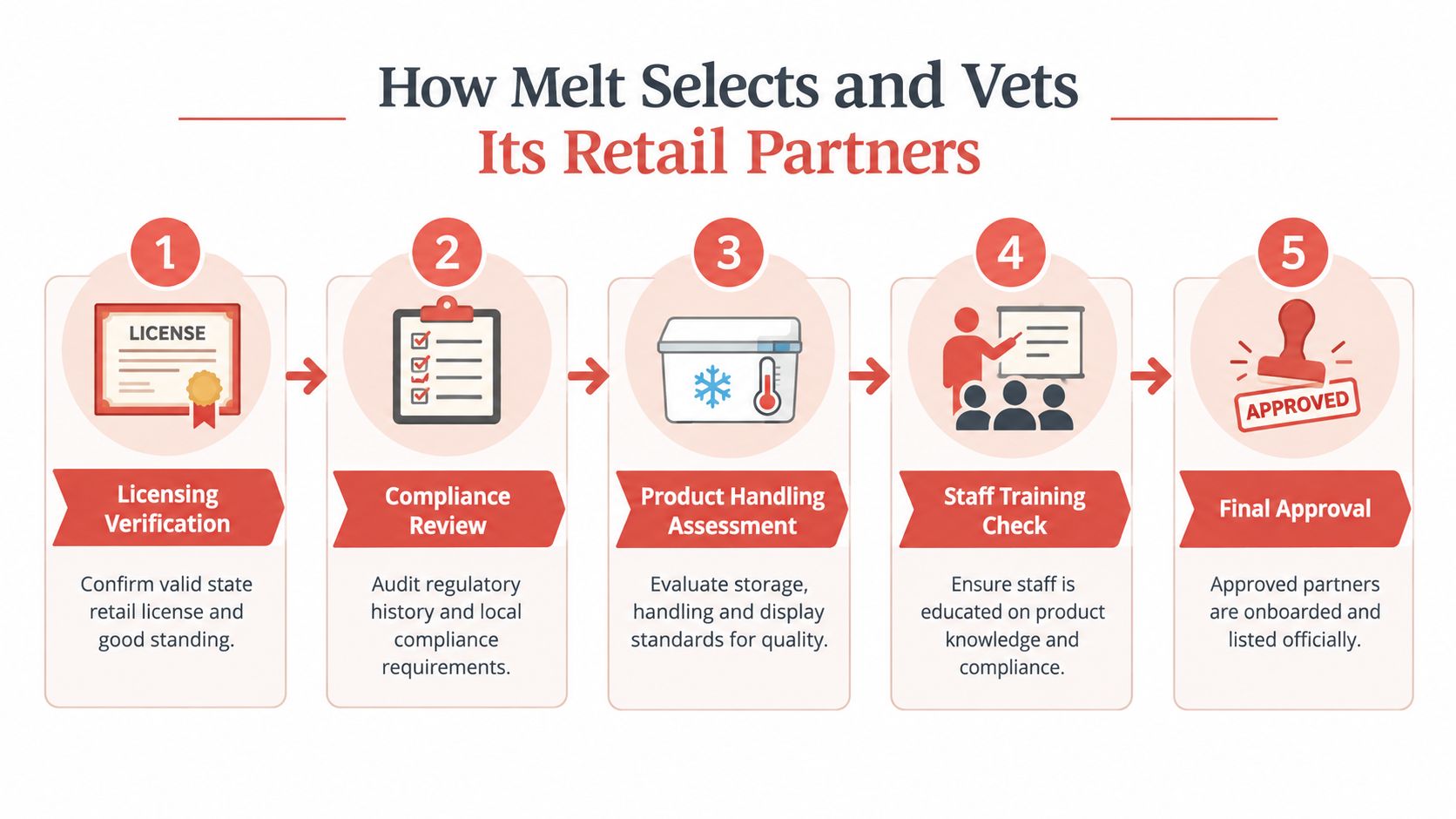
The final step is onboarding. Approved partners should receive merchandising guidance, product information, a reorder contact, and a defined process for complaints, returns, and recalls. Retailers interested in starting that conversation can use the Melt wholesale signup page.
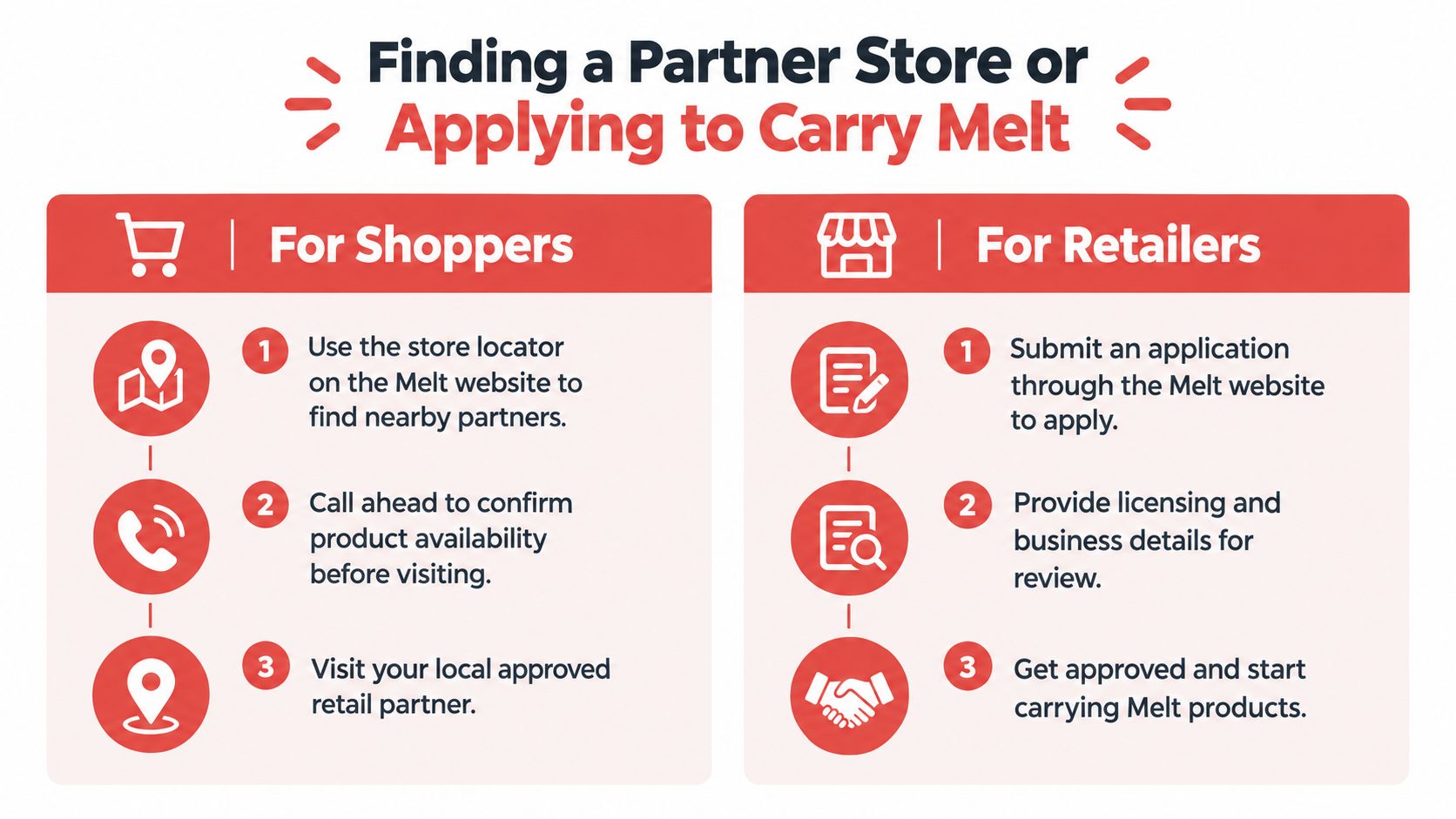
A shopper may spot Melt on a store menu, while a retailer may want to add Melt to its shelves. Each path starts with a different check.
Use the Melt store locator to find a nearby approved retail partner. Call before travelling if you need a particular Melt product, flavor, device, flower option, or edible. Menus and stock change, so a store carrying Melt may not have the full assortment that day.
At the shop, check the label, follow age requirements, and ask staff about current availability. A display is a sign of what the store carries, not a promise that every item is ready for purchase.
Begin with the wholesale or partnership application. The brand can review an application faster when it includes:
An application may lead to an internal review, then a store visit or virtual walkthrough. If both sides proceed, the written agreement should spell out pricing, delivery cadence, inventory ownership, merchandising, compliance duties, complaint handling, and exit procedures. These details show whether the proposed arrangement fits the retailer's licence and the brand's operating requirements, rather than treating the relationship as simple shelf space.
Applicants should also expect response timing to vary. Wait for the brand's review and written next steps instead of treating submission as approval.
The agreement decides inventory ownership, but cannabis licensing rules decide who may legally control and sell the products. In many arrangements, the host retailer handles the licensed transaction and retail sale, while the brand supplies products and support.
No. Cannabis rules differ by state and may restrict ownership, control, revenue sharing, branding, and store operations. A structure that works in one jurisdiction may need substantial changes, or may not be allowed, in another.
The host retailer usually sets the final retail price because it operates the transaction. The agreement may address suggested pricing, promotions, or brand presentation, but those terms must fit local law and the retailer's licensed responsibilities.
The written agreement should explain notice periods, remaining inventory, unpaid invoices, displays, customer communications, and final orders. Neither side should rely on an informal conversation to resolve an exit, especially where regulated inventory is involved.
For the full picture, start with the structure comparison above, then review the vetting and application steps before treating any partnership store as a simple shelf-space deal.
Melt offers adult consumers legal hemp-derived cannabinoid products, including THCA flower, disposable devices, prerolls, and edibles, with third-party testing information and retail-partner access. Visit Melt to explore products, find a nearby partner store, or begin a wholesale conversation.
Your cart is currently empty.