



Free Shipping All Orders Over $95
What makes an edible “strong”? Is it the largest number printed on the package, the amount in one piece, or the way your body converts and absorbs THC? Those questions have different answers, and treating them as one measurement is how many experienced cannabis users end up misjudging an edible.
A useful approach to strong weed edibles starts with literacy rather than bravado. Read the label, separate package potency from serving potency, account for delayed onset, and treat laboratory consistency as part of strength. A product with a smaller labeled dose can feel more predictable, and therefore more useful, than one with a dramatic total that tells you little about what each piece contains.
What makes a weed edible strong: the package total, the amount in one piece, or the effect that dose produces in your body?
The answer depends on four connected factors: labeled THC, per-piece consistency, delayed onset, and individual metabolism. A high milligram total can attract attention, but it does not tell you how much THC reaches you in one bite or how long the experience may take to develop.
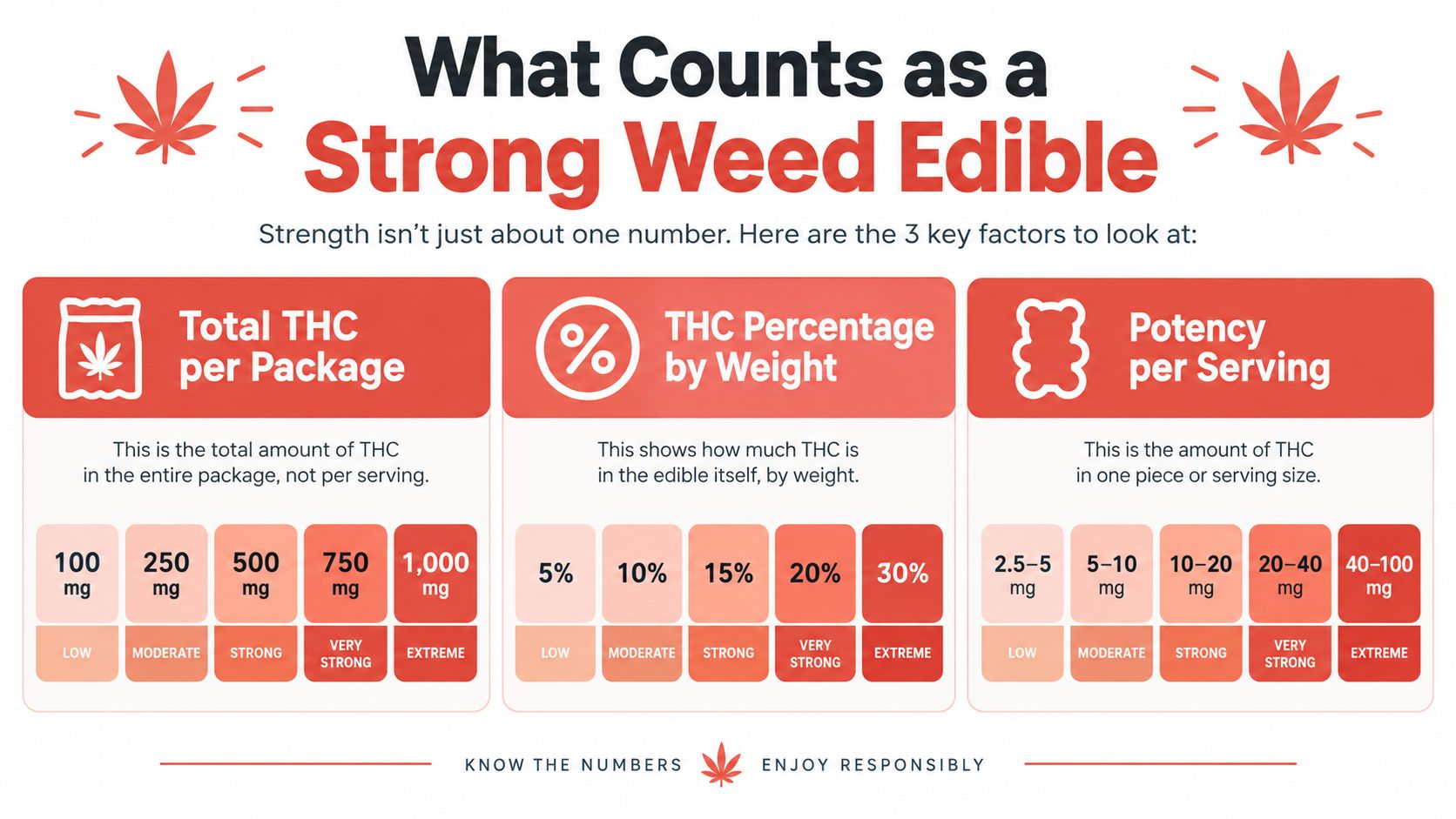
Start with total THC in the package. A bag may list hundreds or 1,000 mg of THC, yet that figure covers everything inside. In markets with serving limits, such products represent multiple servings rather than a conventional single dose. The peer-reviewed review of edible cannabis potency and dosing explains why a package total needs context.
Then check THC per piece. This is the practical figure for choosing one gummy, half a belt, or a measured portion of chocolate. A 500 mg package divided into 5 mg pieces contains more THC overall than a 100 mg package divided into 10 mg pieces, but the second package delivers more THC per piece. The piece, not the bag, determines the amount you take at once.
Strength also includes the effect of that dose. Oral THC is processed differently from inhaled THC, so the same nominal milligram amount can feel substantially different. Food, formulation, metabolism, and tolerance can change the result. One analysis estimated that 1 mg of oral THC can produce a behavioral effect comparable to approximately 5.71 mg of inhaled THC, although individual responses vary widely. The comparison is discussed in this review of THC delivery routes and behavioral effects.
Ask: What dose is likely to produce the effect I want, with enough predictability to manage the experience?
Public-health guidance commonly advises starting with a small amount and waiting before taking more. That approach recognizes that a strong edible is not the product with the largest label. Its practical strength comes from the labeled amount, the consistency of each piece, the delayed oral effect, and your individual response.
What makes an edible “strong” depends partly on where it is sold. Legal markets use different limits for regulated cannabis, state products, and hemp-derived goods. A high total on the package may reflect many lower-dose pieces, while a smaller package may contain fewer pieces with more THC each.
Canada offers a useful regulatory reference. Non-medical cannabis became legal in October 2018, followed by legal sales of edibles, extracts, and topicals on October 17, 2019. Federal rules cap edible cannabis at 10 mg of THC per immediate package, regardless of how many pieces the package contains. Health Canada describes the applicable Canadian cannabis laws and regulations, while this review of Canadian edible regulation and THC exposure provides broader context.
U.S. state markets commonly use a 10 mg THC serving standard, although some jurisdictions set a lower 5 mg limit. These figures describe common state-level rules, not one national requirement. Check the authority governing the market where the product is sold before treating a label as evidence of legality.
| Product category | Maximum THC per serving | Maximum THC per package | Legal basis |
|---|---|---|---|
| Canada, regulated edible cannabis | Not presented as a separate federal package limit | 10 mg | Canadian federal edible framework |
| U.S. state-regulated markets | Commonly 10 mg, with some jurisdictions using 5 mg | Varies by jurisdiction | State cannabis rules |
| Products marketed above regulated package limits | Depends on the product and market | May contain hundreds or 1,000 mg total | Must be evaluated under the applicable local rules |
“Hemp” on the label does not automatically make an online product legal or accurately labeled. Legality depends on the cannabinoid profile, local law, distribution channel, and labeling. The practical rule is simple: total THC is a package fact, not a dosing recommendation.
Why can a strong weed edible feel inactive at first and then become much more intense later? The answer starts with the route THC takes through the body. Unlike inhaled cannabis, an edible must pass through the gastrointestinal system, enter the liver, and undergo first-pass metabolism. That process makes absorption slower and less predictable, while producing the active metabolite 11-hydroxy-THC.
Strength therefore depends on more than the labeled milligram total. The amount in each piece, how consistently pieces are made, the delay before effects appear, and individual metabolism all shape the experience. A product labeled 10 mg may still be difficult to evaluate if one piece is not clearly defined or if the contents vary between pieces.
Controlled studies of commercial edible products containing 10 mg of THC found peak times of roughly 35 to 90 minutes. Brownie studies using approximately 8.4 to 50.6 mg found plasma THC peaks about 0.9 to 2.6 hours after ingestion. These findings are summarized in the Journal of Analytical Toxicology research on oral THC pharmacokinetics.
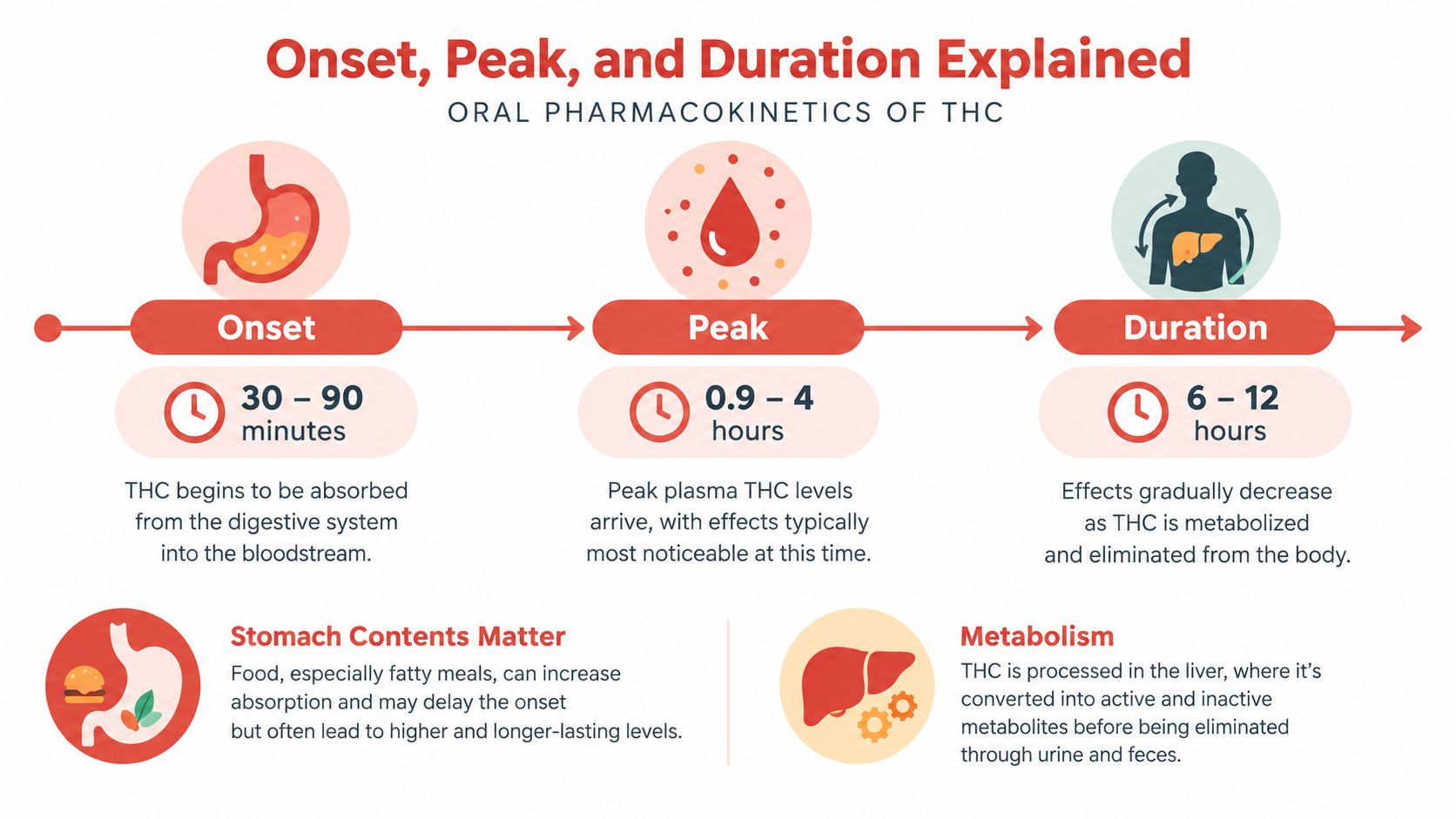
A delayed start can make a dose seem weaker than it is. Someone eats one piece, feels little, and takes another before the first has reached its peak. The second serving then adds to the first, like pouring more water into a glass before checking how full it is. The combined effect may feel unexpectedly strong, even though timing caused the problem.
Practical rule: Treat early quiet as incomplete information, not proof that the edible is weak.
Use this timeline as a planning aid:
For a plain-language explanation of product and timing differences, read this guide to how long edibles take to work.
Oral effects may last longer than expected, particularly with a high dose or limited edible experience. Avoid planning to drive, operate machinery, or handle an important obligation around uncertain onset. A delayed effect remains active, even when the first hour feels uneventful.
Why can the same labeled serving feel manageable one day and unexpectedly intense the next? A product's strength is not only its printed THC total. The experience also depends on per-piece consistency, delayed absorption, individual metabolism, tolerance, food, sleep, and other substances.
A label describes the amount in the product. It does not predict the exact response in every person. One edible can act like the same recipe prepared in different kitchens, with digestion and body chemistry changing the result.
Tolerance changes how the brain responds to repeated cannabis exposure. Regular use may reduce sensitivity to some THC effects, yet tolerance from inhaled cannabis does not reliably predict tolerance to edibles. Oral THC follows a different path through digestion and metabolism, so someone comfortable with inhaled cannabis may still find an edible intense.
Beyond the slower absorption already described, the liver helps determine how oral THC feels after digestion. First-pass metabolism forms 11-hydroxy-THC, an active metabolite associated with the distinctive duration and intensity of edible effects. The pharmacokinetic study of oral THC describes oral exposure as more variable than inhaled exposure, so smoking experience cannot provide a precise edible dose conversion.
Food creates another source of variation. What is in the stomach can affect the timing of effects, while the edible's formulation can influence how much THC reaches circulation. Eating the same labeled dose last week therefore does not guarantee identical timing or intensity today.
CBD does not reliably soften THC's effects. In a controlled Johns Hopkins study, participants received brownies containing either 20 mg THC alone or 20 mg THC combined with 640 mg CBD. The combined formulation produced nearly twice the maximum blood THC concentration and greater impairment, psychomotor effects, and heart-rate elevation, as reported in the controlled THC and CBD interaction study.
Poor sleep, dehydration, anxiety, alcohol, medications, and other substances can also make an experience harder to predict. Treat these conditions as reasons to postpone use or keep the situation simpler, not as reasons to increase the dose because an earlier serving felt mild.
What makes a dosing plan safer for a strong edible: the labeled amount, the consistency of each piece, the delayed rise in effects, and your own response all matter.
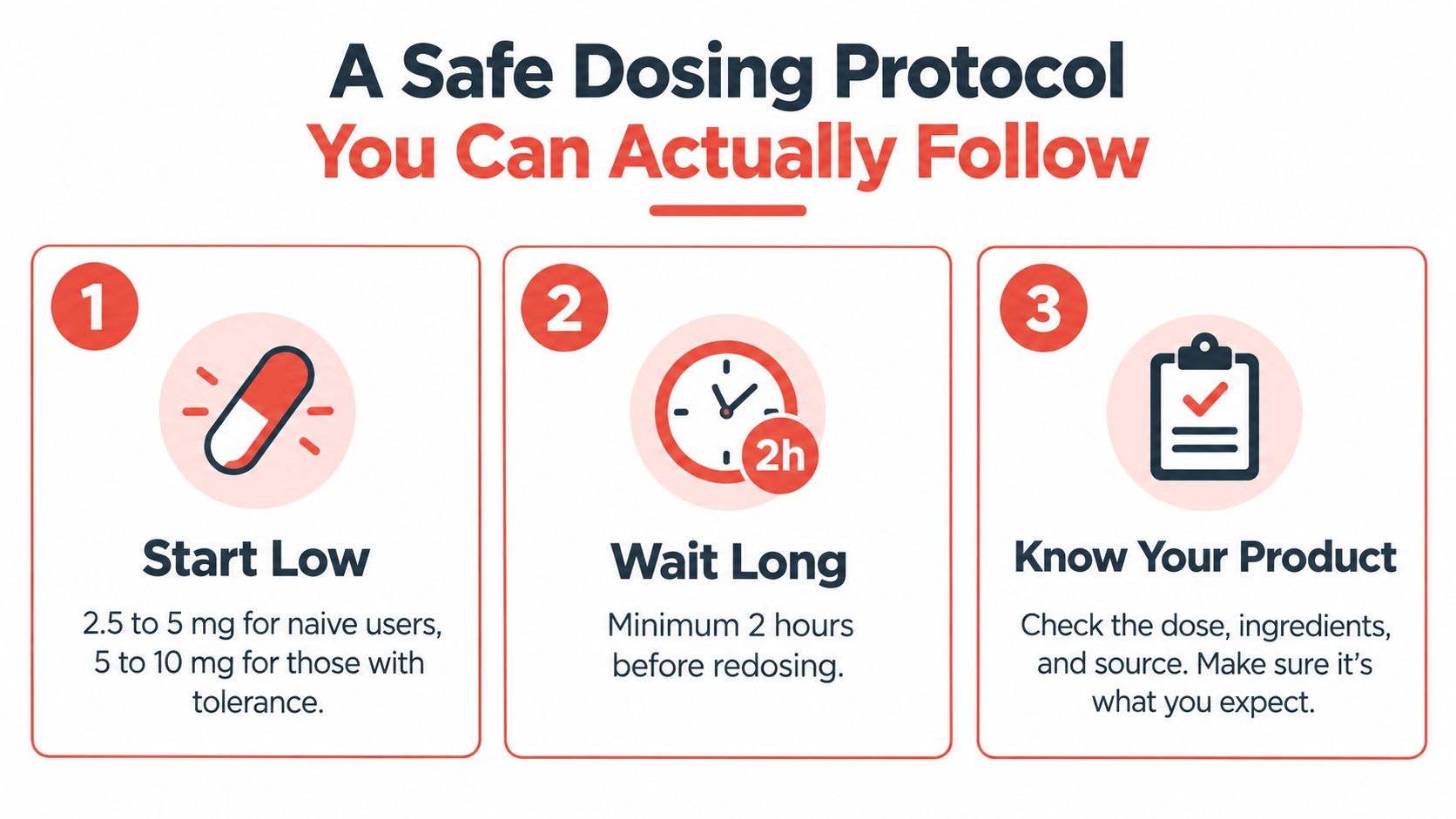
For a new or uncertain response to oral THC, Canadian public-health guidance recommends starting with 2.5 mg THC or less, as described in this review of edible dosing and public-health concerns. Choose a product that states the THC amount per piece or explains how to divide one serving. A high package total is less useful if you cannot identify the amount in the portion you plan to take.
Your smoking or vaping tolerance does not provide a precise edible conversion. Oral THC follows different absorption and metabolism pathways, so base the starting point on your experience with edibles, not cannabis experience alone.
As covered in the onset section, peak effects can arrive between roughly 35 minutes and 2.6 hours, so wait at least that long before considering more. The oral THC pharmacokinetic research also shows why timing varies across oral products and people.
If you choose to take more, record the added amount and the time. Treat the first serving like a slow-loading signal, not an immediate result. Repeated servings made before the first one peaks can stack into an unexpectedly intense experience.
Check the package for:
If anxiety escalates, severe nausea develops, or you become confused or physically unwell, stop consuming and seek appropriate medical help. Do not add alcohol or another substance to change the experience. Contact emergency services for difficulty breathing, loss of consciousness, or severe chest pain.
Screenshot rule: Start with 2.5 mg or less, wait through the peak window, and record what happened before changing your next dose.
For another practical explanation of portioning and timing, read this guide on how to dose edibles.
What makes a weed edible strong in practice: the package total, the amount in each piece, or how predictably the product delivers both? A large THC total signals a concentrated package, but it does not show whether pieces are evenly dosed, whether one serving is clearly defined, or how the formulation may affect your expectations.
Use four questions before buying.
Per-piece labeling gives you a practical starting point. Check whether each gummy, square, belt, or other portion carries the same stated amount. A product with marked pieces and batch-specific testing offers a clearer basis for choosing a serving than a bag that lists only a large total and contains unmarked pieces.
Strength is experienced per serving, while the package total describes everything in the container. That difference is similar to comparing the volume of an entire bottle with the amount poured into one glass.
A certificate of analysis may report measured cannabinoid content and laboratory checks for contaminants. Read it as evidence about a particular batch, not as proof that every piece is identical. Confirm that the report matches the batch number, identifies individual cannabinoids, and presents results you can compare with the label.
A report that cannot be matched to the package gives you less useful information for judging consistency.
Read the cannabinoid panel rather than the THC number alone. Look for listed THC, CBD, and other cannabinoids, along with their amounts or ratios and the per-piece breakdown. A clear label lets you compare products on more than total THC.
As the Johns Hopkins study in the tolerance section showed, a THC-plus-CBD brownie produced higher peak blood THC, so treat a CBD ratio as information, not moderation. The research on CBD and oral THC does not make that result a prediction for every person, but it supports reading the full formulation before purchase.
Scored pieces, a defined serving, child-resistant packaging, and accessible batch testing make the product easier to assess and handle. The consumer and public-health review of adverse reactions and edible labeling discusses accuracy, dose homogeneity, contaminant testing, packaging, and use context as relevant parts of evaluating high-potency edibles.
A verified lower-dose gummy may therefore be more practical than an ambiguous high-dose bar. The lower package total may sound less impressive, but consistent portions give you better control over the amount you choose.
Could the edible still affect you after the strongest effects have faded? Yes. Some people notice tiredness, mental fog, anxiety, or physical unease during the comedown. That period can show how the dose, food, stress, sleep, and setting shaped the experience. It is useful feedback, not a personal failure.
Move somewhere quiet and familiar. Sip water, eat light food if that feels comfortable, and lower stimulation if a screen, room, or conversation increases anxiety. Rest in a safe position. If the experience feels overwhelming, ask a sober, trusted person to remain available.
Do not drive or operate machinery while you feel impaired, groggy, or unable to concentrate. Oral exposure produces higher and longer-lasting concentrations of the metabolite THCCOOH than inhalation, so smoking experience cannot reliably predict impairment or detection windows.
Give yourself enough time to feel fully clear before making safety-sensitive decisions. A lingering fog can matter even when the main effects seem finished.
Write down what happened while the details remain fresh:
“Eating more will make it start faster.” A larger amount adds THC exposure, but it does not remove the digestive and metabolic delay. The eventual effects may become stronger and more difficult to manage.
“The package total is one dose.” As explained under potency standards, regulated packages define multiple servings, not one dose.
“Hemp-derived means risk-free.” The source category does not remove delayed onset, labeling uncertainty, accidental access, or interactions with other substances. The CDC-related public-health evidence summarized in the review of edible poisonings describes label uncertainty and unintentional pediatric cannabis poisonings in some jurisdictions after adult-use legalization. Store products securely and assess the actual label rather than relying on the hemp-derived description.
“Tolerance removes the risk.” Tolerance can change perceived intensity without making a product predictable. A different formulation, food context, break from use, or inconsistent serving can still cause an unexpectedly strong response.
The practical goal is a clear record of how your body responds to a defined serving. Use that record, along with consistent per-piece labeling and the time course of the effects, to make the next decision more carefully.
Melt offers adult consumers hemp-derived cannabinoid products, including high-potency edibles, with product information and third-party lab-report access. Visit Melt to compare serving amounts, formulation details, and testing information.
Your cart is currently empty.