



Free Shipping All Orders Over $95
You're standing at a smoke-shop counter with two packages that look almost interchangeable. One says 10 milligrams of hemp-derived delta-9 THC. The other comes from a licensed cannabis dispensary and also says 10 milligrams. One may sit on a general retail shelf, while the other requires a dispensary visit and a different purchase process. The labels look familiar, but the legal basis, testing expectations, and practical risks aren't necessarily the same.
That confusion is reasonable. Delta-9 THC is the same intoxicating cannabinoid whether it comes from hemp or marijuana, but federal hemp law has historically measured compliance by THC concentration relative to a product's dry weight. State lawmakers can add their own restrictions, and newer legal changes are shifting attention toward total THC and container limits. A careful buyer needs more than the familiar less-than-0.3-percent phrase.
This guide answers four practical questions: what delta-9 THC does in the body, why hemp-derived versions can be sold in places without dispensaries, how an edible experience unfolds, and which certificate of analysis can prove that a gummy contains what its label promises.
The shopper turns both packages over. The hemp-derived gummy has a bright flavor name, a serving panel, and language about federal hemp compliance. The dispensary edible has a state cannabis warning, a regulated retail label, and a different checkout experience. The price difference may reflect taxes, licensing, distribution, and testing requirements, but the front of the package doesn't explain any of that.
The important distinction isn't that one product contains “real” delta-9 and the other doesn't. Both can contain delta-9 THC, the cannabinoid responsible for the familiar intoxicating effect associated with cannabis. The distinction is how the product enters the market and which rules apply to it. Under the federal hemp framework described in the 2023 independent analysis of hemp-derived delta-9 products, hemp products were defined by a dry-weight concentration limit, while federal product requirements such as universal testing and a total-dose cap were limited or absent under that framework.
That creates a label problem for first-time buyers. A number printed in milligrams tells you the intended amount of THC, but it doesn't tell you whether the batch was accurately tested, whether the product is allowed in your state, or whether the seller has applied the correct legal definition.
Practical rule: Treat the package as an invitation to verify, not as proof. The label tells you what the seller claims. The COA and current state rules tell you what you can reasonably trust.
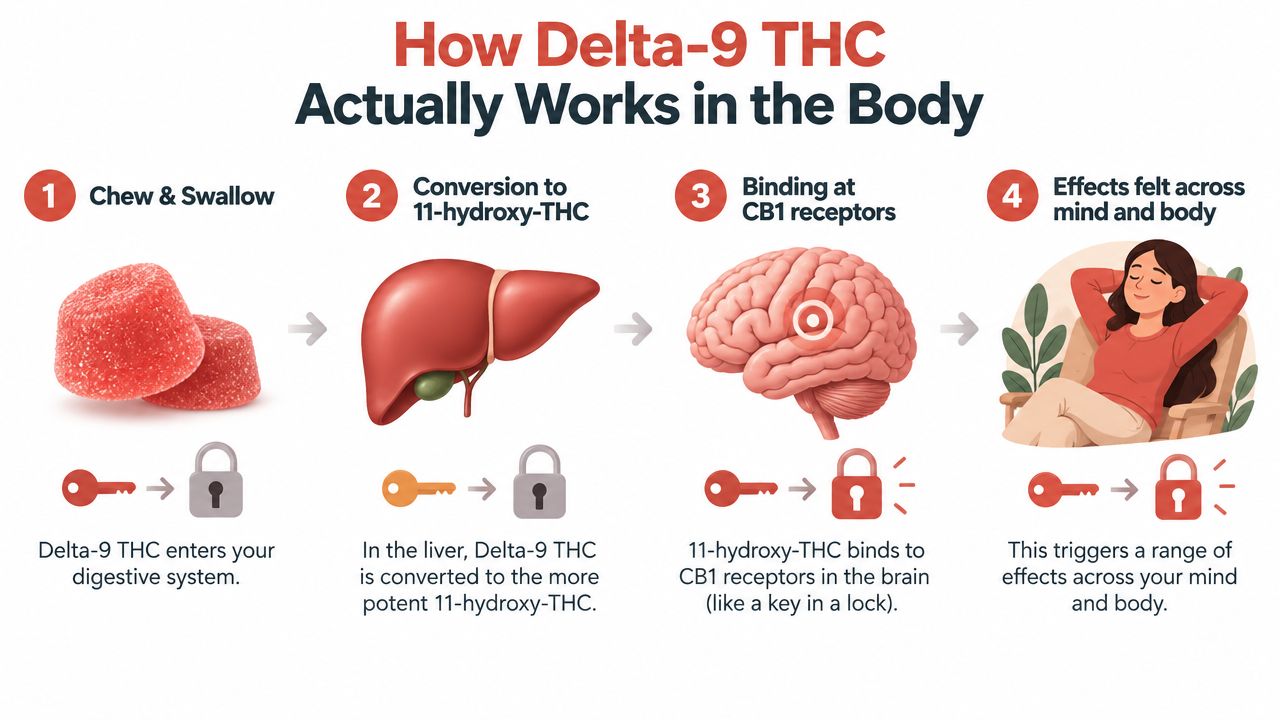
Think of the body's endocannabinoid system as a signaling network with its own messenger molecules and receptors. One of those natural messengers is anandamide, which helps regulate processes such as mood, appetite, memory, and pain signaling. THC resembles some of the molecules that fit into this system, but it can activate the receptors in a different and more noticeable way.
The lock-and-key analogy helps here. CB1 receptors are the locks, and delta-9 THC is a key that fits well enough to activate them. The exact result depends on how many keys reach the locks, where those locks are located, your prior exposure, and your individual metabolism. That's why two adults can take the same labeled amount and describe noticeably different experiences.
Delta-9 THC and delta-8 THC are chemically related forms of THC. The “delta” label refers to the position of a double bond in the molecule, and that small structural difference can change how each compound interacts with the body. They aren't interchangeable labels, and a product marketed as delta-8 isn't a substitute for one labeled delta-9.
Edibles often feel stronger and last longer than inhaled cannabis because digestion and liver metabolism create active metabolites before the effects fully arrive.
The federal starting point is the 2018 Farm Bill, which defined hemp as cannabis containing no more than 0.3% delta-9 THC by dry weight, as summarized in this legal overview of hemp-derived delta-9 gummies. That wording measures THC against the total weight of the dried product, not the number of milligrams in the gummy.
The math is what surprises shoppers. A sufficiently heavy gummy can contain measurable delta-9 THC while remaining below the concentration threshold when the THC is divided by the gummy's dry weight. This is why a hemp-derived product can produce an intoxicating effect while still being marketed as hemp. The rule created a legal route for edible products after federal law distinguished hemp from marijuana by THC concentration rather than treating every product containing THC the same way.
That federal pathway doesn't settle the question everywhere. Some states apply additional packaging limits, use total-THC calculations, restrict chemically modified cannabinoids, or prohibit hemp-derived intoxicating products altogether. Georgia, for example, allows no more than 10 milligrams of total delta-9 THC per gummy and 300 milligrams per package, according to the cited state-law explainer. Colorado has also been identified as a state that restricts products made by chemically modifying a natural hemp component.
| Factor | Hemp-Derived Delta-9 Gummy | Dispensary Cannabis Edible |
|---|---|---|
| Source category | Derived from hemp and marketed under the hemp framework | Sold through a state cannabis system |
| Federal distinction | Historically tied to 0.3% delta-9 THC by dry weight | Cannabis above the hemp threshold falls outside that federal hemp definition |
| Dose framework | Federal hemp rules described in the independent analysis had no federal total-dose cap | State cannabis rules commonly control serving and package formats |
| Testing expectation | The cited analysis found no universal federal testing requirement under the described hemp framework | Testing and labeling depend on the applicable state cannabis program |
| State treatment | Can face separate state caps, bans, or formulation restrictions | Usually governed by the state's licensed cannabis rules |
| Travel and shipping | Must be checked against both origin and destination rules | Transport is subject to cannabis restrictions and state boundaries |
Travel adds another layer. Some current guidance says hemp gummies under the old dry-weight threshold may be allowable through TSA screening, while federal policy is also moving toward tighter total-THC limits and a 0.4 mg per-container cap, with enforcement timing discussed for 2026 in this legal analysis of changing hemp definitions. That combination means a product's status can change even when its packaging hasn't.
Before ordering or carrying a gummy, check the law where you are, where the shipment begins, where it ends, and whether the product uses a state-restricted formulation. Don't assume that a product sold legally in one state can be mailed, flown with, or carried into another.
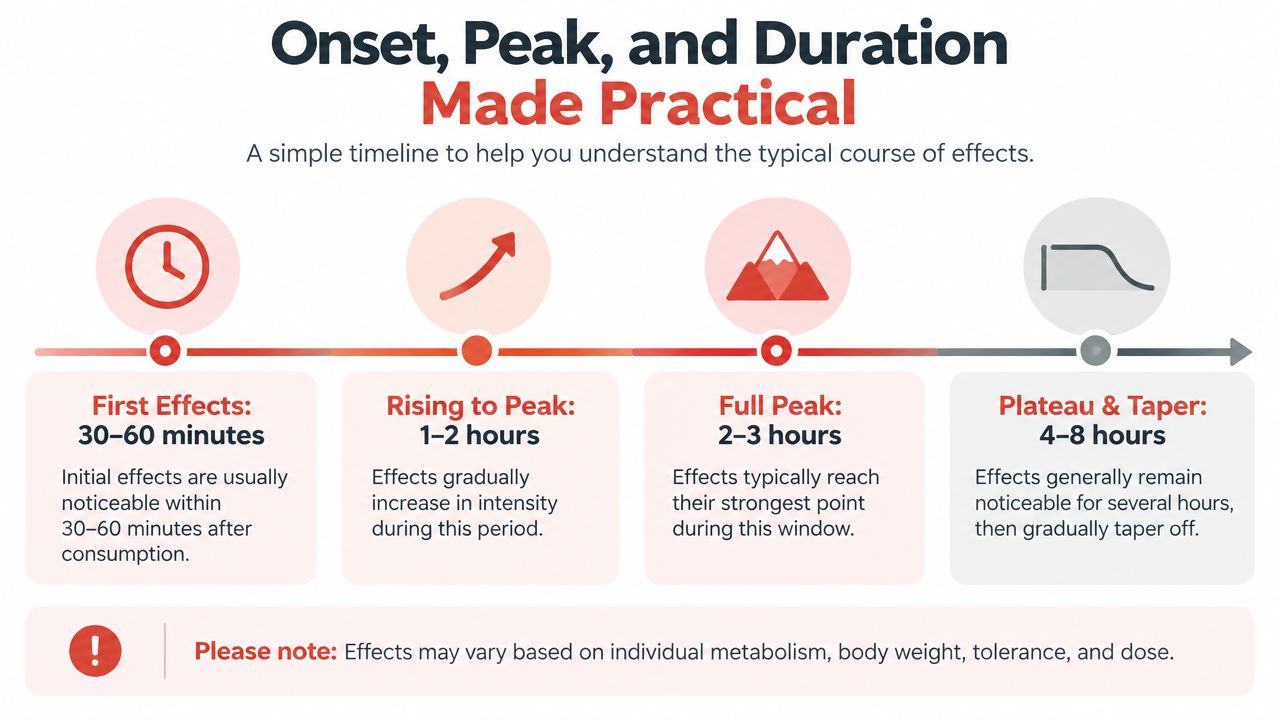
An edible doesn't provide an instant readout. After you chew a delta nine gummy, the first effects may appear in roughly 30 to 60 minutes, the full peak may arrive around 2 to 3 hours, and the plateau and taper can continue for roughly 4 to 8 hours, depending on dose, food, body weight, and individual metabolism. These timing ranges are the practical reason patience matters more than confidence during a first session.
Start with 2.5 to 5 milligrams of delta-9 THC if you're inexperienced or unsure of your sensitivity. Choose a calm setting, keep water nearby, and make sure you don't need to drive, work, care for someone, or make important decisions.
Wait a full two hours before considering more. A gummy that feels inactive at 45 minutes may still be moving through digestion, and adding another piece can cause both doses to rise together. Until you understand your response, keep a single session near 10 milligrams rather than treating a package's total milligrams as a suggested serving. These dosing guidelines are practical harm-reduction advice, not a guarantee of how any individual will feel.
For a deeper explanation of the edible window, see how long delta-9 gummies last.
Food timing and metabolism can shift the experience. Alcohol or another edible can make the session harder to judge, so avoid layering substances while you're learning your baseline. Feeling less intoxicated doesn't necessarily mean every effect has cleared, and next-day grogginess can persist after the obvious high has faded. Don't drive or operate machinery until you feel fully alert and coordinated.
A COA is useful only when it connects to the exact product in your hand. Start with the batch or lot number. It should match the number printed on the package, bottle, or product label. A generic laboratory screenshot without a matching lot number doesn't establish that the tested sample represents your gummy.
Find the delta-9 THC result, then look for total THC. Those figures answer different questions. Delta-9 THC identifies the specific cannabinoid, while total THC may include additional THC contributions defined by the laboratory's testing method and applicable regulations.
Compare the reported potency with the label's milligrams per gummy. The plan for evaluating a premium product is to look for results within 10% of the labeled potency, but that tolerance should be treated as a quality-screening target rather than a universal legal rule. For federally compliant hemp products under the traditional framework, confirm that the product's delta-9 concentration remains under 0.3% by dry weight, using the lab's stated basis and calculation.
The COA reading guide for hemp products can help you decode the common sections without treating every laboratory layout as identical.
A terpene panel may be empty, especially when a gummy doesn't claim to contain meaningful terpene content. That isn't automatically a failure, but the section can reveal whether the formula's flavor or aromatic claims correspond to tested ingredients.
The safety screens deserve equal attention:
Finally, identify the laboratory and its accreditation information, scan the package QR code, and check the report date. A document should be current enough to represent the product still being sold, and the QR code should lead to a complete report rather than a marketing page.
You should be able to reject a questionable delta nine gummy quickly, without studying every word on the package. Use four filters, and let missing information count as information.
Look for a batch-specific COA that you can open before purchase. The seller should identify a real company name and address, provide reachable customer support, and connect the report to the lot number on the package. A bare storefront, an untraceable social-media account, or a lab image with no downloadable document makes verification unnecessarily difficult.
Next, inspect the dose statement. The clearest label tells you the milligrams of delta-9 THC per gummy, not only the total milligrams in the entire bottle. A product line should distinguish lower-dose, standard, and higher-dose options instead of hiding several strengths behind vague serving language.
Manufacturing signals don't replace a COA, but they add context. cGMP-aligned production, allergen controls, identifiable ingredients, and child-resistant packaging indicate that the maker has considered more than the front-label appeal. You should also check whether the ingredient panel explains colors, flavors, sweeteners, and the gummy base clearly.
The high-potency hemp gummy guide is useful when comparing stronger formats, but higher potency should make you more careful about serving size, storage, and state restrictions, not less.
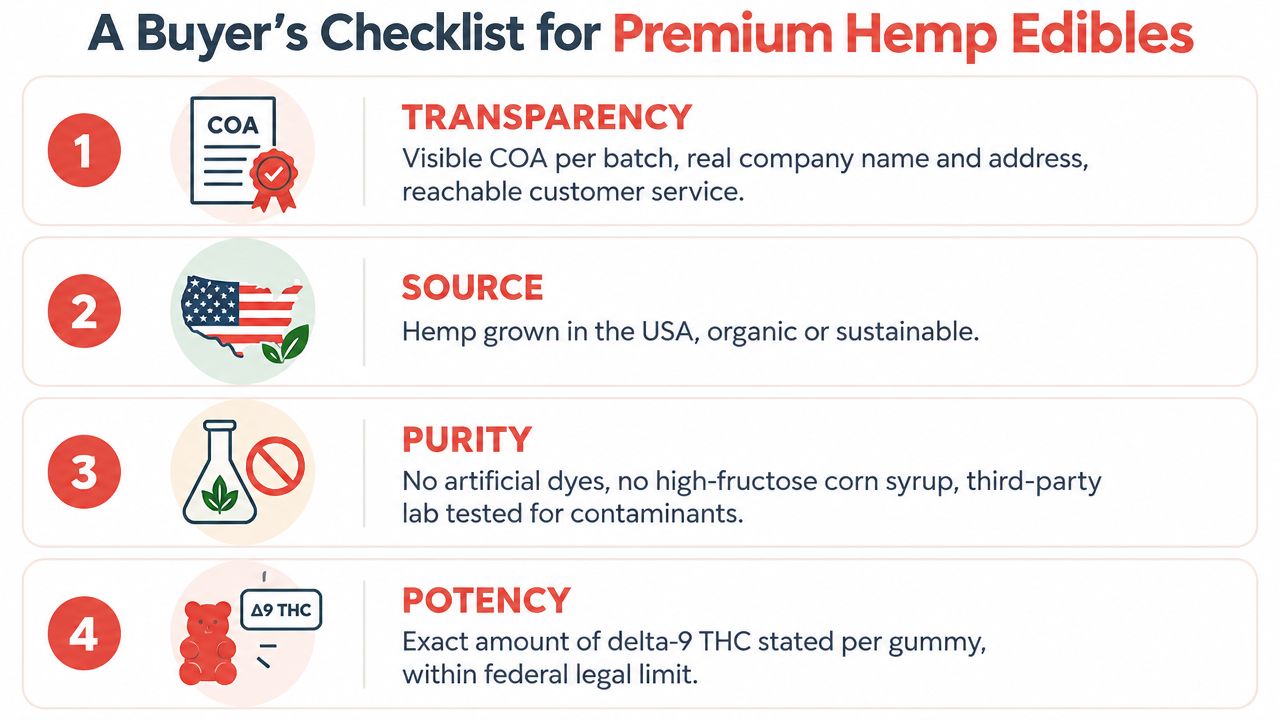
The package should state its hemp basis and provide a clear delta-9 dry-weight claim where that framework applies. Age-gating at checkout is another practical signal that the seller understands adult-use responsibilities. Shipping restrictions should reflect state carveouts rather than treating the entire country as one market.
A reliable label answers three questions quickly: What is in one gummy, which batch was tested, and where is the product allowed?
A practical example makes the checklist easier to use. Melt presents its products as legal hemp-derived cannabinoid offerings and emphasizes third-party testing, transparent lab reports, and age-gated purchasing. The useful part isn't the branding language. It's whether a shopper can open a batch report, connect it to the package, and inspect the actual cannabinoid and contaminant results.
For a brand to earn that trust, the evidence should be visible at the product level. A buyer should be able to find a third-party COA through a QR code or product page, match the lot number, and review potency alongside screens for pesticides, heavy metals, microbials, and residual solvents. If the report only shows a cropped potency panel, the buyer still lacks a complete safety picture.
A California-craft or small-batch position can be a useful transparency signal when it comes with specific manufacturing information. Short ingredient decks are easier to check for sweeteners, colors, flavor extracts, allergens, and the source of the gummy's texture. The phrase “small batch” by itself doesn't prove quality, but a readable formula paired with accessible documentation gives the shopper something concrete to assess.
Contrast that with common warning signs:
Compliance is observable. You don't need to accept a marketing promise when the report, label, lot number, and contact information are available to inspect.
A confident purchase combines four kinds of judgment. Chemistry tells you why the product affects you. Dosing tells you how slowly to approach it. The COA tells you whether the contents match the label. Current law tells you whether possession, shipping, or travel is permitted where you are.
Use this five-part check before clicking buy or handing over your card:
Store gummies away from children and anyone who shouldn't consume them. Avoid driving while impaired, and remember that delta-9 THC can produce a positive drug-test result even when the product is hemp-derived.
The best delta nine gummies decision isn't based on a colorful flavor name or a familiar milligram number. It comes from layering current regulation, receptor-level understanding, cautious dosing, and batch-level lab literacy.
Melt offers hemp-derived cannabinoid products, including edibles, with an age-gated shopping experience and an emphasis on third-party testing and transparent lab reports. Visit Melt to review the product details and COA information before choosing a gummy that fits your state's rules and your experience level.
Your cart is currently empty.