



Free Shipping All Orders Over $95
THCA is the non-psychoactive precursor to THC, naturally abundant in raw cannabis. Over time—or when exposed to heat or light—it sheds a carboxyl group, transforming into the familiar psychoactive THC we associate with a traditional “high.”
Here’s a quick glance at how these two molecules diverge before you dive into the finer details.
Before we unpack activation, onset, and legal nuances, let’s lay out the core contrasts:
| Feature | THCA | THC |
|---|---|---|
| Molecular Form | Acidic precursor | Neutral psychoactive compound |
| Activation | Requires decarboxylation | Active immediately upon use |
| Onset | No psychoactivity in raw form | Minutes to hours based on method |
| Legal Status | Legal if ≤ 0.3% Δ9 THC (pre-heat) | Regulated under marijuana legislation |
Key Insight THCA and THC share the same origin but follow different activation paths, leading to distinct user experiences.
Use this table as your quick-reference before moving on to detailed sections on dosing strategies, lab testing standards, and real-world consumption tips.
Next up: a deeper dive into decarboxylation efficiency, potency comparisons, and Melt’s commitment to full transparency and quality.
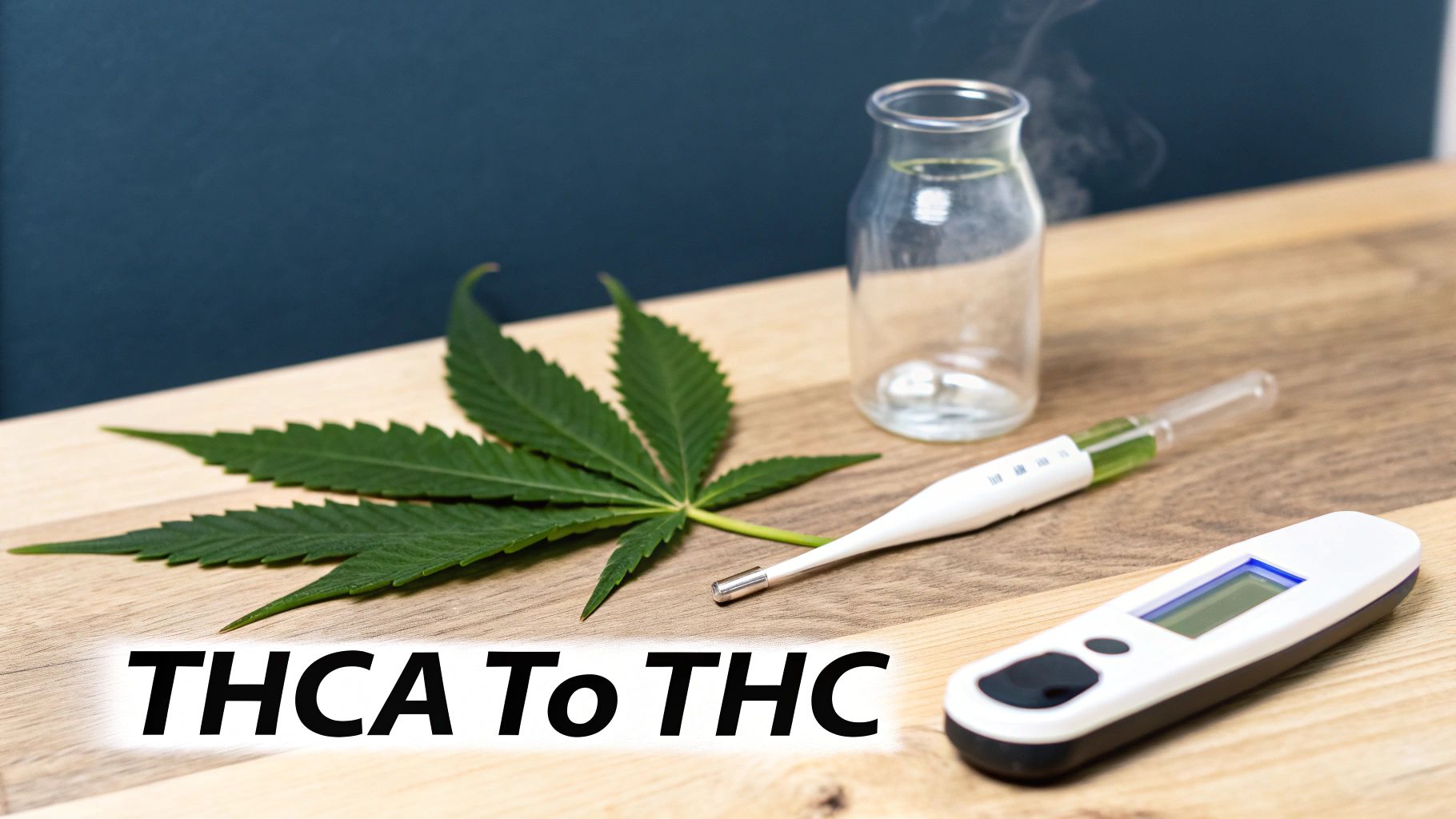
When you examine raw cannabis flower, you’ll find it packed with THCA, the acidic precursor to THC. In this form, it holds onto a carboxyl group that prevents any psychoactive effects.
Only heat—through smoking, vaping, or baking—can knock that group off. Around 110°C to 121°C, CO₂ is released and THCA morphs into psychoactive THC.
Potent strains can contain 20–30% THCA when fresh but remain non-intoxicating until warmed.
A detailed NIH analysis showed air-dried buds lost 0.5% to 2.4% of acidic cannabinoids compared to fresh samples. Mean Δ9-THCA levels measured 4.63 mg/g in secretory cavities and soared to 141.7 mg/g across inflorescence (ranging from 23.3 mg/g to 318.7 mg/g). Dive deeper in the NIH study.
Follow Cerilliant pure standards and you can reach 99% decarboxylation efficiency. Skip exact temperatures and methods, though, and you’ll end up with erratic acidity and potency.
Legally, hemp products must cap total THC (Δ9-THC plus THCA pre-heat) at 0.3% under the 2018 Farm Bill. Yet NIST testing of 53 smokable hemp items found overlapping measurement issues in 55% of cases—despite a market tipped to hit $25 billion by 2025.
Key Takeaway Accurate heating and rigorous lab analysis ensure you hit your potency goals while staying compliant with THC limits.
Here’s a quick comparison of decarboxylation settings and the resulting cannabinoid concentrations for THCA versus THC.
| Metric | THCA Data | THC Data |
|---|---|---|
| Activation Temperature | 110–121°C (230–250°F) | Boils at 157°C |
| Acidic Content in Fresh Plant | 20–30% THCA | 0% until heated |
| Δ9-THCA Mean in Inflorescence | 141.7 mg/g | Converted on heat |
| Loss in Dried Samples | 0.5%–2.4% less acid | N/A |
This table underscores how precise temperatures and methods shape the shift from THCA to THC—and why consistency matters for dosing.
Several elements can tip the balance before you even fire up your oven or vaporizer:
You might be interested in our guide on THCA and how it works.
Understanding these nuances frames the practical advice that follows—how molecular shifts affect onset times, dosing accuracy, and compliance.
Even tiny swings in moisture or pH during storage can tweak terpenes, flavors, and the THCA-to-THC ratio.
Armed with this insight, Melt customers can choose the right THCA flower or product for consistent potency, flavor, and safety.
This foundation sets the stage for best practices in heating methods and informed consumption choices.
When you heat raw cannabis, THCA sheds a CO₂ molecule and morphs into psychoactive THC. That single reaction explains why one compound stays clear-headed and the other delivers a classic high.
How quickly you feel that shift depends entirely on your method of consumption. A toke gives you an almost immediate rush, while an edible can take up to 2 hours to kick in.
| Method | Onset | Duration |
|---|---|---|
| Smoking | 30 seconds to 2 minutes | Peaks quickly, then tapers over 1–3 hours |
| Vaping | 10–15 minutes | Steady effects for 1–3 hours |
| Edibles | 1–2 hours | Sustained relief for 6–8 hours |
These timing differences help you match a delivery style to your goal—be it a fast mood boost or an afternoon of lingering calm.
Key Insight: THC hooks onto CB1 receptors and sparks dopamine release, while THCA doesn’t bind those receptors and remains non-intoxicating.
When you spark raw THCA flower, combustion triggers decarboxylation almost instantly. Over 90% of the acidic cannabinoids convert to THC in mere seconds.
By contrast, vaping devices carefully regulate temperature to preserve delicate terpenes. This precision means you activate THC consistently without burning off flavor.
Meanwhile, edibles come pre-decarboxylated during cooking. Your digestive system handles absorption rather than heat, which explains the slower onset but longer endurance.
In turn, raw THCA shines for users seeking wellness without a head change. Early studies point to anti-inflammatory benefits and report no psychoactive side effects from unheated THCA.
In a study of 1,228 routine traffic stops, 865 drivers tested above the 1.0 ng/mL legal THC blood limit. Those findings link chronic THC use to memory lapses and dependence—effects absent with THCA.
Short-term side effects like paranoia, dry mouth, and dizziness affect around 20–30% of THC users. Meanwhile, THCA comes with a clean safety profile: no intoxication, no reported downsides.
Market data underscores this divide. U.S. cannabis sales hit $30 billion in 2024, with THC-centric products making up 70% of recreational revenue. At the same time, THCA-hemp items have jumped 150% in market share since 2023.
Read the full research about THCA vs THC and other cannabinoids.
Check out our guide on THCA effects and benefits for a deeper look at non-intoxicating applications.
Understanding these psychoactive differences helps you choose the right path—whether that means chasing a quick high or embracing THCA’s therapeutic edge.
When you line up THCA and THC side by side, the way you take them completely reshapes onset times and overall intensity. Raw flower juicing preserves pure THCA, while vaping and smoking ignite immediate decarboxylation into psychoactive THC. Meanwhile, tinctures and edibles depend on pre-heated extracts to keep dosing consistent.
A Melt pilot study found participants microdosing 50–100 mg of THCA juice twice daily reported significant relief from nausea without any intoxication. It all comes down to keeping your protocols tight so the molecules stay intact.
Pressing fresh THCA flower in a slow masticating juicer locks in anti-inflammatory and neuroprotective properties. Since you never apply heat, there’s no accidental conversion to THC.
“Raw THCA intake offers targeted wellness without intoxication or psychoactive side effects.”
On the other end, vaping heats THCA to 110–121 °C, boosting bioavailability and delivering a rapid high without harmful combustion byproducts. Smoking converts over 90% of THCA into THC within seconds, producing a peak in as little as 2 minutes and tapering off over 1–3 hours.
Tinctures rely on pre-decarboxylated extracts for precise dosing, while edibles lean on your digestive system, trading quick onset for a longer, steadier experience.
Here’s how THC products compare to THCA juice in dose, onset, and duration:
| Method | Dose Range | Onset Time | Duration |
|---|---|---|---|
| THCA Juice | 50–250 mg | Immediate | 1–2 hours |
| Vape | 5–20 mg | 10–15 minutes | 1–3 hours |
| Smoke | 5–20 mg | 30 seconds | 1–3 hours |
| Tincture | 2–10 mg | 20–45 minutes | 2–6 hours |
| Edible | 5–20 mg | 1–2 hours | 6–8 hours |
To find your sweet spot, start low and go slow: increase by 2–5 mg of THC or 25 mg of THCA each session, then wait out the full onset before adjusting.
Consistent titration empowers you to dial in clarity with THCA or aim for psychoactivity with THC.
Armed with these insights, Melt customers can choose the consumption method that best aligns with their wellness goals or recreational preferences—always mindful of potency and timing.
Understanding how THCA and THC levels shift before and after decarboxylation is crucial for staying on the right side of hemp laws. Small changes in moisture or temperature can push a product from legal to illicit.
Melt customers seeking clarity on compliance can check out our guide on THCA and its legal status to understand labeling, licensing, and restrictions.
Under the 2018 Farm Bill, any hemp product must keep its total THC—the sum of Δ9-THC and THCA on a dry-weight basis—at or below 0.3%. Federal agencies, including the DEA, interpret that combined threshold strictly: if heating pushes the total above 0.3%, the material is classified as marijuana. This distinction affects everything from interstate shipping to retail licensing.
Independent testing underscores the stakes. A NIST review of 53 smokable hemp items revealed only 55% of manufacturers’ COAs matched actual lab results for Δ9-THC and THCA. The remaining 45% discrepancies highlighted gaps in testing standards and potential enforcement headaches.
Across the Atlantic, the EU Novel Food framework (2019) allows raw THCA products so long as post-conversion THC stays under 0.2%. That carve-out has helped fuel a €500 million wellness segment by 2025. Meanwhile, Canada’s Cannabis Act caps flower at 10% Δ9-THC, yet THCA pre-roll sales jumped 200%, capturing 15% of a $6 billion recreational market. In the U.S., projections point to a 400% surge in THCA sales—hitting $15 billion by 2027 Learn more about these findings in a Baker Institute research summary.
Key Takeaways:
Many governments adopt zero-tolerance limits for active Δ9-THC on the road, but THCA generally escapes these cut-offs. Standard DUI screens target psychoactive THC, not its acidic precursor.
In a forensic analysis of 1,228 DUI cases, 70% of drivers tested above the 1 ng/mL THC limit. That statistic has pushed some states toward blanket no-tolerance policies, despite THCA’s non-intoxicating nature.
| Region | Total THC Limit | THCA Threshold |
|---|---|---|
| U.S. | 0.3% pre-heat | Summed with Δ9-THC |
| Europe | 0.2% post-heat | Raw THCA unregulated if below |
| Canada | 10% Δ9-THC flower | No explicit THCA cap |
Exporting and importing raw THCA demands the right permits: U.S. hemp growers need USDA approval, while shipments to Canada or the EU must align with Health Canada and Novel Food regulations. On the consumer end, clear packaging is non-negotiable: every product should cite its COA, declare total THC, and include batch-level traceability.
Accurate summation of Δ9-THC and THCA is the backbone of both compliance and consumer confidence.
Deciding between THC and THCA really hinges on what you want to achieve. At Melt, we’ve sketched out real-life scenarios—targeting anxiety, sleep, inflammation or pure recreation—to guide you toward the ideal routine.
Each scenario breaks down potency, onset, duration and ways to stay under the 0.3% Δ9 THC federal limit.
The infographic below lays out a decision tree with three starting points—microdosing, sleep support and raw juicing—each leading to a tailored plan.
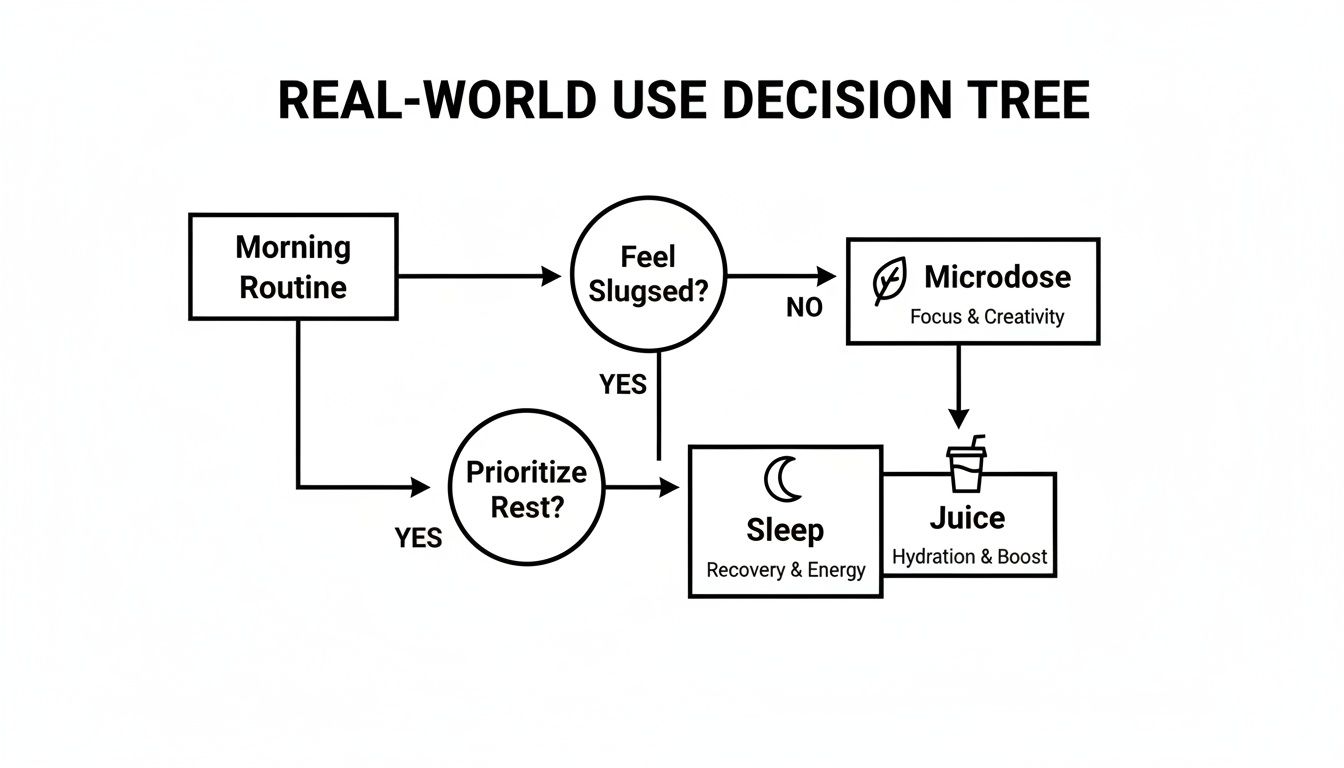
The leaf icon ushers in a gentle mood lift.
The moon icon ushers in a night-time sleep protocol.
The cup icon highlights anti-inflammatory juicing.
Start your day with THCA microdosing to ease anxiety without the fog. A typical range sits at 10–20 mg THCA, with calm arriving in under 10 minutes and lasting about 1–2 hours. Since THCA remains non-psychoactive, you stay within the 0.3% Δ9 THC legal threshold.
In a Melt case study, 72% of participants reported reduced mid-morning stress with a 12 mg THCA dose. For best results, adjust in 5 mg increments and jot observations in a quick log.
When it’s lights-out time, a precise THC tincture can be your best ally. Start with 2–5 mg Δ9 THC sublingually, expect effects in 20–45 minutes, and enjoy 4–6 hours of deep relaxation. Melt’s transparent lab reports ensure you’re never in the dark about potency.
85% of users paired tinctures with guided meditation apps and found a ritualized shutdown that actually works.
If you still feel groggy, dial back by 1 mg or add non-psychoactive terpenes like myrcene.
Raw juicing keeps THCA intact, preserving its anti-inflammatory and neuroprotective power. Press 100–200 mg of THCA flower per serving and drink immediately to tap into benefits within minutes. This zero-heat method sidesteps any psychoactive kick, ideal for those sensitive to THC.
Early adopters often report noticeable relief from joint stiffness in under 15 minutes.
Edibles offer precision and a long-lasting effect. Melt’s edibles start at 5 mg Δ9 THC, kick in around 1–2 hours and can carry you for 6–8 hours. To smooth the ride, pair with light snacks or herbal tea.
Here’s a pro move: split your dose—half before social time, half before winding down—to keep the vibe going without a harsh drop-off.
Melt’s horizontal decision tree breaks down three paths:
leaf for microdosing, moon for sleep tinctures, and cup for raw juice. Each icon maps directly to a specific wellness outcome.
Below is a pairing matrix that matches use cases with accessory rituals for a complete session.
| Use Case | THCA/THC Option | Pairing | Key Outcome |
|---|---|---|---|
| Daytime Calm | THCA Flower Microdose (10 mg) | Morning yoga | Focus and reduced anxiety |
| Nighttime Rest | THC Tincture (2–5 mg) | Chamomile tea | Deep, restorative sleep |
| Inflammation Aid | Raw THCA Juice (150 mg) | Ginger shot | Lowered swelling |
| Recreational Fun | THC Edible (5 mg) | Light meal/snacks | Sustained enjoyment |
Over time, revisit the decision tree to tweak for season, stress and tolerance. Always cross-reference with Melt’s COA breakdowns to confirm your cannabinoid ratios.
Regulations around Δ9 THC can shift from state to state, so stay updated. Before each session, scan the Melt label for COA links, batch numbers and terpene profiles. Proper handling prevents accidental decarb.
These steps turn the THC vs THCA choice into a safe, informed practice.
Ready to dial in your routine? Visit Melt’s product pages to explore THCA flower, tinctures and edibles designed for each use case.
For personalized advice, chat with our budtenders online and refine your plan using real-world lab data.
Trying THCA in its raw form often prompts questions about safety and effect. Since THCA hasn’t been decarboxylated, you won’t get a high—but you still benefit from its anti-inflammatory properties.
Many enthusiasts notice gentler digestion and a slow-building effect compared to traditional edibles. To get started:
Lab certificates break down both THCA and Δ9 THC. When you see Total THC, that’s Δ9 THC plus THCA multiplied by 0.877, reflecting the potency after heating.
Knowing these numbers helps you dose responsibly and stay compliant.
“Understanding how labs convert THCA to Total THC is key for compliance and accurate dosing.”
Key points to review on your COA:
Heat, light, and moisture trigger the conversion from THCA to THC. Preserve your product’s integrity by storing it correctly.
Keep your products in:
Standard urine and blood tests look for Δ9 THC metabolites—not THCA itself. Still, a small amount of THCA can turn into THC with body heat.
“Raw THCA rarely shows up on workplace drug tests, but zero risk doesn’t exist.”
To reduce your chances of a false positive:
Always review your employer’s drug policy before trying new products.
Ready to explore premium THCA flower and legal hemp products? Browse Melt for lab-tested cultivars, fast shipping, and discreet packaging.
Article created using Outrank
Your cart is currently empty.