



Free Shipping All Orders Over $95
Inhaled Delta-9 THC usually produces noticeable effects for about 1 to 3 hours and impairment for about 2 to 4 hours, while edibles usually last about 4 to 8 hours with impairment lasting at least 8 hours. These are population averages, not guarantees.
If you no longer feel high, does that mean you're ready to drive, work, or care for someone? That's the gap a simple duration estimate can't answer. Feeling high, being impaired, and having detectable THC in your body are different timelines, and the method you choose changes each one.
Smoking and vaping produce a faster onset and generally a shorter noticeable high than swallowed cannabis. The National Institute on Drug Abuse describes the subjective effects of smoked marijuana as typically lasting 1 to 3 hours, while noting that THC can remain detectable for days or weeks after use.
For a practical route-by-route comparison, Health Canada's consumer information describes inhaled effects beginning within seconds to minutes, with full effects developing over approximately 10 to 30 minutes and residual effects potentially continuing for 24 hours.
Delta-9 THC duration by consumption method
| Method | Onset | Peak or full effects | Noticeable high | Impairment window |
|---|---|---|---|---|
| Smoked or vaped | Within seconds to minutes | 10 to 30 minutes | Typically 1 to 3 hours, sometimes up to 6 hours | Commonly 2 to 4 hours, with residual effects potentially continuing for 24 hours |
| Oral, including gummies, candies, and drinks | Delayed by digestion | Later, after absorption and liver processing | Longer than inhalation, potentially extending into the next morning | Plan for a longer period without driving or safety-sensitive responsibilities |
The oral row deliberately doesn't turn a delayed product into a precise countdown. Its strongest effects can arrive well after you first notice something, and a quiet beginning doesn't tell you how the experience will end.
Broader public-health ranges don't necessarily contradict shorter typical estimates. Ottawa Public Health states that smoking or vaping effects can last up to 6 hours or more.
Dose, concentration, inhalation technique, tolerance, and individual metabolism help explain that spread. A brief session with potent oil may deliver more THC than someone expects from the small amount of material used.
Timing boundary: A duration table describes what people may experience. It doesn't certify when an individual can safely drive or operate machinery.
Inhaling is like taking an express lane into the bloodstream. Eating is more like boarding a slow ferry, with digestion and liver processing between the dose and its full effects.
Say someone takes a puff while another person eats a gummy. The person inhaling receives feedback quickly because THC passes through the lungs into the bloodstream. The person eating may still be waiting for absorption while the other person already feels intoxicated.
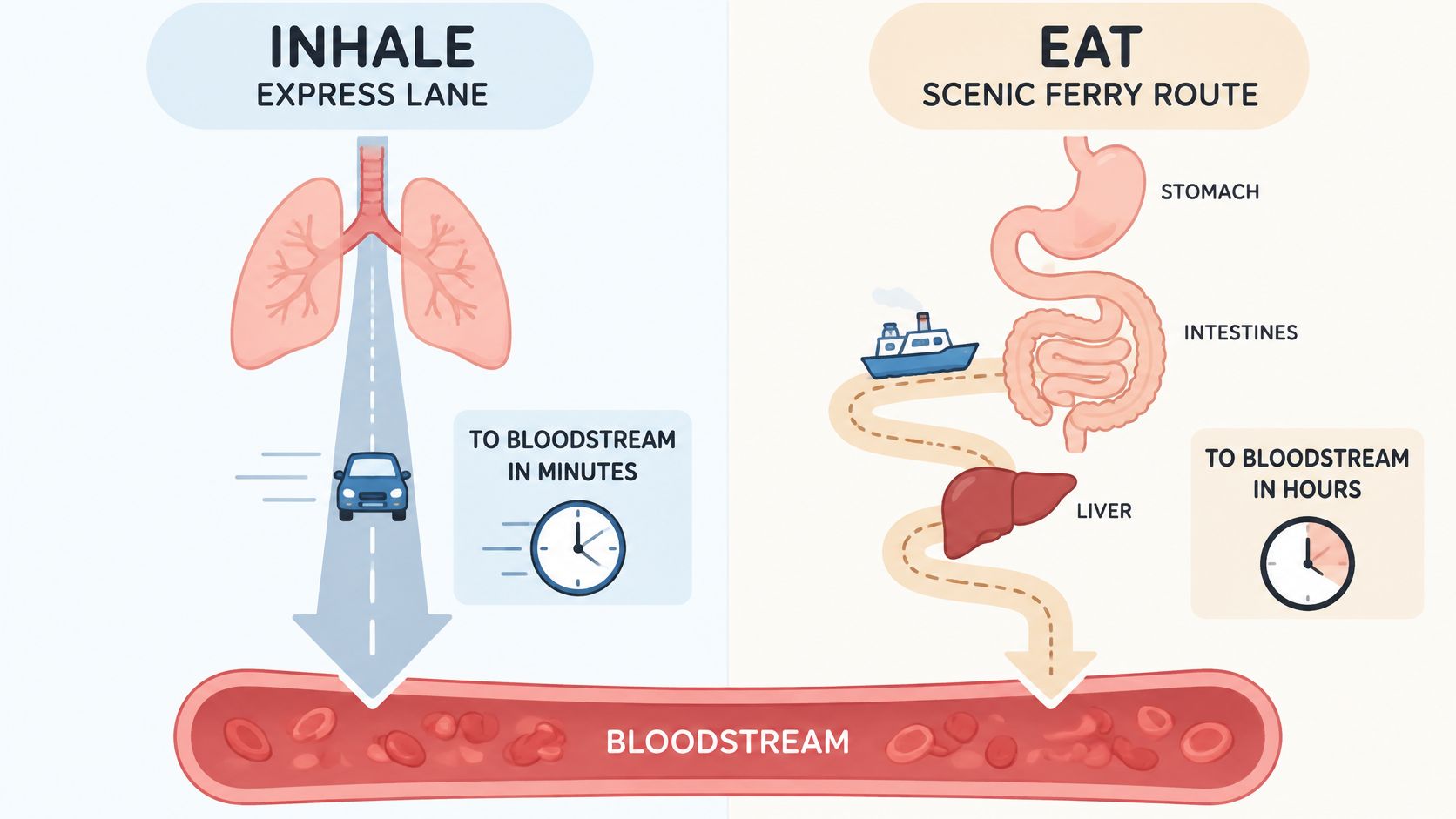
An edible must move through the gastrointestinal tract, and food in the stomach can change its absorption. The liver also converts swallowed THC into 11-hydroxy-THC, an active metabolite associated with stronger or more prolonged effects.
That means an edible isn't just smoked cannabis with a delayed start. The processing route changes the experience itself, including how gradually it builds and how long it may remain noticeable.
According to Health Canada's guidance on using cannabis products, oral effects commonly begin within 30 minutes to 2 hours, feel strongest around 2 to 4 hours, and typically last 4 to 8 hours. Acute effects can sometimes take 12 hours to subside, and the guidance supports waiting at least 4 hours before considering additional edible THC.
The delayed beginning is the trap: taking more because you don't feel much yet can turn an unfinished dose into overlapping doses.
With inhalation, an early sensation tells you THC has arrived, but it doesn't mean the full effect is already established. Repeated puffs can increase exposure while the experience is still developing.
With an edible, the absence of an early sensation tells you much less. You can't reliably distinguish a slow dose from an insufficient dose by checking how you feel soon after swallowing it.
Our comparison of edibles and smoking can help you weigh the practical differences between routes. For timing, the important choice is whether you have room for delayed feedback and a prolonged experience, not which format looks easier to consume.
Labeled milligrams are only part of the story. They describe product content, not a personalized finish time, and they don't make different routes interchangeable.
The Centers for Disease Control and Prevention warns that edible intoxication may take 30 minutes to 2 hours to appear. That delay makes it easier to consume more before the original serving has fully taken effect.
Factors that change how long a Delta-9 high lasts
| Factor | Effect on duration | What to expect in practice |
|---|---|---|
| Dose | Higher exposure can prolong intoxication | Increasing an edible serving may lengthen the experience, not just intensify it |
| Potency, including concentrates | Makes it easier to consume a large THC amount quickly | A small-looking amount isn't necessarily a small dose |
| Tolerance from regular use | Changes how strongly and how long effects are perceived | Feeling less affected doesn't establish that performance is normal |
| Food in the stomach | Changes edible absorption | A familiar serving can develop differently under different meal conditions |
| Body weight and metabolism | Contributes to individual differences in processing | Matching someone else's dose doesn't match their finish time |
| Alcohol or other medications | Can increase impairment or complicate the experience | Mixed substances make timing estimates less reliable |
| Inhalation depth and repeated puffs | Changes total exposure during a session | Several quick pulls can become a larger dose before you reassess |
| Delayed edible onset | Separates consumption from useful feedback | Early redosing can produce unexpectedly intense or prolonged effects |
Potency describes concentration. Dose describes the amount you consume. A highly concentrated product can deliver substantial THC in a small volume, so judging by the size of a puff, candy, or portion is unreliable.
The distinction matters when changing products. A serving that looks similar to your usual serving may contain a different amount of THC or a different cannabinoid blend.
Tolerance introduces another complication. A regular consumer may report a milder experience than an occasional consumer, but that subjective difference isn't a reliable test of attention, coordination, or judgment.
You can't choose your metabolism or predict your response from body weight alone. You can choose the amount you take and whether you add more while the first amount is still developing.
Keep those decisions separate. Decide on the initial serving before consuming, then establish a redosing checkpoint rather than repeatedly asking whether you feel enough.
For edibles, use the full-effect waiting rule rather than the earliest-onset estimate. A quiet beginning isn't evidence that another serving is needed. If medications are part of your routine, ask a pharmacist or clinician about interactions instead of stopping prescribed treatment or improvising around it.
Consider a hypothetical evening: two adults begin at 8 pm, one using a vape labeled with a 10 mg amount and another eating a 10 mg gummy. Those matching labels don't establish equal absorbed doses, equal intensity, or equal impairment.
The illustration below shows a possible pattern, not the expected outcome of that particular dose. In practice, inhaled delivery is especially difficult to equate with swallowed milligrams.
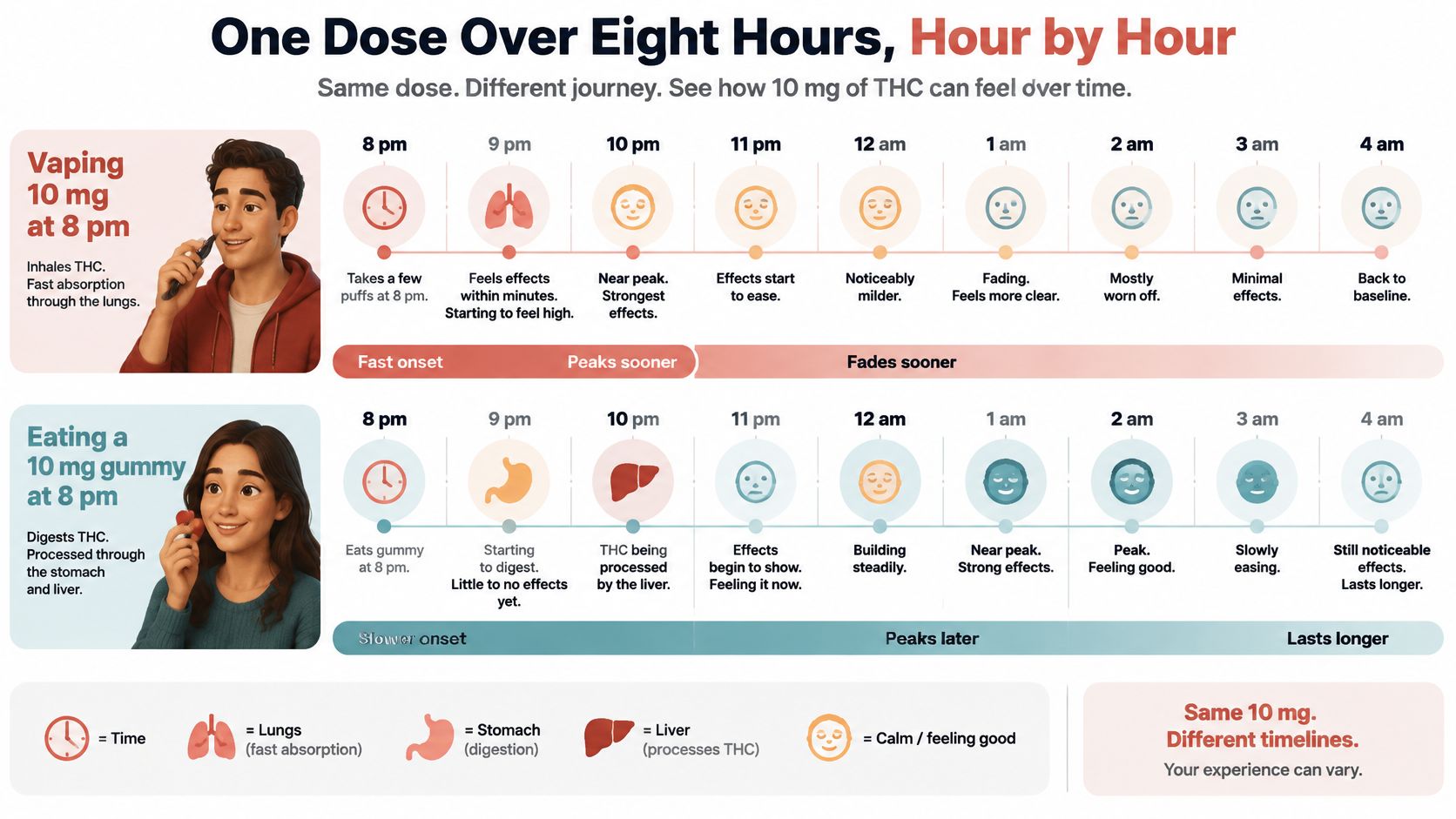
| Time in the hypothetical example | Person vaping | Person eating the gummy |
|---|---|---|
| 8 pm | Takes the initial inhalations and stops to assess | Eats the planned serving and records it |
| 9 pm | Already aware of the effects | May notice effects, or may still feel little |
| 10 pm | May feel the strongest sensations easing | Could be experiencing a continuing rise |
| 11 pm | Might feel less high, without being cleared to drive | May still be approaching the strongest effects |
| Midnight | Shouldn't use reduced intensity as proof of recovery | Shouldn't assume bedtime ends impairment |
| 1 am | Additional puffs would change the original timeline | Additional servings would complicate the original timeline |
| 2 am | Fatigue can make self-assessment harder | A prolonged experience may still be noticeable |
| 3 am | An early work shift remains a planning concern | Morning responsibilities may require backup |
| 4 am | The example ends, not necessarily every residual effect | The example ends, not necessarily the edible's effects |
The important distinction is blood concentration versus functional effect. A review of cannabis and driving performance describes inhaled THC blood concentrations peaking about 3 to 10 minutes after the final inhalation, while peak driving impairment may occur 20 to 40 minutes later.
That lag explains why a rapid blood peak isn't a recovery signal. THC moving through the body and a person regaining driving-related skills aren't interchangeable measurements.
The hypothetical evening also assumes neither person keeps consuming. A prolonged vaping session or an extra gummy changes the question from how long one dose lasts to how overlapping exposures develop.
For planning around bedtime or morning commitments, our guide to how long edibles last gives additional context. The useful takeaway isn't a promised bedtime finish; it's that identical-looking labels can produce very different evenings.
A faded high isn't proof of a clear head. You may notice less euphoria or altered perception while still having trouble dividing attention, reacting quickly, or making sound decisions.
The Colorado Department of Transportation's guidance on waiting to drive distinguishes roughly 2 to 4 hours of inhaled-cannabis impairment from at least 8 hours after edibles. It also discusses circumstances in which impairment can last more than 24 hours, so neither range establishes an individual safe-driving cutoff.
Some activities tolerate minor distraction. Driving, operating machinery, supervising a child near water, or making consequential workplace decisions don't.
The table below uses decision rules rather than safety guarantees. There's no reliable way to turn a general impairment range into a universal minimum wait for every task.
Minimum waits before activities after Delta-9 THC
| Activity | After inhaled THC | After edible THC |
|---|---|---|
| Driving or operating machinery | Don't resume while effects or uncertainty remain; arrange alternate transport | Allow a wider margin; avoid driving until the next day when effects are uncertain |
| Caring for children or other people | Wait until fully clear-headed, with a margin; arrange a sober caregiver beforehand | Wait until fully clear-headed, with a wider margin and backup for delayed effects |
| Work that needs focus or quick decisions | Postpone safety-sensitive tasks until fully recovered | Keep demanding or consequential work outside the potential residual-effect period |
| Exercise | Avoid activities requiring balance, traffic awareness, or quick reactions while affected | Account for delayed effects before leaving for an activity or isolated setting |
Safety decision: If you're unsure whether you're impaired, treat that uncertainty as a reason to postpone the activity, not a reason to test yourself doing it.
Feeling conversational, walking normally, or completing a familiar task doesn't establish that you can respond appropriately to a sudden hazard. Driving combines attention, perception, judgment, and rapid decisions in a way that a quiet room doesn't.
Falling blood-THC levels also don't reliably identify restored performance. A lab measurement answers a different question from whether you can safely manage an unexpected event.
For caregiving, plan for the person who depends on you rather than for the moment you expect to feel normal. Arrange a sober adult who can respond to an emergency without needing you to drive or make urgent decisions.
High doses, oral products, mixed substances, and lingering fog call for wider margins. The next morning is a checkpoint, not automatic clearance: if you still feel affected, don't resume safety-sensitive activities.
A useful plan records what you took, when you took it, and which responsibilities you've moved out of the way. It shouldn't depend on remembering details accurately while intoxicated.
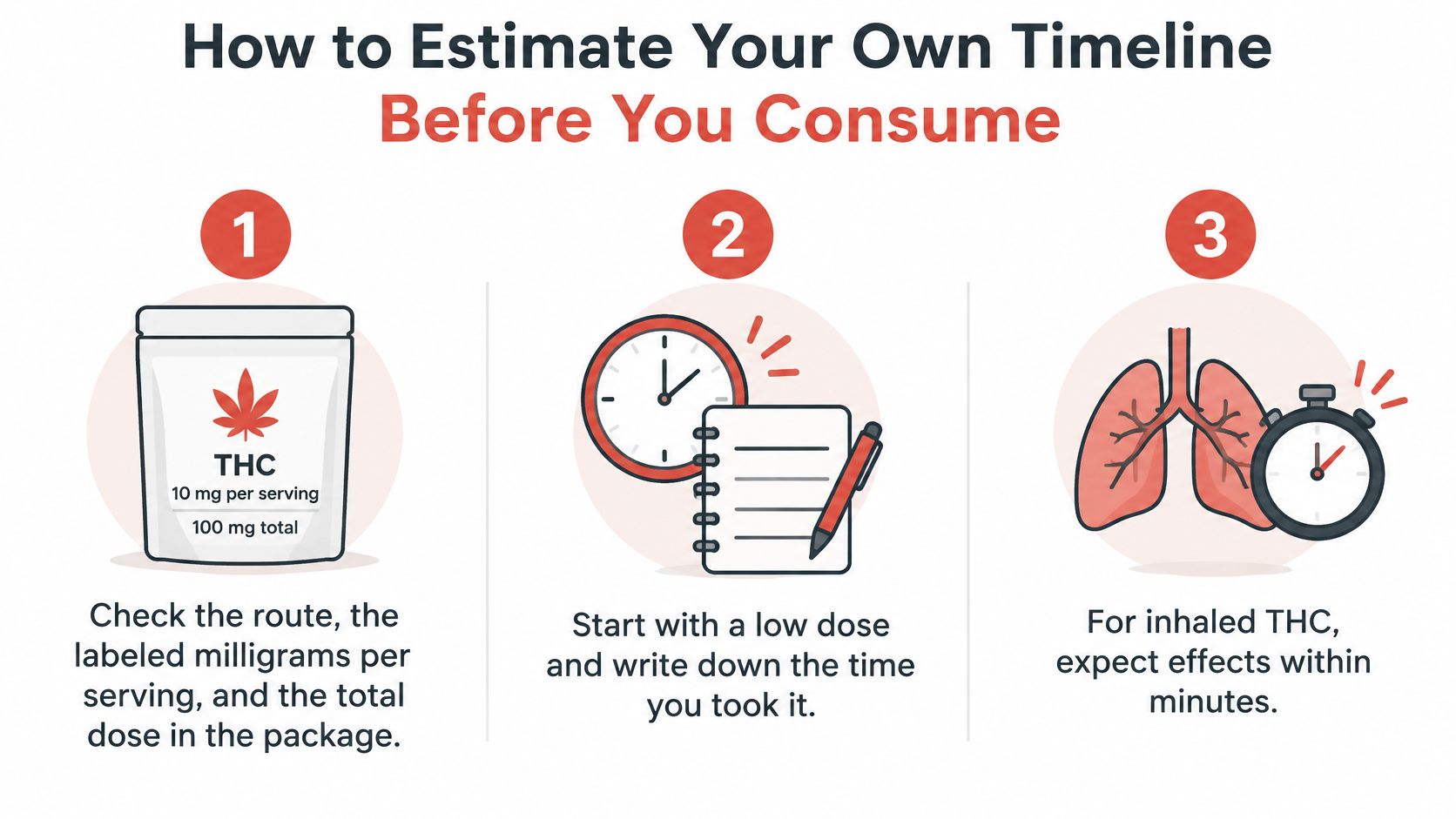
Record observations after you're fully recovered, including whether onset was slower than expected or effects carried into your next planned activity. Treat that record as information about that occasion, not proof that the same product will always behave identically.
A practical note also names your backup plan. Writing who will drive or cover a responsibility is more useful than writing that you'll decide later.
Choose the route that fits the time you can genuinely leave free. If your schedule depends on being unimpaired at an exact moment, postponing consumption is more reliable than selecting a product you hope will finish quickly.
Before buying, distinguish per-serving content, package content, and cannabinoid composition. A Delta-9-only timing guide can't establish the duration of a blended product just because Delta-9 appears on its label.
Our Melt Bites Zour Belts THC gummy belts contain 1000mg of Delta-9 + THCP and come in Pink Lemonade, Rainbow, Strawberry, and Watermelon. That combined content doesn't tell you the amount in an individual serving or predict your personal duration, so review the serving information rather than treating the headline amount as dosing guidance.
For any high-potency item, choose the longest practical margin and avoid adding another product to chase an expected onset. A product name, flavor, or familiar format doesn't replace checking what you're consuming.
Your plan needs a start time, an earliest reconsideration time, and a protected period without safety-sensitive commitments. The end of that protected period remains a reassessment point, not permission to drive.
Before consuming, put those details in your phone, alongside your planned amount and transport arrangement. Keep the note visible while effects develop so that a moment of impatience doesn't replace the decision you made while clear-headed.
Melt offers edibles and inhalable cannabis products, so route and serving information belong at the center of your shopping decision. Visit Melt to compare formats and review product details, then write your timing and transportation plan before opening a package.
Your cart is currently empty.