



Free Shipping All Orders Over $95
Yes, you can freeze gummies, and a freezer held at 0°F (-18°C) or below keeps properly handled food safe indefinitely, but the best quality target is 1 to 3 months. The catch is that safe doesn't mean unchanged: a frozen gummy can be safe to eat and still come out harder, stickier, or less pleasant to chew.
The answer to “can you freeze gummies?” is straightforward; the more useful question is whether you'll like them after they thaw. Freezing stops microorganisms from growing, but doesn't kill most of them or preserve texture and flavor as they are. Cold storage buys time, not a reset button. The U.S. Food and Drug Administration's food-storage guidance explains why indefinite safety at freezer temperature isn't the same as indefinite quality.
| Storage condition | Safety | Quality expectation |
|---|---|---|
| Continuous 0°F (-18°C), sealed | Safe indefinitely | Best within 1 to 3 months |
| Frozen past 12 months, sealed | Still safe if held at 0°F | Clumping and quality decline likely |
| Unfrozen, sealed at room temperature | Safe within labeled dates | Typical shelf life of 6 to 12 months, as reported in a cannabis-edible storage guide |
| Thawed in refrigerator, then refrozen | Generally safe if still cold | Some moisture loss and texture change |
| Thawed at room temperature | Avoid refreezing if it has warmed | Don't refreeze; discard if safety is uncertain |
Freezing makes the most sense for fresh, surplus gummies you won't use soon. It can't restore pieces already degraded by heat or humidity, or a pack that's been torn, wet, or poorly sealed. For a quick check on whether an older package is still worth keeping, see this guide to whether gummies expire.
The container matters because air and moisture can spoil the experience even while the gummies stay frozen. Air exposure dries candy and encourages freezer burn; moisture can leave the surface sticky after thawing. An open or poorly sealed package can also pick up odors from nearby foods.
| Container | Air exposure | Best for |
|---|---|---|
| Vacuum-sealed bag | Lowest | One to three months of storage |
| Rigid airtight container with tight lid | Low | Short storage and frequent access |
| Heavy zip freezer bag, air pressed out | Moderate | Everyday portions and quick freezing |
| Original child-resistant packaging | Depends on seal | Unopened packs with labels intact |
For a small batch you'll reach for often, a rigid freezer-safe container is easy to open and reseal. A heavy zip freezer bag works for everyday portions: press out as much air as you can before closing it. If you're keeping gummies for a longer stretch, vacuum sealing leaves the least air around them. Keep an unopened product in its original child-resistant packaging when the seal is intact, so the label, batch details, and dosing information stay with the gummies. For additional background on storage and freshness, visit this guide to how long weed can stay fresh.
Whatever you choose, use a moisture-resistant container and leave as little air above the gummies as possible. Store the package away from strong-smelling foods such as onions, coffee, or fish, which can affect the candy's aroma. Cannabis edibles should remain child-resistant and out of children's reach even when they're in the freezer.
These steps focus on keeping the pieces separate and limiting moisture changes. Freezing doesn't sterilize food, and microorganisms can become active again after thawing. The USDA's freezing and food-safety guidance also makes clear that food held continuously at 0°F remains safe indefinitely, while quality can decline over time.
Refreezing: A batch thawed slowly in the refrigerator can generally be refrozen once if it's still cold and firm, but expect some moisture loss and a change in texture. Don't refreeze gummies that have warmed at room temperature; discard them if you're unsure they've stayed safely cold. Products with perishable fillings or ingredients need stricter handling than ordinary shelf-stable candy.
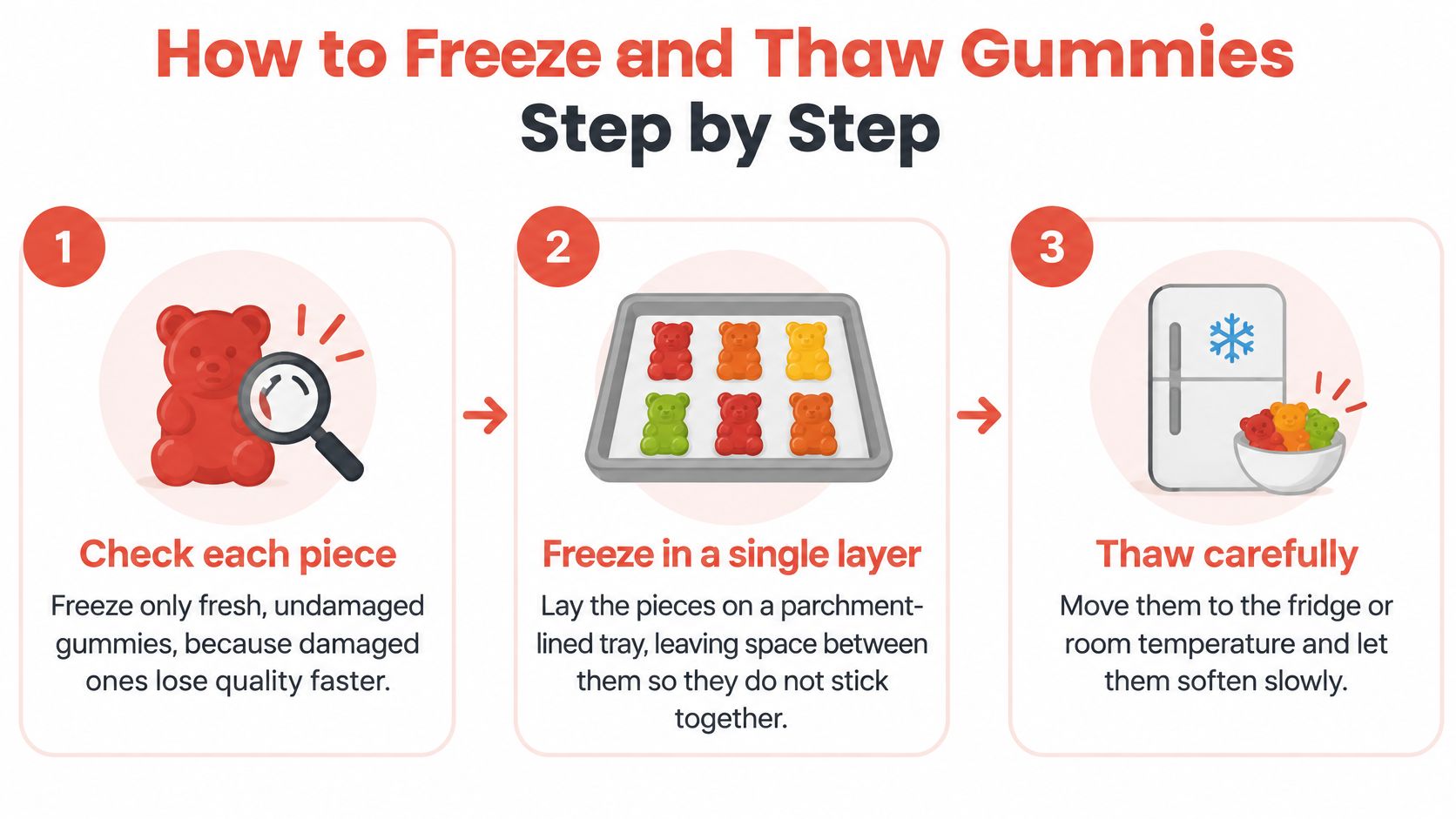
Gummies frozen into one mass usually weren't separated before they went into the bag. The fix for the next batch is to spread the pieces on a parchment-lined tray and freeze them until firm before packing. If the batch is already fused, you may be able to separate the pieces after they've softened slightly in the refrigerator, but the texture may not return to its original state.
| Symptom | Likely cause | Fix |
|---|---|---|
| Gummies fused into one mass | Frozen in a pile without pre-freezing | Pre-freeze in a single layer next time |
| Wet or sticky surface | Condensation from opening a cold package | Thaw sealed in the refrigerator |
| Harder or chewier texture | Ice crystals and moisture migration | Use within 1 to 3 months; this change can't be reversed |
| Dry, freezer-burned edges | Air left in the bag | Vacuum-seal or press out as much air as possible |
| Off smell | Poor packaging or strong odors nearby | Discard if the smell is off; repackage the next batch |
| Torn, swollen, or moldy package | Compromised seal or contamination | Discard the batch |
A wet or sticky surface often means the cold package was opened before the gummies had time to warm gradually. Keep the package sealed while it thaws in the refrigerator; opening it immediately lets moisture from warmer air settle on the candy. The FDA's guidance on refrigerator temperatures and food safety recommends refrigerator thawing for perishable foods and notes that refreezing after refrigerator thawing can be safe, though it may reduce quality.
Harder or chewier gummies usually reflect changes in the candy's gel and moisture, not a problem you can fix after thawing. Use frozen batches within the quality window and portion future batches so you don't have to thaw and refreeze the same package repeatedly. Dry, freezer-burned edges point to too much air in the container, so reduce air exposure next time rather than refreezing the damaged pieces.
Discard gummies if the package is wet, swollen, or torn, or if you find mold or notice an off smell. Appearance and texture alone can't confirm that food is safe. Don't eat questionable gummies just because they've been frozen.
Colder doesn't automatically mean better for cannabis gummies. Freezer guidance for ordinary candy can help with food storage, but it doesn't prove that freezing preserves cannabinoids or potency. The Utah State University Extension guide to freezing foods explains that freezing can protect food quality when packaging and temperature are controlled, but it can't establish how a specific cannabinoid product will perform. Follow the manufacturer's storage instructions and any product-specific testing instead of assuming a freezer extends potency.
Keep the original label and batch packaging with the gummies, so you can identify the product and follow its serving information after it's frozen. Don't cut or divide gummies from a high-potency bag unless you know the dose in each piece; freezing doesn't make an uncertain portion easier to measure. For more on serving amounts, use this guide to how to dose edibles.
The freezer also doesn't replace child-resistant storage. Keep the package sealed and out of children's reach, and retain the label rather than transferring gummies into an unmarked container. Hemp-derived cannabinoid products can be subject to state and local rules, so check the rules where you live and don't carry frozen edibles across state lines without confirming what's allowed.
Don't use freezing to compensate for poor storage, an opened product kept too long, or a package that's already compromised. It slows some changes; it doesn't undo them.
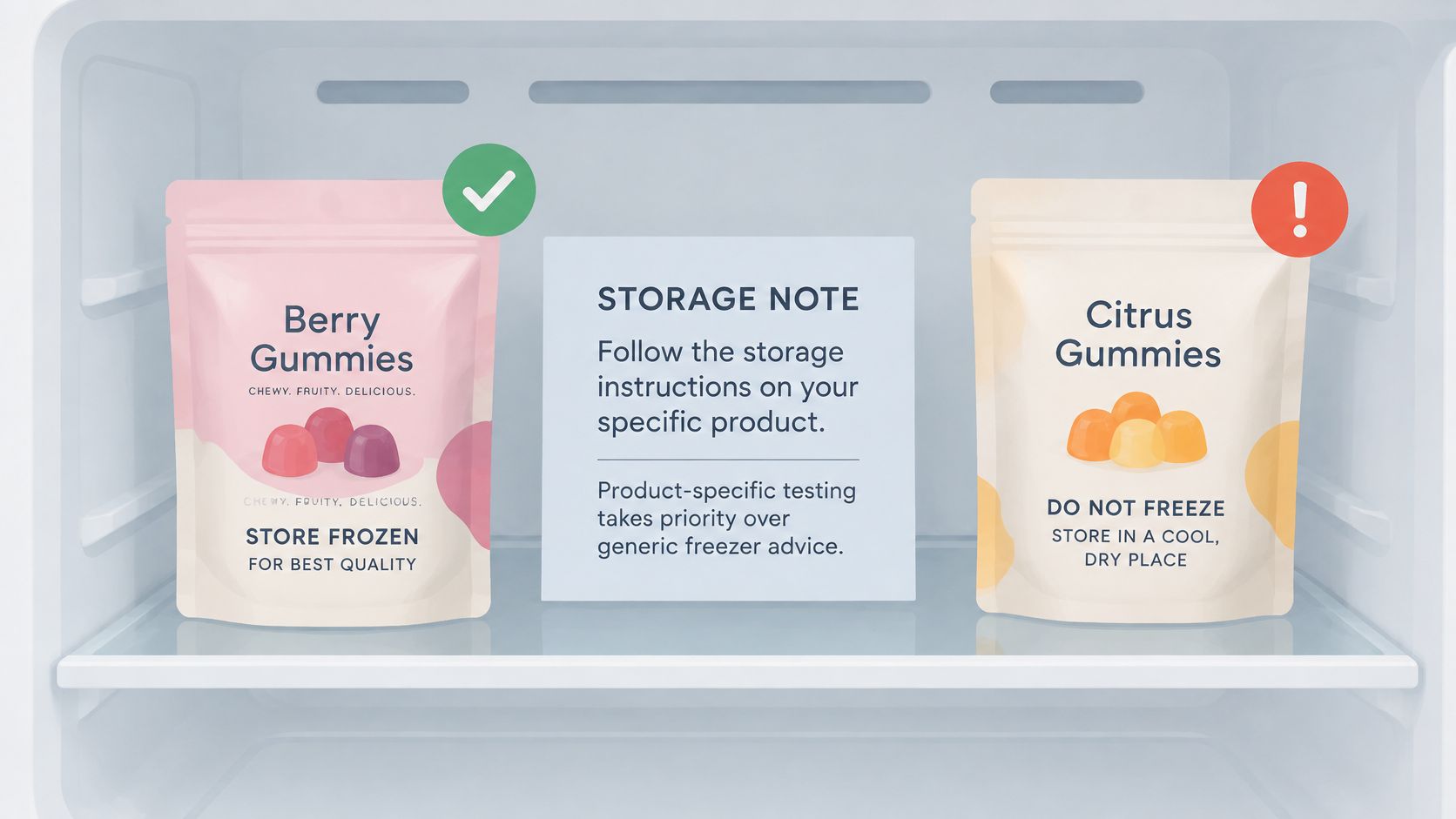
Use this go-or-no-go check before putting a batch away:
Freeze the batch only if each answer is yes. If not, keep it sealed in a cool, dry place and follow the product's label. Skip anything past its date or already wet, torn, or visibly abnormal; freezing can't restore it.
Before storing, write the product name and freeze date on the package and set a reminder to use it within the quality window. For bulk cannabis edibles, divide the gummies into smaller sealed portions and keep the original label with them. Follow the product's own storage instructions first.
Melt offers Melt Bites sour THC gummies in 1000mg bags, including Watermelon Sour and Sour Gummy Worms THC Crawlers. If you're choosing gummies to store, visit Melt to explore the lineup and keep the product's storage and serving directions with your package.
Your cart is currently empty.