



Free Shipping All Orders Over $95
You're halfway through ordering a tincture online when one question interrupts the checkout: does the label match what's in the bottle? The product page may promise a precise cannabinoid amount and a clean formulation, but a polished description isn't the same as evidence. A lab report online gives you a way to inspect the specific product instead of taking the marketing claim on faith.
That report is usually called a Certificate of Analysis, or COA. The useful question isn't only whether a brand posts one. It's whether the document belongs to the exact batch you're buying, comes from an identifiable independent laboratory, includes the relevant safety panels, and is recent enough to describe that product.
A product page can tell you that a tincture contains CBD, that a vape uses a particular strain profile, or that an edible has a stated potency. Before you buy, a batch-specific COA lets you ask a more useful question: what did a laboratory find in this particular item or lot?
Cannabis and hemp lab reports commonly contain potency, terpene, and safety-testing information. Public COA libraries explain that these documents show what's in a cannabis product and help organize reports that brands and dispensaries publish across many websites. The value is practical. Instead of treating a product page as the final word, you can examine the paperwork behind it through resources such as OpenCOA's public lab-report repository.
Three buyer concerns make that habit worthwhile:
Practical rule: Treat the product label as a claim and the matching COA as the supporting evidence.
New York's regulated cannabis guidance illustrates how this evidence is moving closer to the point of purchase. Licensed dispensary products must include a label with a link or QR code leading directly to the product's Certificate of Analysis, or to a website where the report can be found. The New York cannabis lab-report guidance describes the COA as a way for shoppers to review required testing results for the specific product.
You don't need to become a chemist. You need a repeatable check that protects your health, money, and confidence each time you shop.
Think of a COA as a vehicle inspection record for a finished cannabis or hemp product. An inspection sticker doesn't prove that every car of the same model is safe forever. It records which vehicle was checked, what the inspector examined, and when the inspection occurred. A COA works in a similar way, except the object being checked is a defined product sample from a production batch.
A laboratory receives a sample, performs specified analyses, and reports the findings. The document should identify the product and connect the results to a batch, lot, or sample identifier. That connection is the foundation of trust. Without it, the numbers may describe a related product, an older run, or a generic formulation rather than the package in front of you.
The seller does not just write down its own measurements and call them laboratory results. A credible process uses an identifiable testing laboratory, records the sample information, and presents the laboratory's findings and sign-off. The sample also needs a clear path from the production lot to the lab, because uncertainty during handling weakens the connection between the reported result and the product you're buying.
The plain-language explanation of a Certificate of Analysis is useful for shoppers who want to understand the document before opening a PDF. Look for the lab identity, product description, sample details, test date, methods or panels, results, and approval information.
Regulatory requirements can sound like paperwork, but they exist for a buyer-facing reason. Testing rules may require laboratories to examine both the product's intended compounds and substances that could affect safety. A report therefore serves two audiences at once. Businesses use it for traceability and regulatory review, while consumers use it to check whether the product's claims and safety information are supported.
A COA is not a permanent guarantee. It describes the submitted sample under the stated testing conditions. That's why the specific product identity, batch number, and date matter more than a decorative “lab tested” badge.
A COA becomes easier to read when you stop treating it as one dense page and instead scan it as a set of buyer questions. First ask, “Which product is this?” Then ask, “What compounds did the lab measure?” Finally ask, “What safety checks did the sample pass?”
The header typically anchors the report with details such as the product name, batch or lot number, laboratory name, sample information, and test date. If the package says one batch number and the PDF says another, pause before interpreting any result. A perfect potency figure from the wrong lot is still the wrong evidence.
| COA section | What it tests for | What it protects you against |
|---|---|---|
| Cannabinoid profile | THC, THCa, CBD, CBDa, CBN, and other measured cannabinoids | Misunderstanding potency or the product's cannabinoid composition |
| Terpene profile | Terpenes associated with the sample | Confusing a strain or flavor description with the chemistry actually measured |
| Residual solvents | Solvents that may remain after extraction, including compounds such as butane, hexane, heptane, and BTX | Exposure to unwanted extraction residues |
| Pesticide screen | Specified agricultural chemicals | Buying a product with undisclosed pesticide contamination |
| Heavy-metal screen | Metals such as lead and arsenic | Exposure to contaminants that can enter plant material or processing streams |
| Microbial panel | Microorganisms, including E. coli, Salmonella, yeast, and mold | Consuming material with potentially unsafe microbial contamination |
The AOCS overview of cannabis testing explains why these panels matter operationally. It notes that jurisdictions may require testing for cannabinoids, terpenes, residual solvents, pesticides, heavy metals, and microorganisms, and uses Colorado requirements as an example.
A panel may show numerical results, a reporting limit, and a pass or fail status. ND, or “not detected,” doesn't mean the laboratory proved absolute zero. It means the substance wasn't detected at or above the method's stated detection capability. The limit of detection helps you understand what a result can and can't establish.
At the bottom, look for analyst approval, a laboratory director, a signature, or another form of authorization. The exact presentation varies, but the report should make clear who issued the work. Potency without safety testing, or results without an accountable laboratory identity, leaves important parts of the trust chain unverified.
A report can look official and still be unhelpful. Use this five-step flow before you rely on it.
Start with the QR code on the label or product page when one is available. New York's consumer-facing approach requires the code to lead to the report itself or to a website where the report can be found, rather than leaving shoppers to search blindly. If a brand offers a general “lab results” folder, keep going until you find the document tied to the item you're considering.
Compare the product name, form, flavor or strain description, and serving information. A flower COA shouldn't be used to support an edible, and a report for one formulation shouldn't automatically support another. Similar packaging and shared product names make this check easy to skip.
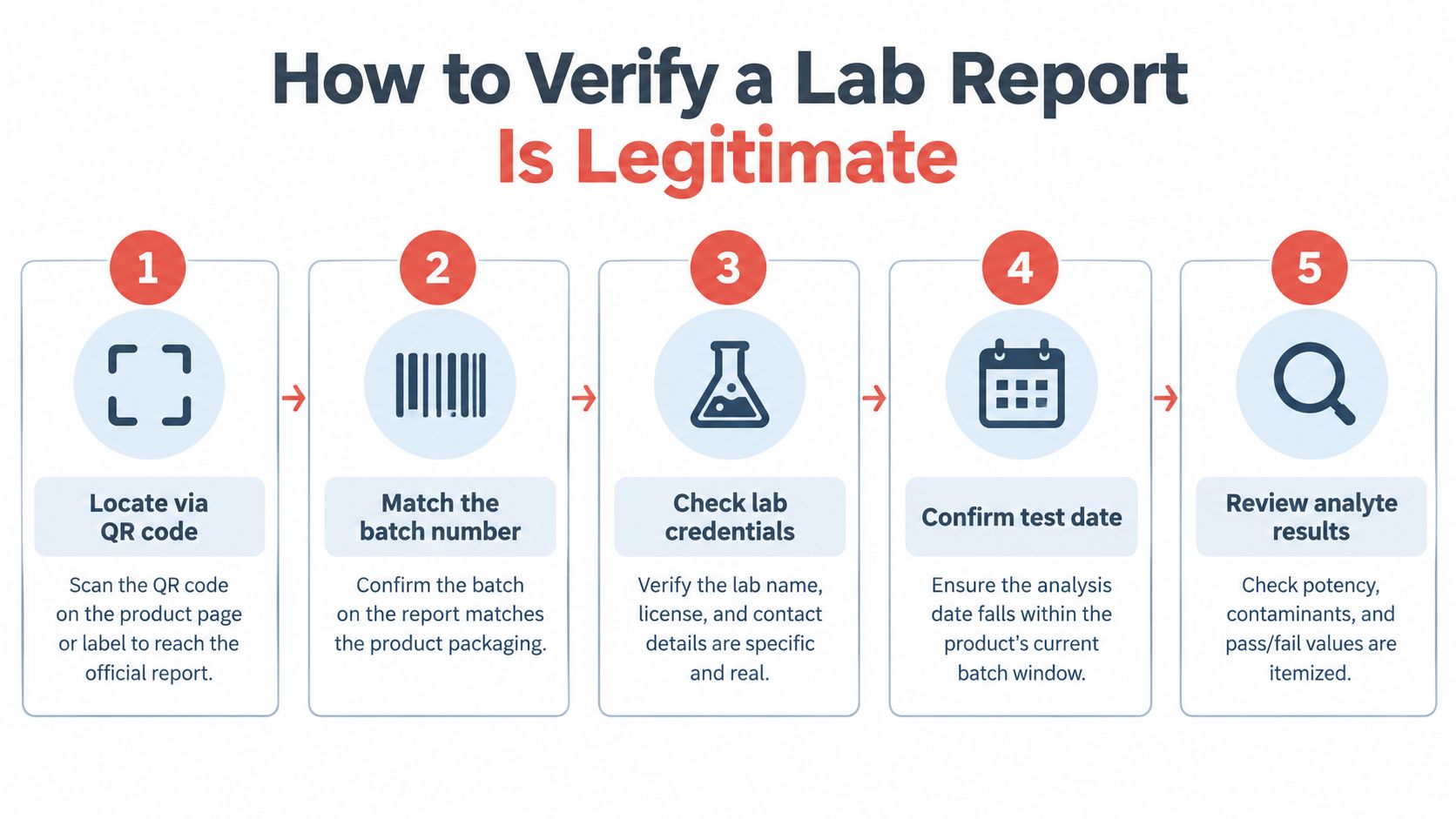
Find the batch or lot identifier printed on the package, then locate the same identifier on the COA. Don't accept a report merely because the brand name matches. The guidance on good lab reports emphasizes the practical details shoppers need, including the batch number and the report's connection to a specific product.
Record the laboratory's full name, address, contact details, accreditation information, and any license or certificate identifier shown on the document. An independent laboratory should be distinguishable from the seller. If the report names only “third-party lab” without a verifiable identity, you can't meaningfully assess who performed the work.
Compare the manufacturing or packaging information with the sample and analysis dates. The report should make sense for the current batch, not merely represent an old document recycled onto a newer product. Then check that the report itemizes the panels relevant to the product, including potency and applicable contaminant tests.
Save this short checklist to your phone:
A fictional 1000 mg CBD tincture in a 30 mL bottle makes the arithmetic easier to see. Suppose the label presents a serving as 1 mL, and the cannabinoid panel reports 33 mg of CBD per serving and 33.3 mg per mL. Those figures are close enough to help the shopper understand that the laboratory measured a concentration broadly consistent with the front-of-package claim. The COA still matters because it shows the measured result, not just the advertised target.
| Test panel | Sample result | What it means for you |
|---|---|---|
| CBD | 33 mg per serving | The measured amount supports the stated serving potency |
| CBD concentration | 33.3 mg per mL | You can estimate the active amount in each measured milliliter |
| Total THC | Reported on the cannabinoid panel | Helps you assess whether THC is present and how the report expresses it |
| Terpenes | Itemized percentages or compounds | Offers chemistry-based flavor and profile clues, not a guaranteed effect |
| Heavy metals | Pass | The sample met the laboratory's stated limits for that panel |
| Pesticides | Pass | The tested pesticide screen did not exceed the applicable limits |
| Microbials | Pass | The sample met the stated microbial criteria |
| Residual solvents | Pass or ND, depending on the report | Shows whether tested extraction residues were detected within the report's limits |
Total CBD usually represents the report's calculated or measured CBD content across the relevant forms. Total THC helps you understand the amount of THC represented by the testing method, which matters if you're avoiding psychoactive cannabinoids or are concerned about drug testing. A “not detected” result means the laboratory didn't detect the compound at or above its stated reporting capability, not that every possible test would find absolute zero.
Terpenes deserve a lighter touch. A terpene panel can help explain flavor and aroma differences between products, but it shouldn't be treated as a promise of a particular experience. Chemistry can inform your choice without predicting exactly how your body will respond.
To compare prices, divide the product price by the total milligrams of the active cannabinoid named on the label. For this fictional bottle, the stated total is 1000 mg, so the calculation is:
Product price ÷ 1000 = cost per milligram of CBD
That comparison becomes meaningful only when the reported potency, package size, and batch identity line up. For a deeper explanation of labels, potency fields, and result terminology, consult this guide to understanding lab-test results.
A PDF can look polished and still fail the basic identity test. The most important warning sign is a broken link between the report and the item you're holding.
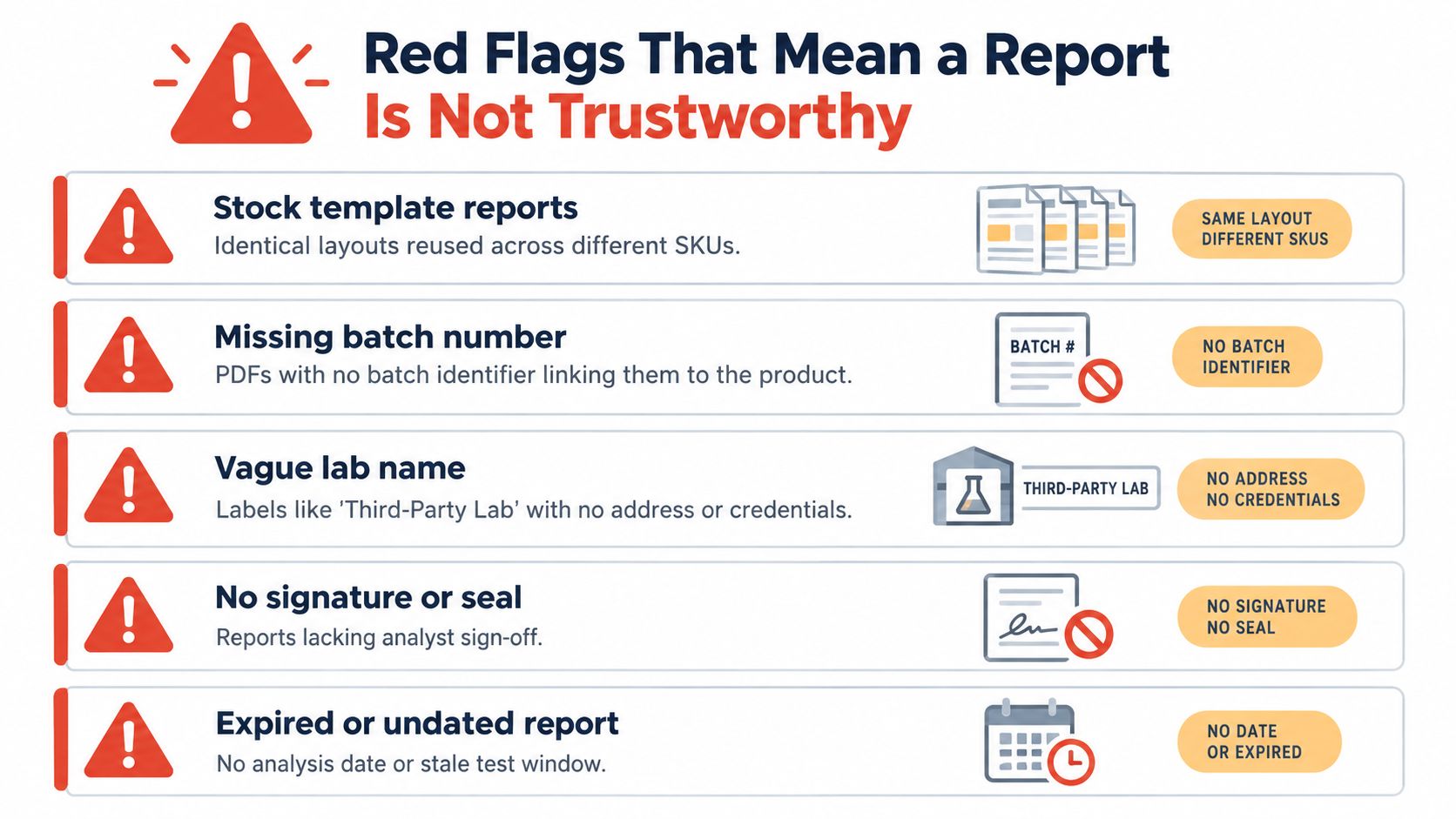
Watch for these problems:
A cannabinoid result marked “pass” also doesn't automatically prove that the product passed every relevant safety check. Scroll through the document and look for separate pesticide, heavy-metal, residual-solvent, and microbial panels. If those sections are missing, the report answers only part of your question.
Blurry screenshots create another obstacle. If you can't read the batch number, test date, units, or detection limits, you can't verify the claims. A report hosted on a brand's website isn't automatically invalid, but the document should still identify the issuing lab clearly enough for you to assess it independently.
A lab report earns trust through connected details, not through a logo or the word “passed.”
Melt's published approach follows the same trust chain a careful buyer can use with any cannabis or hemp brand. Each product is matched to a batch-specific Certificate of Analysis, and the report is made available through the product and lab-report experience so shoppers can compare the package information with the laboratory document before buying.
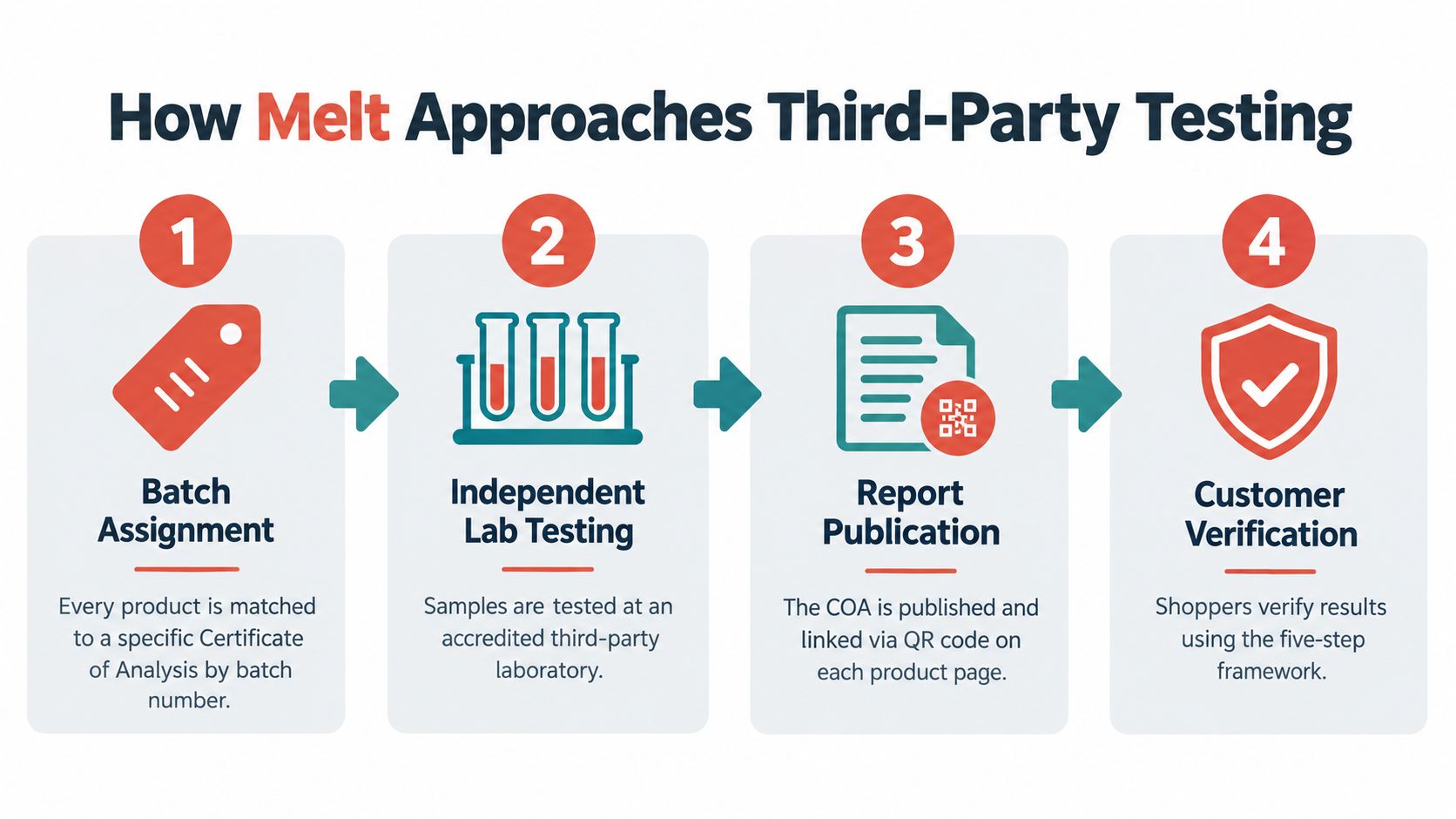
That structure matters because it gives the buyer several points to check:
Publishing the cannabinoid and safety information together is more useful than displaying only a flattering potency figure. A complete document gives shoppers room to ask whether the report includes pesticides, heavy metals, microorganisms, and other relevant analytes, not just whether the product contains the advertised cannabinoid.
That's the broader lesson. Transparency isn't a one-time badge. It's a repeatable process that keeps the product, batch, laboratory, date, and results connected. Melt offers online access to batch-level lab reports for its hemp-derived cannabinoid products, so adult shoppers can apply the verification questions covered here before ordering.
Visit Melt to browse its hemp-derived cannabinoid products and review the available batch-specific lab information before you buy. Use the product page and COA together, then check the batch, laboratory, date, potency, and safety panels as part of your normal shopping routine.
Your cart is currently empty.