



Free Shipping All Orders Over $95
The most common advice about the Sun Rock strain is to look for a particular effect or potency. That advice starts in the wrong place. “Sun Rock” often names an infused product format, not a single cultivar, so the label alone can't tell you what's in the bud, how strong a batch is, or how it might feel.
Start by identifying the product: is it flower coated with concentrate and kief, a seed seller's named cultivar, or a retailer's product name? Then check the batch label and certificate of analysis (COA). Those details offer a much more reliable guide than the name on the jar.
In many listings, Sun Rock describes an infused format: a flower bud coated with cannabis oil or concentrate and then covered in kief. Its chemistry depends on the flower and other ingredients used, so the name doesn't establish a fixed genetic lineage or profile. Other listings use “Sun Rock” for an indica-dominant hybrid associated with OG Kush genetics, while retailers may use it as the name of a particular product or batch.
Think of the name like “club sandwich” on a menu. It tells you the style, not the bread or the filling. You still need the ingredient list to know what you're getting.
| Meaning | What Defines It | First Check |
|---|---|---|
| Infused sunrock format | Flower coated with oil or concentrate, then kief | Base flower cultivar and extract source |
| Named indica-dominant hybrid | Seed-listing cultivar with OG Kush lineage | Breeder listing and terpene panel |
| Retail product name | One brand's batch of flower or infused product | Batch certificate of analysis |
The distinction isn't just about wording. A product made from flower, concentrate, and kief can have a different profile from a cultivar sold under the same name. Some retailers also list Sun Rock and Moon Rock flower together under one name, so confirm which product the listing describes before interpreting its figures.
Identify which meaning applies first. Until you know whether you're looking at a cultivar, an infused format, or a retail product name, claims about effects, potency, or flavor are hard to assess.
An infused sunrock can combine materials from more than one cultivar. The Cannabis Training University's overview of sunrocks describes the format as flower coated with oil or concentrate and covered with kief, and notes that it isn't a single strain with fixed genetics.
The assembly process shows why a name alone can't guarantee a particular profile:
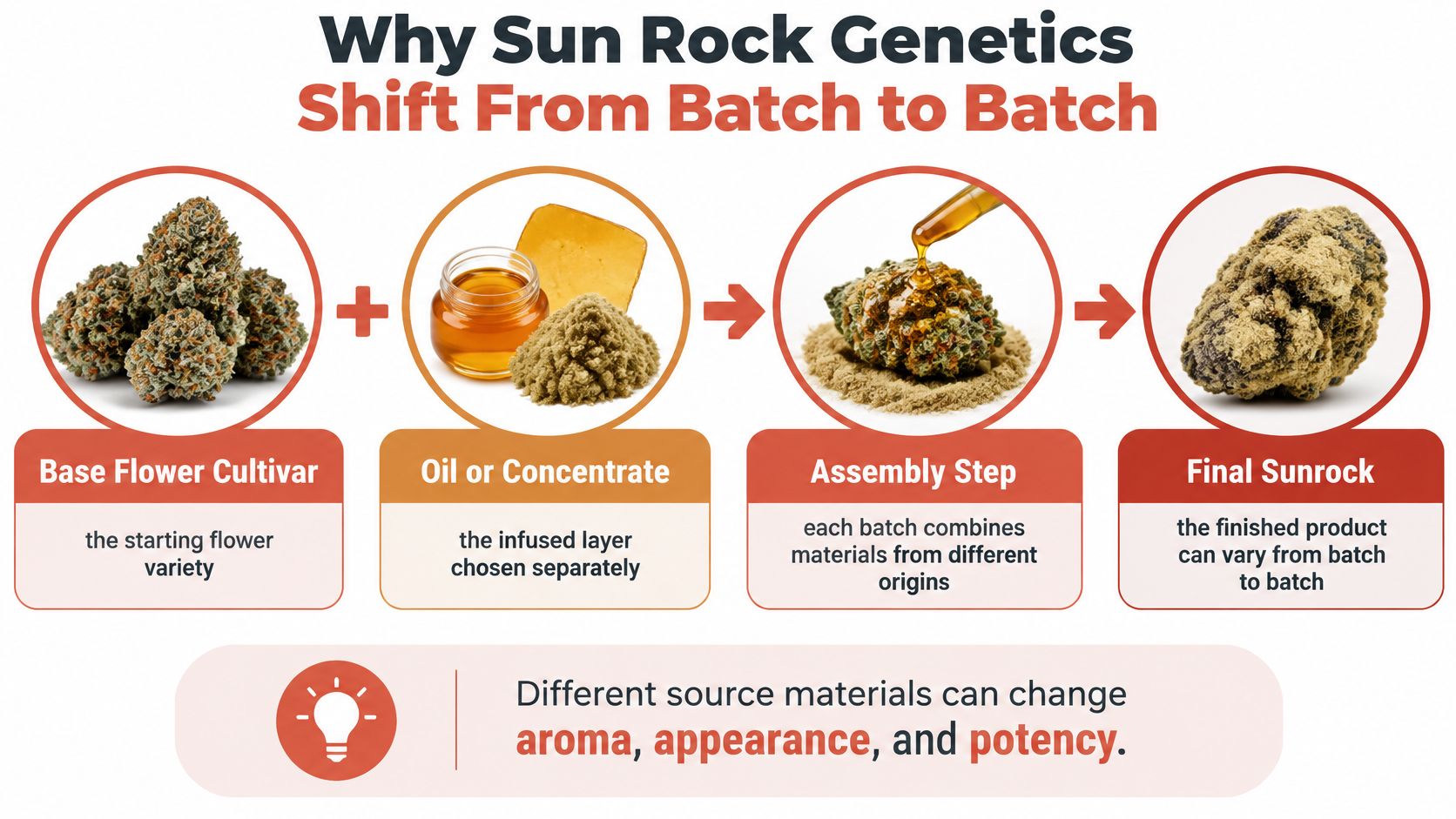
For example, a flower from one cultivar coated with concentrate from another may carry aromas from both. Adding kief from yet another source can shift the overall profile again. Two batches sold as Sun Rock may therefore differ in lineage, aroma, and cannabinoid content.
OG Kush is often associated with sunrock-style products because of its resin production and myrcene-forward profile. That association doesn't prove that every Sun Rock product contains OG Kush genetics.
Ask before buying: Which cultivar is the base flower, what extract was used, and what does the finished batch test show?
Lineage on a Sun Rock label is usually a hint about ingredients, not a fixed genetic ID. The finished batch can carry flower, concentrate, and kief from different sources, so the certificate of analysis and terpene panel matter more than the name on the jar.
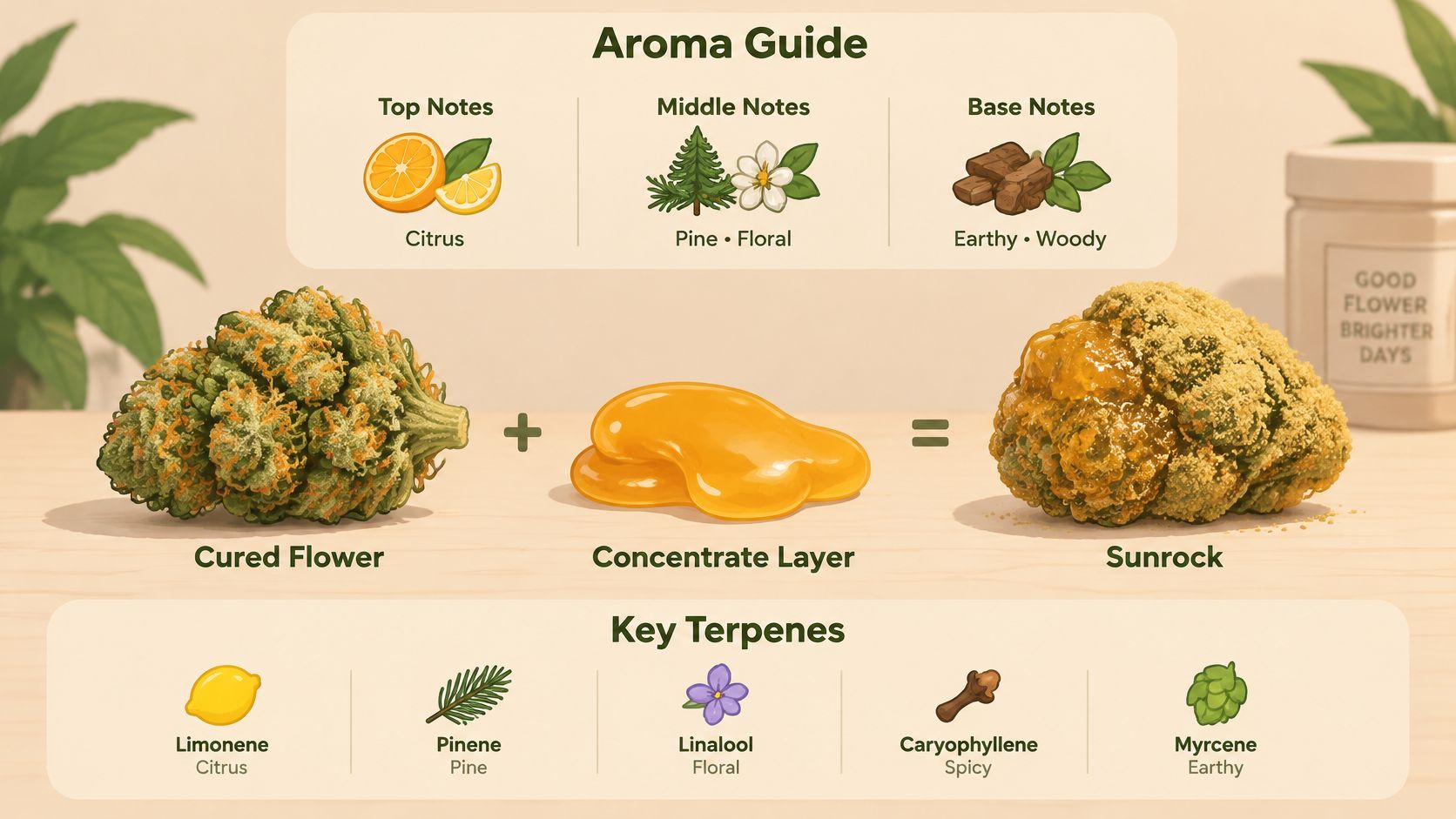
| Terpene | Aroma | Where It Tends to Appear | Evidence Level |
|---|---|---|---|
| Myrcene | Earthy, musky, herbal | OG Kush-associated products | Mostly preclinical |
| Limonene | Citrus, lemon peel | Citrus-leaning batches | Mostly preclinical, limited human data |
| Beta-caryophyllene | Peppery, woody | Spicy or woody batches | Mostly preclinical |
| Alpha-pinene | Pine, fresh | Pine-forward batches | Mostly preclinical |
| Linalool | Floral, lavender | Floral-leaning batches | Limited human data |
Terpene research is strongest at the aroma and chemistry level. Claims about calm, sleep, appetite, or anxiety relief are less settled, especially for a specific infused batch. Read a limonene-heavy result as a citrus clue, not a promised effect.
A terpene panel is most useful when you compare the order of abundance, not only whether a terpene appears. Start with total terpene content, often listed as a percentage by weight, then check the three most abundant terpenes. If myrcene leads, expect an earthier first impression; if pinene or limonene leads, the nose may read brighter or sharper. For label-reading basics, this guide to strain-specific terpenes explains how those panels are usually organized.
A label such as Dadirri Strawberry Pine may point toward fruit and pine, but treat it as a cue to verify against the batch panel. OG Kush-associated products may lean myrcene-forward, with earthy or musky aromas, yet the tested batch is still the better evidence. When two jars share a Sun Rock name, the COA is what tells you whether they smell alike or merely share packaging.
This video offers another visual introduction to sunrocks and their components.
Ask three sellers how much THC Sun Rock contains and you may get three very different answers. All of them can be accurate at once, because the name can refer to ordinary dried flower or to an infused composite of flower, oil, and kief. Comparing the two formats as one category is what produces the confusion, and a batch-level lab report is the only thing that settles it.
| Source Type | Reported THC | Format and Notes |
|---|---|---|
| Named cultivar seed listings | Well below infused products | Dried flower sold under a strain name |
| Seed company estimate, 2024 | 50–80% or more | Depends on production method |
| Infused 1 g product, 2026 listing | 67.65% | Listed at $19.72 before tax |
The 2024 Blimburn Seeds article states that infused sunrocks commonly contain 50–80% or more THC, depending on production method. That estimate applies to the infused format, and the gap makes sense once you see the recipe. A sunrock starts as flower, then gets coated in concentrate and rolled in kief, and each added layer is far richer in cannabinoids than the bud underneath. Each coating acts like a distillation step: the same starting material ends up far more concentrated.
A COA may report THCA and delta-9 THC separately, along with a calculated total THC value. Total THC estimates the potential THC after heating, accounting for the conversion of THCA using the standard factor of 0.877. A batch showing 80% THCA and 2% delta-9 THC would carry a calculated total near 72%, even though the paperwork lists three different numbers. The certificate's own labels and calculation notes tell you which figure a package borrowed.
When two listings disagree, resist the urge to average them or trust the bigger number. Match the format first, then the batch number, then the lab that produced the report. A guide to reading a certificate of analysis walks through the listed results line by line.
Every percentage is a claim about a specific batch and format, never a permanent feature of the Sun Rock name. The only reliable anchor is the current batch COA, with its cannabinoid results, testing lab, and date in one document.
Reported experiences with high-potency sunrock products can include body heaviness, relaxation, or euphoria. Some people may instead feel overstimulated or anxious, especially when they take more THC than they can comfortably handle. The name doesn't predict which experience you'll have.
| Method | Onset | Duration | Starting Approach |
|---|---|---|---|
| Smoke or vape | 1–5 minutes | 1–3 hours | One small puff, then wait 10–15 minutes |
| Edible or infused gummy | 30 minutes–2 hours | 4–8 hours | One low serving, then wait at least 2 hours |
| Tincture under the tongue | 15–45 minutes | 2–4 hours | Small measured dose, then wait 1 hour |
These are general guide ranges, not promises. Product strength, the way you consume it, your tolerance, and whether you've eaten can all affect how quickly you notice a change and how long it lasts. Edibles deserve extra caution because they may take longer to take effect, which can tempt someone to take more before the first serving has fully registered.
The Holland Club's Sunrock listing and product discussion highlights the wide range of products and the need to think about dose, delayed impairment, and anxiety risk, rather than treating the name or an “indica” label as a reliable predictor. Two products with the same THC percentage can feel different because their terpene balance, CBD content, route of use, and the person's tolerance aren't necessarily the same.
Terpene-related claims about sleep or calm remain uncertain for people. Most supporting research is preclinical, so don't rely on a terpene name to prevent anxiety or sedation. The limited human finding about limonene isn't a promise that a particular product will reduce anxiety for you.
Take extra care if you're under 21, pregnant or breastfeeding, have a heart condition, have a history of psychosis or severe anxiety, or take sedating medication. Don't drive or operate machinery after using cannabis, and avoid combining it with alcohol or other intoxicating substances. If you feel unwell, stop using the product and seek help if symptoms are severe or don't improve.
Federal hemp rules set a limit of 0.3% delta-9 THC on a dry-weight basis, but many infused or high-THC products exceed that threshold. The legal status of a product can depend on where you live, the product's ingredients, and how local rules treat hemp-derived or cannabis products. Don't assume that a listing available online is legal to buy or possess in your location.
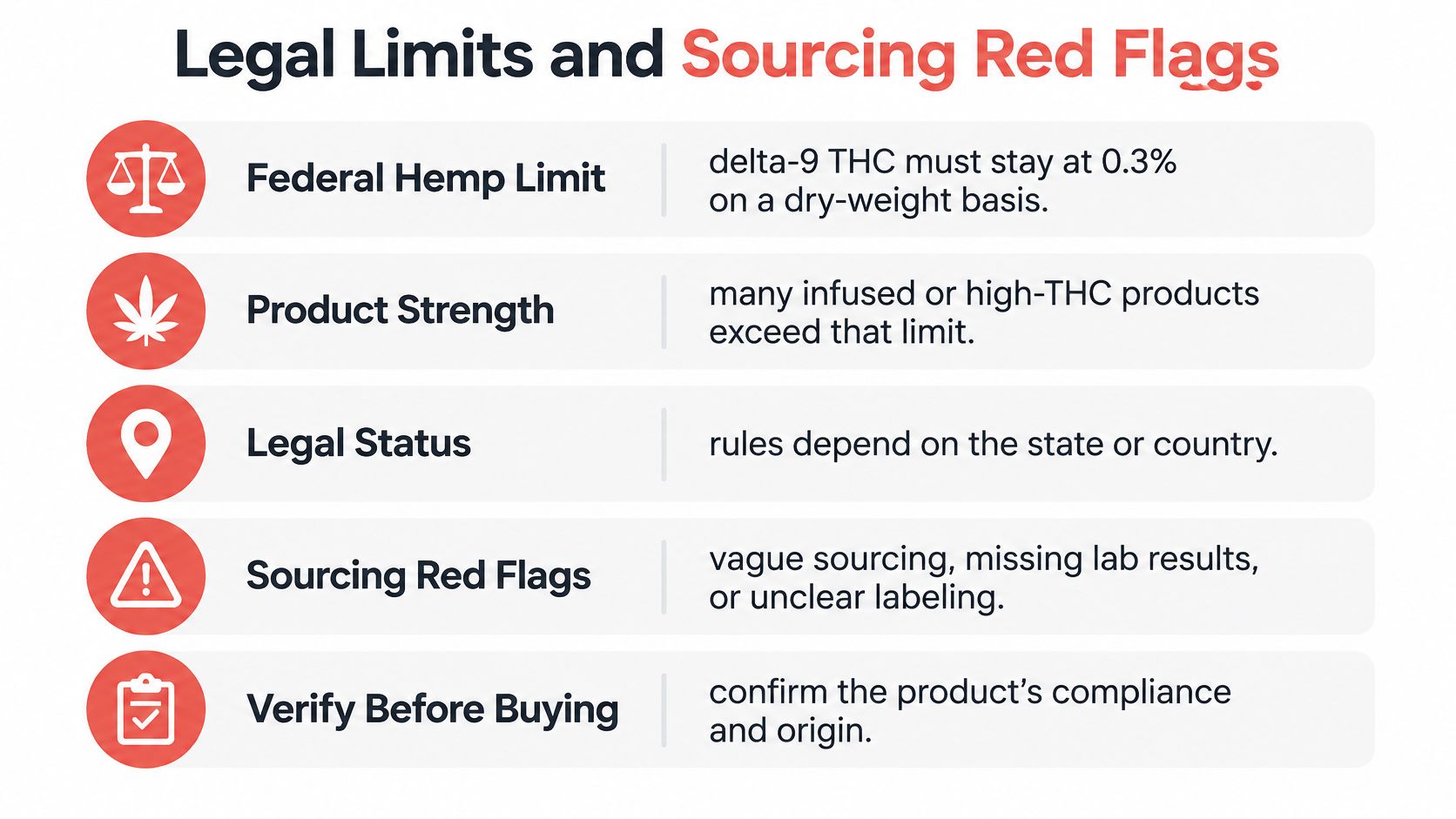
Before buying, check for basic product information. Missing details make it harder to verify the contents, and a dramatic potency claim without lab support is a reason to pause.
A concrete listing can help show what to compare. In 2026, TrenchTown Cannabis listed a 1-gram Dadirri Strawberry Pine Sun Rock product at $19.72 before tax, with 67.65% THC. Use that as a product-specific example, not as a standard price or potency benchmark. Check whether the certificate matches the listed product and batch, then review the results and any stated contaminant testing.
Rules and shipping restrictions can change by location, so check local cannabis laws before buying or travelling with a product. Age requirements and restrictions on shipping THCA products also differ. Confirm a seller's age checks, lab-report access, and shipping policies on its site, and verify that the product is permitted where you are.
Choose by the experience and level of control you want, not by the name on the jar.
Claims about relaxation, energy, or sleep are possibilities, not guarantees. Two batches sold under the same name may have different ingredients and may feel different, so choose based on the product's actual label and your own comfort level.
Before buying, confirm that the batch COA identifies total THC, THCA, a terpene panel, and contaminant results. Then begin with the lowest serving that makes sense for the product and record how it feels. That single habit gives you better information than the Sun Rock name can.
Melt offers curated hemp-derived products, including THCA flower, prerolls, disposables, and edibles, with an emphasis on strain-specific terpene profiles and transparent lab reports. If you're comparing batch information before you buy, visit Melt to explore its product details and educational resources.
Your cart is currently empty.