



Free Shipping All Orders Over $95
The biggest difference between THCA and Delta 9 THC really boils down to one simple thing: heat. THCA is the non-intoxicating compound found in raw cannabis. When you light it, vape it, or cook it, it transforms into the Delta 9 THC that everyone knows. That single chemical reaction changes everything, from its effects to its legal status.
Trying to navigate the cannabis world can feel like learning a new language, especially with terms like THCA and Delta 9 THC getting tossed around. But understanding what sets them apart is key to making smart choices about the products you use. The whole thing is basically a before-and-after story driven by a process called decarboxylation.
THCA (Tetrahydrocannabinolic Acid) is the original, raw cannabinoid found in fresh cannabis and hemp plants. In this state, it’s non-intoxicating—it won’t get you high. But once you add heat from a lighter, vaporizer, or even your oven, THCA drops a carboxyl acid group and becomes Delta 9 THC.
This conversion is what unlocks the psychoactive effects of cannabis. Think of THCA as the locked version of THC; heat is the key. This isn’t just some fun fact for chemistry nerds—it has huge implications for your experience, how products are made, and, most importantly, how they stay legal under federal law.
To cut through the noise, it helps to see the main differences side-by-side. The table below breaks down the most important distinctions between THCA and Delta-9 THC, from their natural state to their legal standing.
| Attribute | THCA (Tetrahydrocannabinolic Acid) | Delta-9 THC (Tetrahydrocannabinol) |
|---|---|---|
| Psychoactivity | Non-psychoactive in its raw, unheated state. | Psychoactive and responsible for the classic cannabis "high". |
| Natural State | The dominant cannabinoid found in raw cannabis and hemp plants. | Found in trace amounts in raw plants; becomes dominant after heating. |
| Activation | Requires heat (decarboxylation) to convert into Delta 9 THC. | Already in its active form; no heat is needed for psychoactive effects. |
| Legal Status | Federally compliant under the 2018 Farm Bill if from hemp with ≤0.3% Δ9 THC. | Federally classified as a Schedule I controlled substance. |
This little snapshot helps explain why the label on a product and its real-world effects can seem so different at first glance. It all comes back to that simple application of heat.
At the core of the THCA vs. Delta-9 THC debate is a really simple chemical switch. In its raw, natural state, the cannabis plant is loaded with THCA (tetrahydrocannabinolic acid), a non-psychoactive compound. Its unique molecular structure is what keeps it from getting you high.
The key difference comes down to one tiny piece of its chemical makeup: an extra carboxyl group. Think of your brain’s CB1 receptors as locks and cannabinoids as keys. That carboxyl group on THCA is like a bulky, oversized keychain, making the key too big to fit the lock. Because it can’t bind to those receptors, raw THCA won’t produce any intoxicating effects.
This is exactly why munching on a raw cannabis nug won’t do anything. For THCA to turn into the psychoactive Delta-9 THC we all know, it has to go through a process called decarboxylation.
Decarboxylation is just a fancy word for what happens when you apply heat. When you smoke, vape, or cook with cannabis, the heat kicks off a chemical reaction that boots that extra carboxyl group off the THCA molecule. That reaction is what transforms non-psychoactive THCA into psychoactive Delta-9 THC.
It's this simple transformation that unlocks the classic cannabis experience. Once it’s slimmed down, the Delta-9 THC molecule is the perfect shape to bind with those CB1 receptors in your brain, setting off the chain reaction that leads to the familiar high.
Key Takeaway: Heat is the catalyst that turns potential into reality. Without it, THCA is non-intoxicating. With it, you get the potent Delta-9 THC that defines the traditional cannabis high.
The conversion process is surprisingly efficient. When done right, THCA transforms into its active counterpart with very little loss in potency. Decarboxylation converts roughly 90% of THCA into active Delta-9 THC, which is why the final strength is so close to traditional cannabis. Getting this right depends on precise temperature control—the sweet spot is between 220-250°F—to ensure a full conversion without burning off the good stuff.
To really get it, just look at the simple journey from the raw plant to the active compound you feel. The flowchart below shows exactly how heat flips that chemical switch.
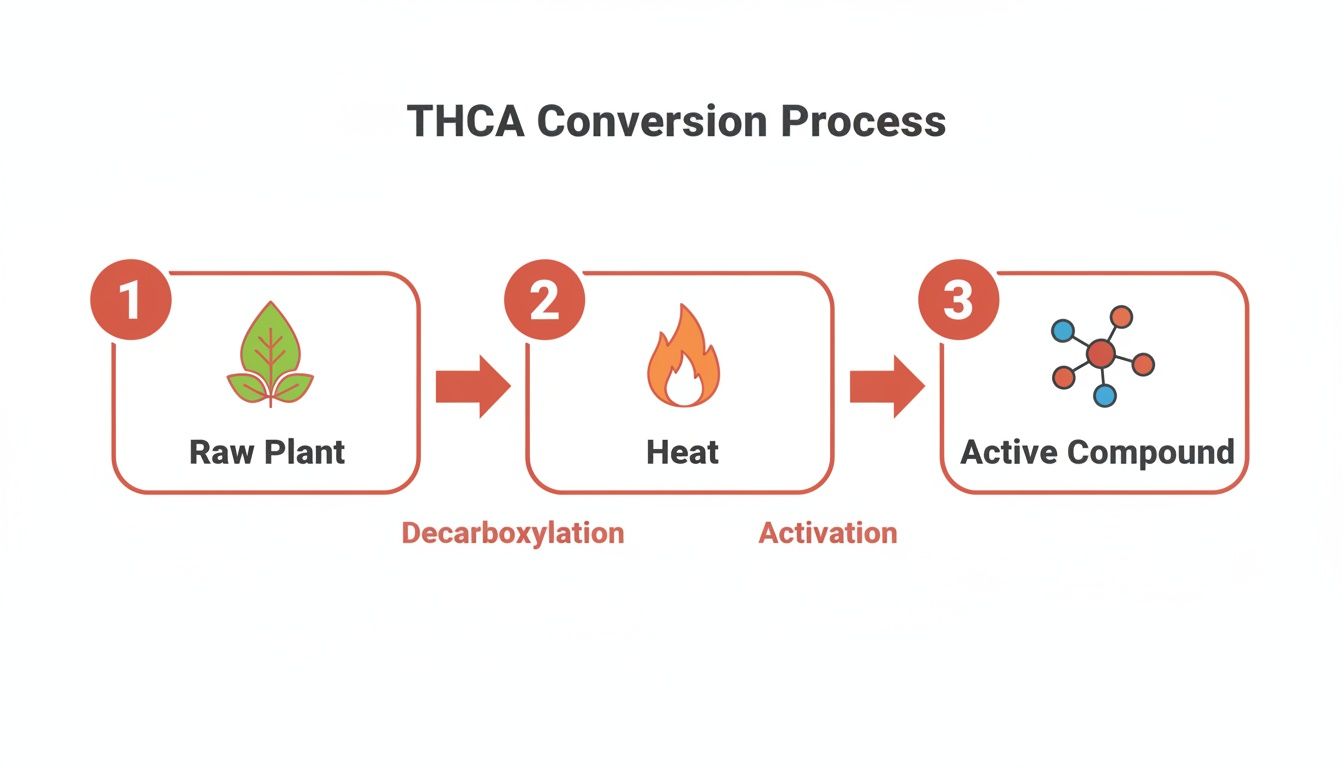
This process is fundamental to both the user experience and federal regulations. It’s also critical for anyone looking to make their own edibles, since you need to manage the temperature just right to get the effects you want. For a deeper dive, check out our guide on making a cannabis-infused coconut oil infusion. This simple but crucial chemical reaction is the bridge between a federally compliant hemp product and a powerfully psychoactive experience.
One of the biggest myths floating around is that THCA is somehow “weaker” than delta-9 THC. In its raw, unheated form, that’s absolutely true—it’s non-psychoactive. But the second you light up or vape it, that potential is unlocked, delivering a high that’s practically identical to what you’d get from traditional THC.
The real difference isn't in the ultimate strength but in how you get there. Smoking high-THCA flower is a totally different ride than eating a delta-9 gummy. It’s not about which one is stronger, but about how the effects show up and how long they stick around.
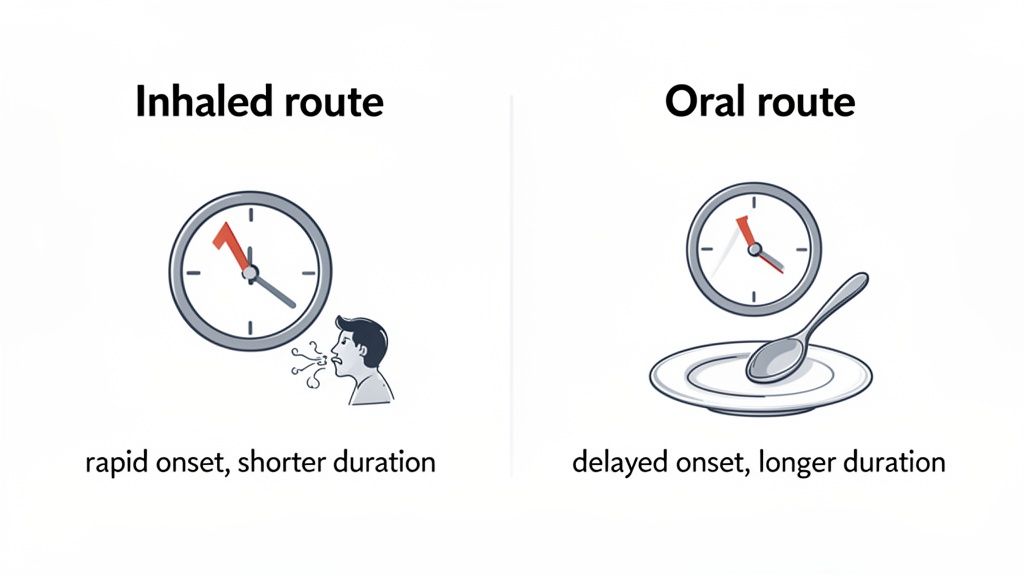
Understanding this is key to matching the experience to your expectations, whether you're looking for a quick lift or a long-lasting journey.
How fast you feel the effects is where the delivery method really shines. It completely changes the game.
Inhaled THCA (Flower, Vapes): When you smoke or vape THCA, the heat instantly converts it to delta-9 THC right before it hits your lungs. From there, it’s absorbed directly into your bloodstream. You’ll start feeling the effects within 1 to 5 minutes, which is perfect for anyone who wants immediate feedback and control.
Ingested Delta-9 THC (Edibles): Edibles take the scenic route. After you eat a gummy, it travels through your digestive system to your liver for processing. This journey can take anywhere from 30 to 90 minutes—sometimes even longer—before you feel anything at all.
This time gap is a huge deal. The fast action of smoking THCA gives you near-instant results, while the slow build of edibles demands patience and careful dosing to avoid getting hit with too much, too late.
Just as the onset times are worlds apart, so are the duration and vibe of the high. A good rule of thumb is that a faster onset usually means a shorter experience.
Inhaling THCA gives you a powerful but fairly brief high. The peak usually hits within the first 30 minutes and then gently fades over the next 1 to 3 hours. This makes it a great choice when you want to feel good for a specific window of time, like a creative burst or a social hangout, without sidelining your whole day.
Delta-9 edibles, on the other hand, are a much bigger commitment. When your liver metabolizes delta-9, it transforms it into 11-hydroxy-THC, a compound that’s even more potent. The result is an experience that’s not just longer—lasting 4 to 8 hours or more—but often feels much more intense and centered in your body.
When heated, THCA converts to roughly 90% delta-9 THC, delivering similar euphoria. The key difference is that the high from flower feels milder than what you get from edibles. Delta-9 gummies can feel 2-3x stronger because of how the liver metabolizes them. In fact, user surveys show 65% of people prefer THCA flower for its "clearer" high, reporting 40% fewer paranoia episodes compared to straight delta-9.
Beyond the numbers, people often report that the experiences just feel different. Vaping or smoking high-quality THCA flower is frequently described as a "cleaner" or "clearer" head high. It can spark creativity and focus without the heavy, couch-locked feeling that edibles sometimes bring on. For a deeper dive, check out our guide on the effects and benefits of THCA.
In contrast, the high from delta-9 edibles is famous for its powerful "body load." The effects can feel more profound and sedative, making them a better fit for deep relaxation, managing pain, or settling in for a movie marathon—not so much for ticking off your to-do list.
The line between THCA and delta-9 THC isn't just about chemistry—it’s the entire foundation of the modern hemp market. Understanding the legal status of these compounds can be confusing, but it’s crucial. It all boils down to one federal law and how its specific wording opened the door for a whole new world of hemp products.
The 2018 Farm Bill made hemp federally legal by defining it as any cannabis plant with no more than 0.3% delta-9 THC by dry weight. That definition zeroed in only on the already psychoactive delta-9 THC, completely ignoring its non-psychoactive precursor, THCA. This created the legal distinction that brands operate within today.
Because of this, a product can be loaded with THCA and still be considered federally compliant hemp, as long as its delta-9 THC levels stay below that 0.3% threshold. This is the heart of the legal conversation around THCA vs. delta-9.
This legal framework means a grower can cultivate hemp flower with over 25% THCA that still tests under the 0.3% delta-9 THC limit. Before you light it up, that flower is legally classified as hemp, not marijuana, making it legal to sell and ship in many states. But the second you apply heat by smoking or vaping, that THCA instantly converts into delta-9 THC, giving you an experience identical to traditional cannabis.
This is why legality is the main battleground. Hemp flower rich in THCA—often hitting 25-35% by weight—tests under 0.3% delta-9 before it’s heated, making it federally legal. Yet, smoking it turns it into psychoactive delta-9. You can find more insights on the THCA vs delta-9 legal framework on hemp-flower.com.
Delta-9 THC, on the other hand, remains a Schedule I controlled substance at the federal level if it comes from marijuana (cannabis with more than 0.3% delta-9 THC). The only federally legal delta-9 products are those that are derived from hemp and meet that same strict concentration limit.
While the Farm Bill sets the federal stage, it isn't the whole story. States have the final say, and many have moved to close what they see as a loophole.
Important Takeaway: Federal compliance does not guarantee state-level legality. Always check your local laws before purchasing THCA products, as the legal landscape is constantly changing.
Several states have passed their own laws defining hemp based on "Total THC." This calculation often includes the potential delta-9 that can be created from THCA (usually calculated as THCA % * 0.877 + Delta-9 THC %). Under these "Total THC" rules, high-THCA flower is reclassified as marijuana and becomes illegal.
This messy web of regulations creates a patchwork of legality across the country. Reputable brands like Melt won't ship THCA products to states where they are banned, which just shows how important it is to stay informed about your local laws. This legal nuance is probably the biggest practical difference when comparing THCA vs. delta-9 THC.
In the world of hemp cannabinoids, a product’s label is just the start of the story. The real proof—of quality, safety, and even legality—is in the Certificate of Analysis (COA). This document comes from an independent, third-party lab and is your best tool for seeing exactly what’s inside that THCA flower or delta-9 edible. Any brand worth its salt will make these reports easy to find.
A COA is a detailed breakdown of a product’s chemical makeup. It shows you the precise cannabinoid levels and screens for things you don't want, like heavy metals or pesticides. For anyone trying to understand the difference between THCA and delta-9 THC, learning to read a COA is non-negotiable. It’s the only way to be sure a product is federally compliant and has the potency you’re paying for.
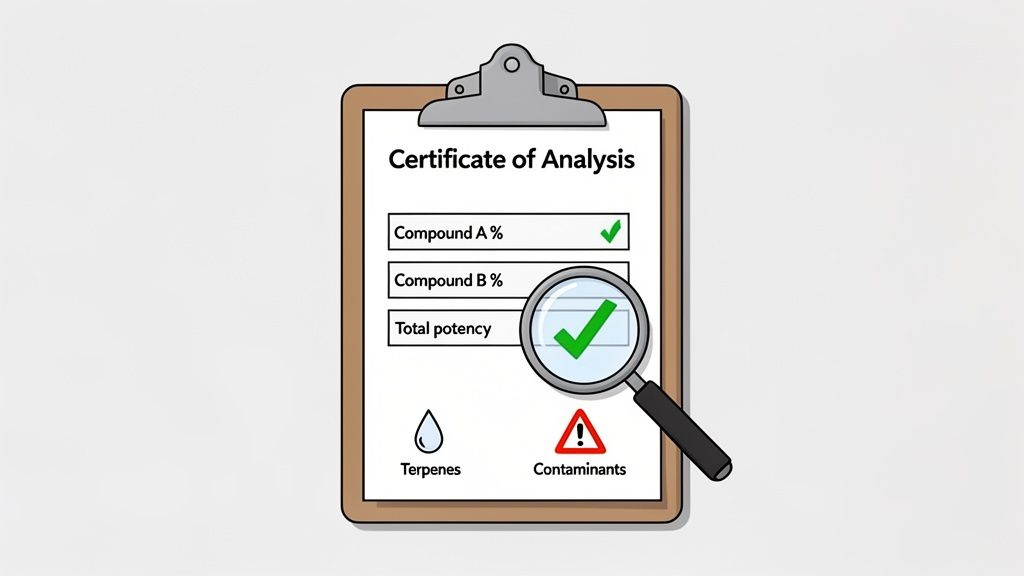
The first thing to check on any COA is the cannabinoid profile. This is where you'll find the hard numbers for THCA, delta-9 THC, and other compounds.
The standard formula to calculate a product's full potential is: Total THC = (THCA % × 0.877) + Delta-9 THC %. That 0.877 is a conversion factor that accounts for the mass lost when THCA becomes delta-9 THC. This gives you the truest sense of the potency you'll actually experience.
Beyond the cannabinoids, a solid COA gives you a full safety report. This section is all about making sure the product is clean and free from stuff that could be harmful. Don't skip this part.
Look for these tests—they should all have a "Pass" or "ND" (Not Detected) next to them:
A complete COA with passing grades across the board is the sign of a transparent, trustworthy brand. It shows they care about quality control far beyond just scraping by legally. By taking a minute to review these documents, you can confidently spot the premium products. You can check out our full library of lab reports for every product we offer to see what transparent testing looks like.
So, THCA or delta-9? The truth is, one isn't "better" than the other. It’s all about matching the cannabinoid to your lifestyle, your goals, and what the law says where you live.
This isn't about deep chemistry anymore. Let's get practical. Are you looking for a quick creative boost or a long-lasting wave of relaxation? Your answer will point you to the right product.
If you value speed, control, and that classic cannabis experience, THCA is your go-to. Since it’s almost always smoked or vaped, the effects hit almost instantly—usually within a few minutes. This is perfect when you want immediate feedback on your dose.
Reach for THCA products like flower or disposables if you:
Here’s a real-world scenario: You're a musician about to start a jam session and need a creative spark. A few puffs from a Melt AMF Blend disposable deliver a near-instant head high, sharpening your focus without the long wait of an edible. The effects are potent but fade in a couple of hours, leaving you clear-headed when you're done.
Delta-9, especially in edibles, is built for the long haul. Its journey through your digestive system creates a delayed but powerful and incredibly long-lasting effect. This makes it the top choice for anyone seeking sustained relief or a deep, full-body experience without smoking.
Opt for delta-9 edibles like Melt Bites gummies when you're looking for:
Making the right choice really just comes down to your priorities. Both cannabinoids can get you to the same place, but they take very different roads to get there.
| Your Priority | The Better Choice | Why It Works |
|---|---|---|
| Speed and Control | THCA (Inhaled) | Effects hit in minutes, letting you adjust your dose in real-time. |
| Duration and Intensity | Delta-9 (Edibles) | Gives you hours of sustained, potent effects for all-day relief or deep relaxation. |
| Legal Accessibility | THCA (Hemp-Derived) | It’s federally compliant under the Farm Bill, so it's available in more places. |
| Discretion and Ease | Delta-9 (Edibles) | A simple, smoke-free way to consume with no odor or extra gear needed. |
Ultimately, it’s a personal call. By understanding these key differences, you can pick the product that fits your needs perfectly and guarantees a great experience every time.
Even with a detailed breakdown, the nuances between THCA and delta-9 THC can spark a few more questions. We get it. Here are the most common queries we hear, with clear answers to help you choose confidently.
Yes, almost certainly. Standard drug tests aren’t sophisticated enough to tell different THC cannabinoids apart—they just look for THC metabolites. When you smoke or vape THCA, your body converts it into delta-9 THC.
That process creates the exact same metabolite, THC-COOH, that drug screenings are designed to find. So, if you're subject to drug testing for any reason, it's best to avoid all THC products, including THCA.
In its raw, unheated form, THCA is completely non-psychoactive. It won't get you high at all. But don't let that fool you. Once you apply heat, THCA converts to delta-9 THC with an efficiency of about 87.7%.
What does that mean in the real world? A flower with 25% THCA will deliver a psychoactive punch that’s nearly identical to a traditional cannabis flower with a similar THC percentage. Functionally, the potency is the same once it's lit.
The Bottom Line: Don't mistake "non-psychoactive" for "weak." Once you apply heat, THCA flower is on par with traditional delta-9 THC cannabis, offering a powerful and comparable experience.
Absolutely, just not the kind that gets you high. In its raw state, THCA is being explored for its potential therapeutic benefits, like anti-inflammatory and neuroprotective properties. These are wellness advantages, completely separate from the classic euphoric buzz.
This is why some people add raw cannabis leaves or flower into their smoothies and juices. But if you’re after the iconic effects of cannabis, you have to heat the flower. Without decarboxylation, there’s no high.
No, it isn't. High-THCA flower is federally compliant under the 2018 Farm Bill, but only if its delta-9 THC content stays below the 0.3% dry weight limit. This federal loophole is the entire reason the THCA market exists.
However, several states have created their own rules that either ban THCA outright or use a "Total THC" calculation. This standard adds the potential delta-9 THC from THCA, which makes most high-THCA products illegal in those areas.
The legal landscape is always shifting, so staying informed about your local regulations is critical.
Ready to explore premium, lab-tested cannabinoids with transparent results? At Melt, we offer a curated collection of potent THCA flower, disposables, and delta 9 edibles crafted in sunny California. Shop the full collection and experience the Melt difference today.
Your cart is currently empty.