



Free Shipping All Orders Over $95
If a shop calls a cartridge legal, does that already tell you the oil is clean? It doesn't. Legal answers whether you may buy it where you live. Potency answers how much cannabinoid the lab measured. Contaminant testing answers whether pesticides, solvents, and metals were checked on that batch. A weed vape pen can pass one of those tests and fail the others.
A weed vape pen is a small battery-powered heater for cannabis oil, not a miniature joint. The hardware only warms distillate, live resin, or a THCA-based oil into an aerosol you inhale. What you breathe depends on who made the oil, what was added to it, and whether anyone tested the finished cartridge.
That habit is already common among younger adults. In the 2023 Monitoring the Future survey summarized by the National Institute on Drug Abuse, 22% of adults ages 19–30 reported vaping cannabis at least once in the previous year, and 14% reported use in the previous 30 days. Among adults ages 35–50, those figures were 9% and 6%. Past-year use in the younger group was more than twice the older group's rate. The device format is established. The buying decision still comes down to source and formulation.
A weed vape pen heats cannabis oil, such as distillate, live resin, or THCA-based oil, into an aerosol. Four formats cover almost every counter.
| Type | Power | Refillable | Best for | Main trade-off |
|---|---|---|---|---|
| Disposable all-in-one | Sealed built-in battery | No | First-time users and travel | Battery and hardware cannot be inspected or replaced |
| Rechargeable pen with prefilled cartridge | Rechargeable battery | No | Daily use of one preferred oil | Cartridge hardware quality varies by brand |
| 510-thread pen with separate cartridge | Rechargeable battery | Swap cartridges | Trying many oils and strains | Mismatched threads or hardware can leak |
| Pod system | Rechargeable battery | Swap pods | Discreet, low-dose sessions | Replacement coils are a recurring cost |
Disposables win on simplicity. You charge if the unit allows it, draw, and stop when the oil is gone. You can't open the coil, swap a bad seal, or see how the oil was filled. That's a poor fit if you want to inspect hardware before a long trip.
A prefilled rechargeable pen suits one oil you already like. You keep the battery and replace only that cartridge style. Quality still tracks the brand that built the cart, so a pretty label doesn't equal a stable seal.
A 510-thread pen is the flexible choice. You screw on cartridges from many makers and change strains without buying a new battery. Threads that look compatible can still sit crooked. A loose fit leaks oil onto the battery contact and wastes the fill.
Pod systems stay small and suit short, lower-dose sessions. The cost shows up later, because coils and pods are a repeat purchase.
Match the pen to the habit, not the loudest package.
The terpene profile of the oil, not the shell of the pen, drives most of the flavor you'll notice. Hardware only decides whether that oil is heated evenly.
A kettle held at a set temperature behaves nothing like a stove left on high. A well-built weed vape pen should act like the kettle: the same heat, draw after draw, instead of a random hot spike.
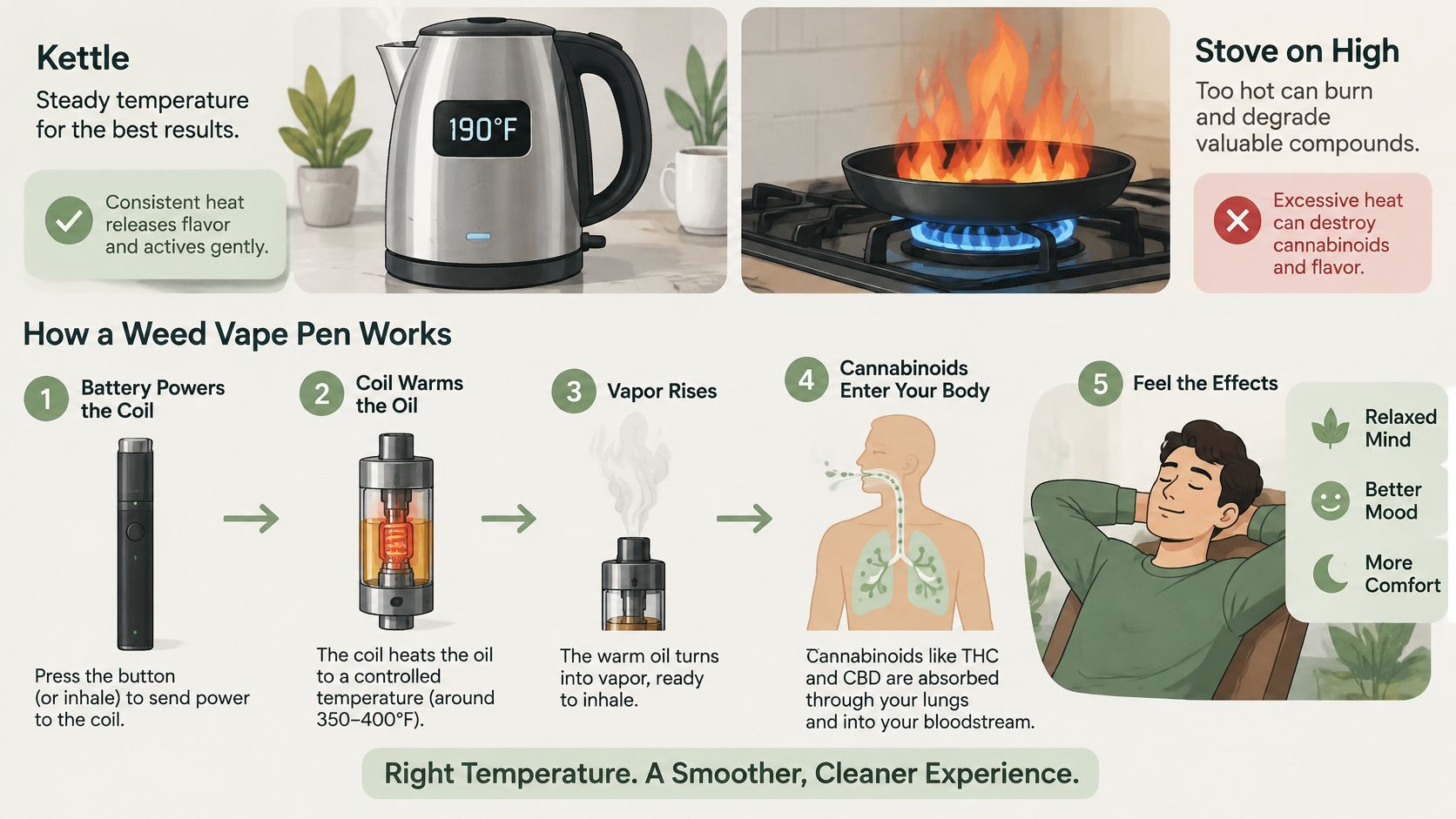
The sequence is short, and each step has a failure mode.
Terpenes leave the oil before most cannabinoids. A coil that runs hot on the first inhale can strip the strain's aroma before you've tasted what the label promised.
This short clip shows the same heating path in motion, from activation through aerosol.
Modeled heating makes the trade-off concrete. In a peer-reviewed model of a 180–220°C range, about 10% of THC evaporated within 20 seconds at 180°C, versus 34% at 220°C. After 40 seconds those shares were about 20% and about 50%. The estimated THC evaporation rate rose roughly threefold for each 20°C above 160°C.
| Setting | After 20 seconds | After 40 seconds | Practical effect |
|---|---|---|---|
| 180°C | About 10% | About 20% | Gentler, slower delivery with more flavor retained |
| 220°C | 34% | About 50% | Faster, more concentrated delivery with higher thermal stress |
Higher settings push a faster, more concentrated aerosol. They also add thermal stress and can flatten flavor on the same draw.
Look for regulated, repeatable heating, not a pen that dumps uncontrolled high-power pulses into the coil. When you read a product test, ask whether it measured the delivered aerosol, not only the potency of oil sitting in the tank. Oil potency tells you what was filled. Aerosol testing tells you what the heat released.
The sharper safety question isn't vape versus flower. It's where the oil came from and what was mixed into it.
The 2019 U.S. outbreak of e-cigarette or vaping product use-associated lung injury, called EVALI, is the reference case. By January 7, 2020, the CDC case report recorded 2,602 lung-injury cases across all 50 states, Washington, D.C., Puerto Rico, and the U.S. Virgin Islands, including 57 confirmed deaths. Among 1,979 patients with substance-use data, 1,620 people, or 82%, reported a THC-containing vaping product. Among 809 patients who said where they got THC products, 627, or 78%, used only informal sources such as friends, family, or dealers. 131, or 16%, used only commercial sources.
Product testing tied the outbreak strongly to vitamin E acetate. FDA data in that same report found the additive in 50% of tested THC-containing samples, and CDC investigations found it in many products linked to cases. It should not be added to vaping products. That finding doesn't prove every pen is dangerous. It does show what an unlisted thickener can do.
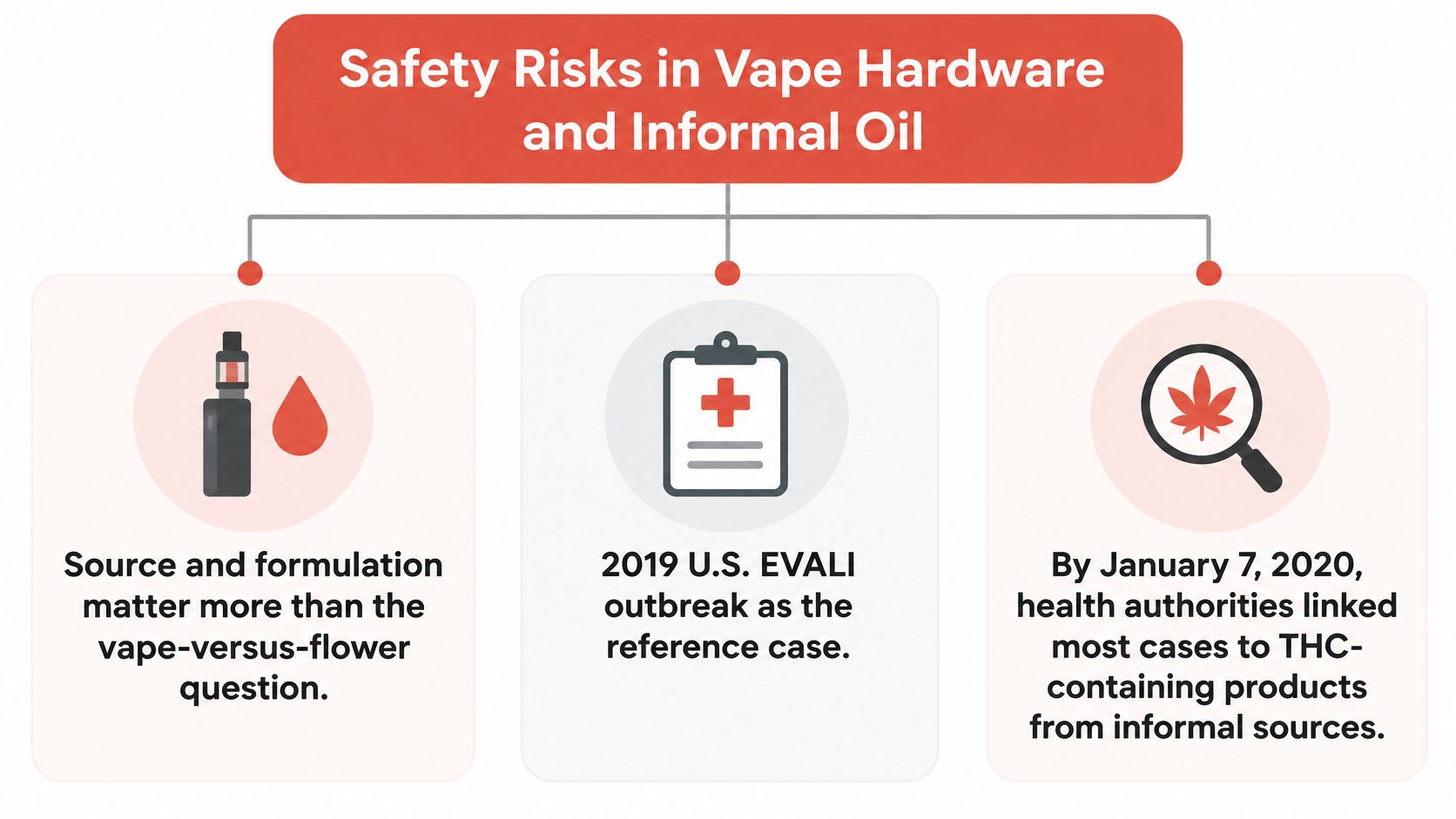
Treat these as separate checks. Passing one doesn't clear the others.
A clean report on fresh oil doesn't describe a coil that's been run dry for a week. Test the formulation and respect the hardware.
The outbreak and the metal findings don't mean every weed vape pen is unsafe. They do make regulated manufacturing, ingredient controls, and independent testing the factors that matter most. No brand, including a licensed one, is risk-free. A commercial source lowers one documented risk. It doesn't retire the others.
Legal status follows the product type and where you stand, and it still doesn't answer whether the oil was tested.
Under U.S. federal hemp rules, a hemp product stays on the hemp side of the line at 0.3% delta-9 THC by dry weight. Above that line, the same molecules are treated as cannabis, and cannabis rules are set state by state. A cartridge can be hemp-compliant on paper and still be banned in the state you're shipping to.
States split on recreational cannabis, on THCA products, and on hemp-derived THC. Many require the buyer to be at least 21, with age checks before sale. A retailer in one state can't grant you permission in another.
Shipping follows the same map. If a product is prohibited where you live, having it mailed there doesn't make the shipment lawful. Outside the United States, national regimes differ again, so a U.S. hemp label is not a travel pass. The practical habit is to read your own rule, not the claim printed on a checkout page. A plain map of state cannabis laws is a starting point, then you confirm the current text for your state.
Run this before you pay or travel:
A product that clears the legal test can still carry contamination risk. The cartridge checks in the buying steps still apply after the law says yes.
THCA in raw plant material isn't the compound that produces the familiar cannabis effect. Heat converts it toward THC. The pen's heating step is what decides how much THC you receive from a THCA-forward oil. A label that only shouts a THCA percentage skips that conversion.
Terpenes are the aroma and flavor compounds. They leave the oil earlier than cannabinoids, so the first draw on a hot pen can taste unlike the profile printed on the report. That's a heating mismatch, not proof the oil was fake.
Don't shop one number for every goal.
Flavor first. Pick a pen with steady, moderate heat and an oil whose report lists terpenes. If you want to know what those names mean on a label, start with what terpenes in weed do, then match the listed ones to the aroma you want. A fruity name with no terpene data gives you nothing to compare. A cartridge that lists its dominant terpenes lets you predict the smell before you buy.
Potency first. Read both THCA and THC on the same report. Then line those figures up with the pen type you already chose. A disposable with fixed heat gives you less room to moderate delivery than a 510-thread battery with repeatable settings. The bigger percentage isn't automatically the stronger session if the device runs cooler and slower.
A milder session. Choose a lower-potency oil and a device meant for short draws, such as a pod, rather than chasing the highest THCA number and trying to "take it easy" on a hot coil.
Say you're comparing two carts that both say mango. One lists no terpenes. The other lists a dominant terpene and a THCA figure tied to that lot. Only the second gives you a prediction you can check against the first inhale.
Terpene and cannabinoid numbers only help when the report is for the exact cartridge in your hand, same lot, same oil.
Pick the device type that fits how you'll use it, confirm the rule where you live, then verify the product before you pay. Skipping the last step is how a legal, potent cartridge still becomes a bad buy.
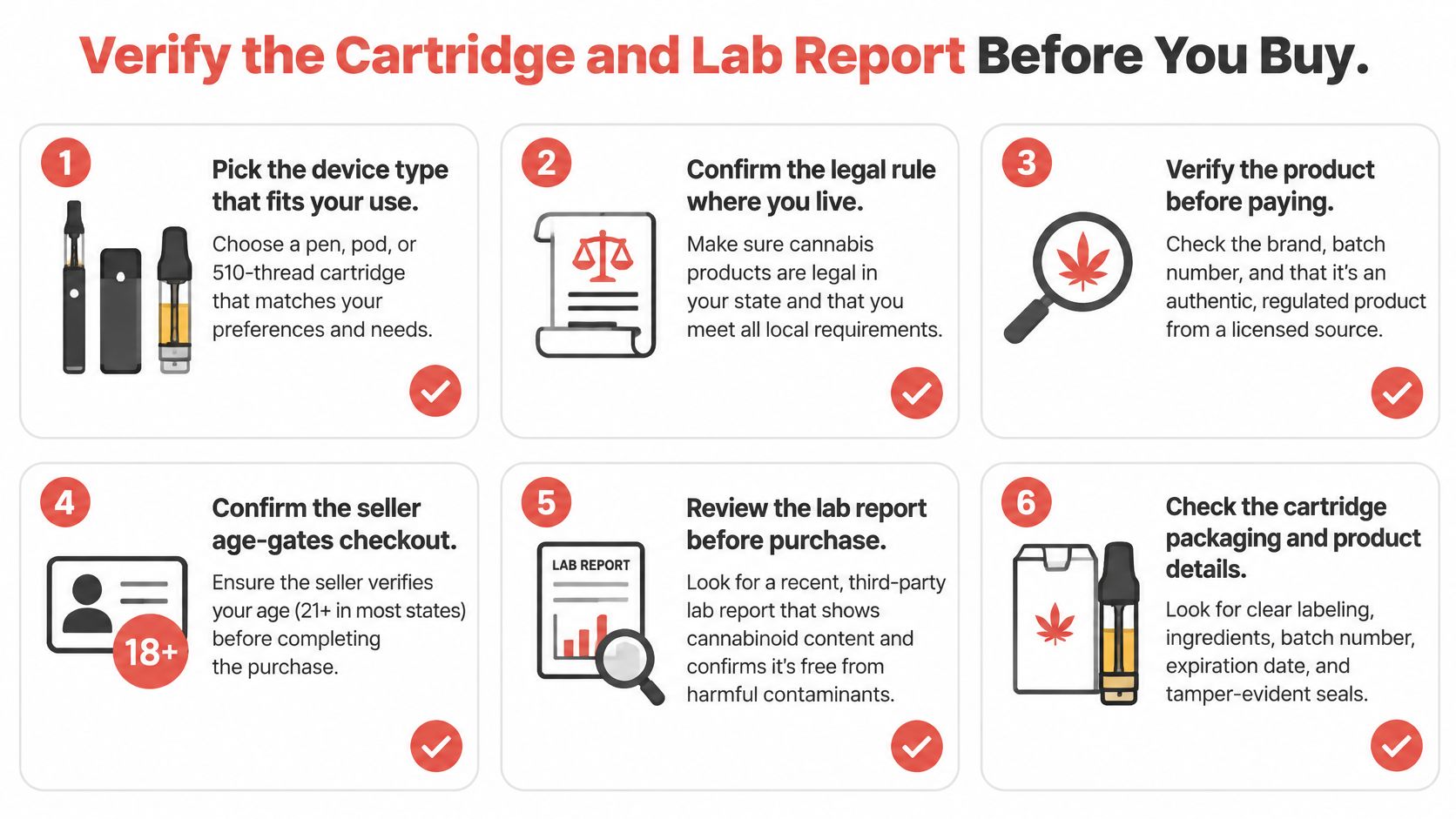
The CDC's guidance says vitamin E acetate should not be added to vaping products, advises against THC vapes from informal sources, and warns against adding anything the manufacturer didn't intend. "Buy legal" doesn't finish that job. Legality, potency, ingredient disclosure, and contaminant testing answer different questions. A cartridge can be age-gated and still hide a thinner. It can show a high cannabinoid number and still skip pesticides.
If any item fails, skip the purchase. Don't average a pass on three checks against a miss on one.
A useful report lists the tested lot, the analytical method, the detection limits, and whether the sample was fresh oil or aerosol after use. Those details tell you what was measured. They aren't a promise that every later puff stays identical.
Melt is one neutral example of publishing third-party results, and the same five checks apply to any brand. Flower, prerolls, edibles, and other products in that lineup are lab-tested, and every Melt Exotic Preroll is tested by a third party for cannabinoid potency, residual solvents, heavy metals, and pesticides. A report is a starting point, not a guarantee the pen will behave well after weeks of heat and pocket time.
| Warning sign | Likely cause | Action |
|---|---|---|
| Burnt or harsh taste | Overheated or dry coil | Stop using the cartridge and don't keep drawing |
| Oil leaking from the mouthpiece or base | Damaged seal or mismatched cartridge | Stop, check the thread fit, and replace the cartridge |
| Device hot to the touch | Battery or heater fault | Stop and don't charge or use the device |
| Oil with no batch report | Unverified formulation | Don't use the product |
Stop at the first warning sign. Another draw doesn't fix a dry coil, a bad seal, or a missing report.
Choose the pen type that matches your goal, verify the report for that exact product, and set the device aside as soon as taste, heat, or a missing lot number tells you something's off.
Melt builds hemp-derived disposables and related products for adults who want strain-specific flavor and batch-level lab reports, not a mystery fill. If you're comparing a weed vape pen by oil source, terpene detail, and contaminant testing rather than a legal checkbox alone, start with the lineup and the reports on Melt. Shop only where the product is lawful for you, and match the device to the session you want.
Your cart is currently empty.