



Free Shipping All Orders Over $95
In a survey published in Frontiers in Psychiatry, 40.9% of respondents reported using CBD for anxiety relief. That tells us why calming cannabis products attract attention, but it doesn't establish that they prevent paranoia. If you're looking for weed that doesn't make you paranoid, the more useful starting question is how much THC you'll consume, and how reliably you can control it.
No strain, CBD ratio, or product format guarantees a paranoia-free experience. The practical goal is risk reduction: predictable potency, a small THC exposure, enough time between doses, and a clear plan for stopping if you feel unwell.
Paranoia risk by product format and cannabinoid profile
| Format or profile | Typical THC exposure | Paranoia risk pattern | First step to lower risk |
|---|---|---|---|
| High-THC flower or concentrates | Concentrated THC delivered quickly | Greater concern for new or THC-sensitive users | Choose lower potency and take only a small inhalation |
| Vapes and cartridges | Concentrated THC with an inhaled dose that's difficult to measure | Easy to underestimate exposure | Check cartridge potency, but don't mistake cartridge totals for a dose |
| THC-dominant edibles | A measurable amount with delayed effects | Taking more before the first dose develops can cause overshooting | Choose a small labeled serving and wait through the full effect |
| THC-plus-CBD balanced products | THC with CBD present | Lower average risk than THC-prevalent profiles, not zero | Verify the actual amounts of both cannabinoids |
| CBD-dominant, very-low-THC products | Little THC relative to CBD | Lowest average risk among the profiles compared in the research | Confirm the THC amount in the serving you'll use |
| Indica-labelled or terpene-rich flower | Determined by the cannabinoid content | The label doesn't reliably predict paranoia | Read the potency report rather than choosing by the name |
Read this as a practical screening order, not a proven head-to-head ranking of every delivery method. The strongest comparison concerns cannabinoid profiles: a 2025 meta-analysis indexed in PubMed, pooling 13 studies and 13,559 participants, found stronger paranoia effects with THC-prevalent cannabinoids than with mixed THC-CBD or CBD-prevalent cannabinoids.
The useful distinction is not just smoking versus eating. It's whether the product makes a large THC exposure easy, whether you can measure your serving, and whether the effects arrive slowly enough to tempt you into taking more.
A precisely labeled edible may make the amount easier to identify, but its delayed effects require patience. A vape provides quicker feedback, yet a puff isn't a standardized milligram serving. Neither format is automatically the better choice for someone who has already had frightening reactions.
Likewise, CBD-dominant doesn't mean THC-free. Check the amount of THC in the portion you intend to consume, rather than accepting the front-of-package description as a dosing instruction.
A product that makes a small dose easy to identify is more useful than a product with a reassuring name.
These categories describe average risk, not your personal outcome. A lower-risk profile can still feel uncomfortable, particularly when the serving is larger than expected or the circumstances aren't right.
A controlled study summarized in the National Academies evidence review gave 17 healthy adults oral THC doses of 0, 10, 25, or 50 mg, and the highest-dose condition produced statistically significant increases in paranoia, restlessness, and nervousness. A strain name is like a menu word for spicy; the milligram amount is closer to the actual heat.
THC acts at CB1 receptors in the brain. Its effects aren't limited to pleasant intoxication, and increasing exposure can make the experience more unsettling rather than more relaxing.
This diagram illustrates the distinction between smaller and larger exposures.
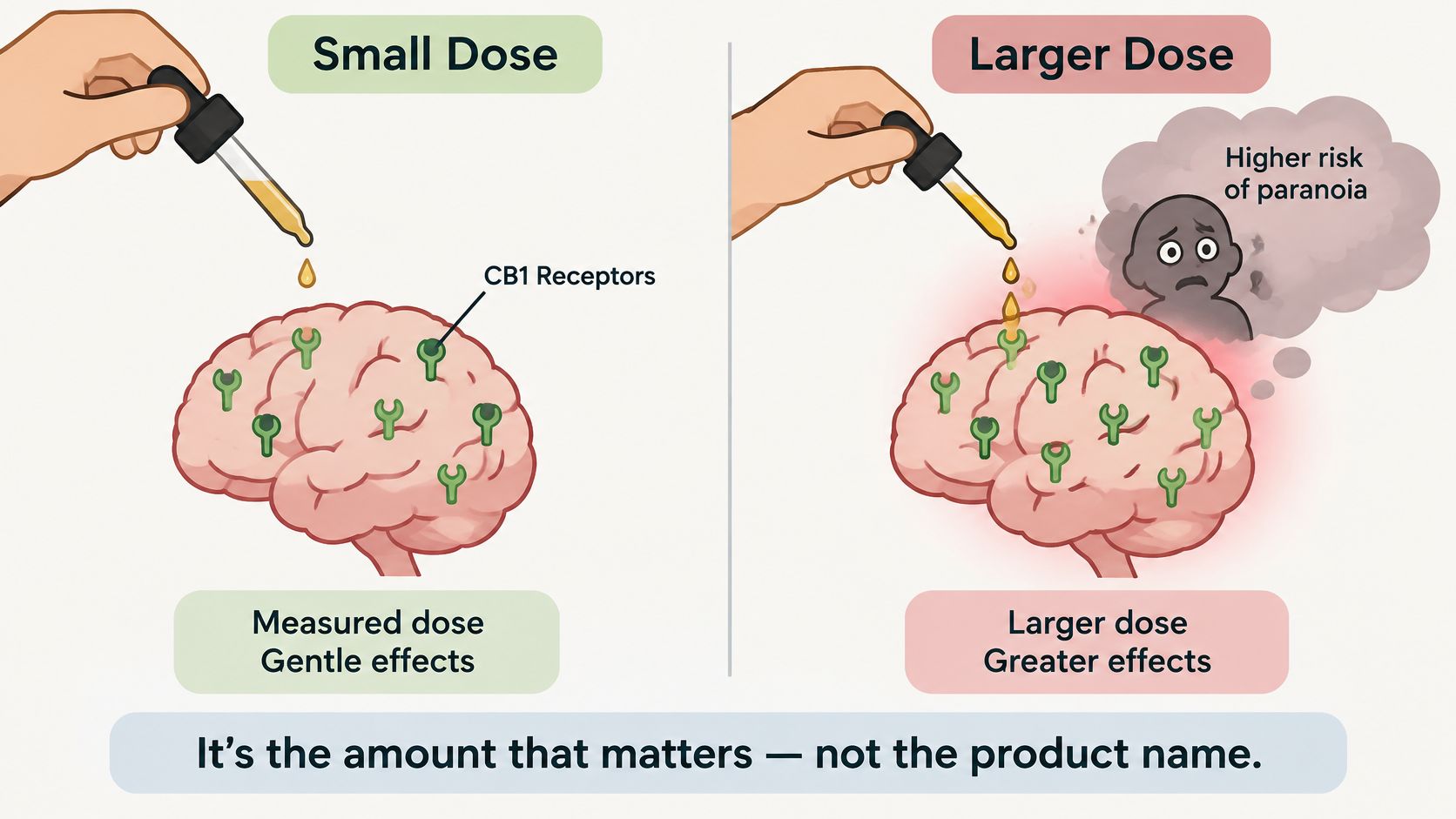
Potency describes the concentration in a product. Dose describes the amount you take. Strong flower used in a tiny quantity and weaker flower used repeatedly aren't equivalent exposures, even if the weaker product sounds less intimidating.
The National Institute on Drug Abuse identifies anxiety, fear, distrust, paranoia, and panic as possible effects of consuming large amounts of THC. That makes reducing exposure a more defensible strategy than searching for a strain that supposedly cannot cause those effects.
Consider someone who switches from an uncomfortable sativa-labelled product to a stronger indica-labelled product. If they consume the same amount of material, they've changed the name without necessarily reducing the psychoactive exposure.
The video offers another way to approach cannabis effects and dose awareness.
There's no universal milligram amount that separates comfortable from uncomfortable. Tolerance, mental-health history, and setting can change how the same exposure feels, so someone else's usual serving isn't a reliable target for you.
CBD has meaningful supportive evidence, but that evidence is narrower than the promise that CBD cancels THC. A randomized experiment described in Reuters' reporting on CBD and THC found less THC-related paranoia after CBD pretreatment; its study conditions and results are summarized below.
What the CBD evidence shows
| Study type | Who and what was given | Result for paranoia or anxiety |
|---|---|---|
| Randomized study reported in 2013 | 48 healthy participants received 600 mg CBD or placebo before 1.5 mg intravenous THC | Clinically significant positive psychotic symptoms were less likely after CBD, with an odds ratio of 0.22; THC-related paranoia was also lower |
| Observational study published in 2024 | People using CBD-dominant versus THC-dominant cannabis | Lower anxiety with CBD-dominant cannabis, with an adjusted DASS anxiety difference of −1.03, p=0.02; post-use paranoia increased with THC-dominant and THC-plus-CBD products |
| Randomized crossover study | 8 mg THC plus 16 mg CBD, a 2:1 CBD-to-THC ratio | Psychotomimetic symptoms still occurred, so the ratio wasn't a guaranteed shield |
The crossover result, discussed in this human laboratory evidence review, is the important counterweight to the supportive findings. CBD can be present without preventing psychosis-like effects, including the kinds of altered thoughts and perceptions that can make intoxication frightening.
A CBD-to-THC ratio describes relative amounts, not how much THC you'll consume. A larger serving of a balanced product can deliver more THC than a tiny serving of a THC-dominant product.
Read the cannabinoid names in order, too. CBD-to-THC and THC-to-CBD describe opposite relationships, and a prominent ratio without clear labels is easy to misread.
Practical rule: Treat CBD as a possible influence on the experience, not permission to increase THC.
Pretreatment before intravenous THC isn't the same as taking a retail gummy, smoking flower, or adding CBD once paranoia has started. Observational comparisons also can't establish that CBD alone caused the difference, because people choose products for different reasons and use them under different circumstances.
The useful shopping conclusion is modest: CBD-dominant, low-THC products may be a more cautious option, but the actual THC serving still matters. Don't use a favorable ratio to justify a large serving, and don't rely on CBD as an emergency antidote.
If a product repeatedly causes paranoia despite containing CBD, that reaction matters more than the formula's marketing. Stop using it rather than assuming you need a different ratio to make it work.
Only about 52% of sampled Colorado flower products met the state's THC-label accuracy standard, with pre-rolls especially prone to over-labeling, according to NORML's coverage of cannabis label testing. The same coverage describes a 2025 audit in which flower and edible labels generally reported more THC than independent testing detected.
Over-labeling doesn't mean every product is secretly stronger. It means the package isn't always a dependable measurement, which makes comparing products and repeating a familiar dose harder.
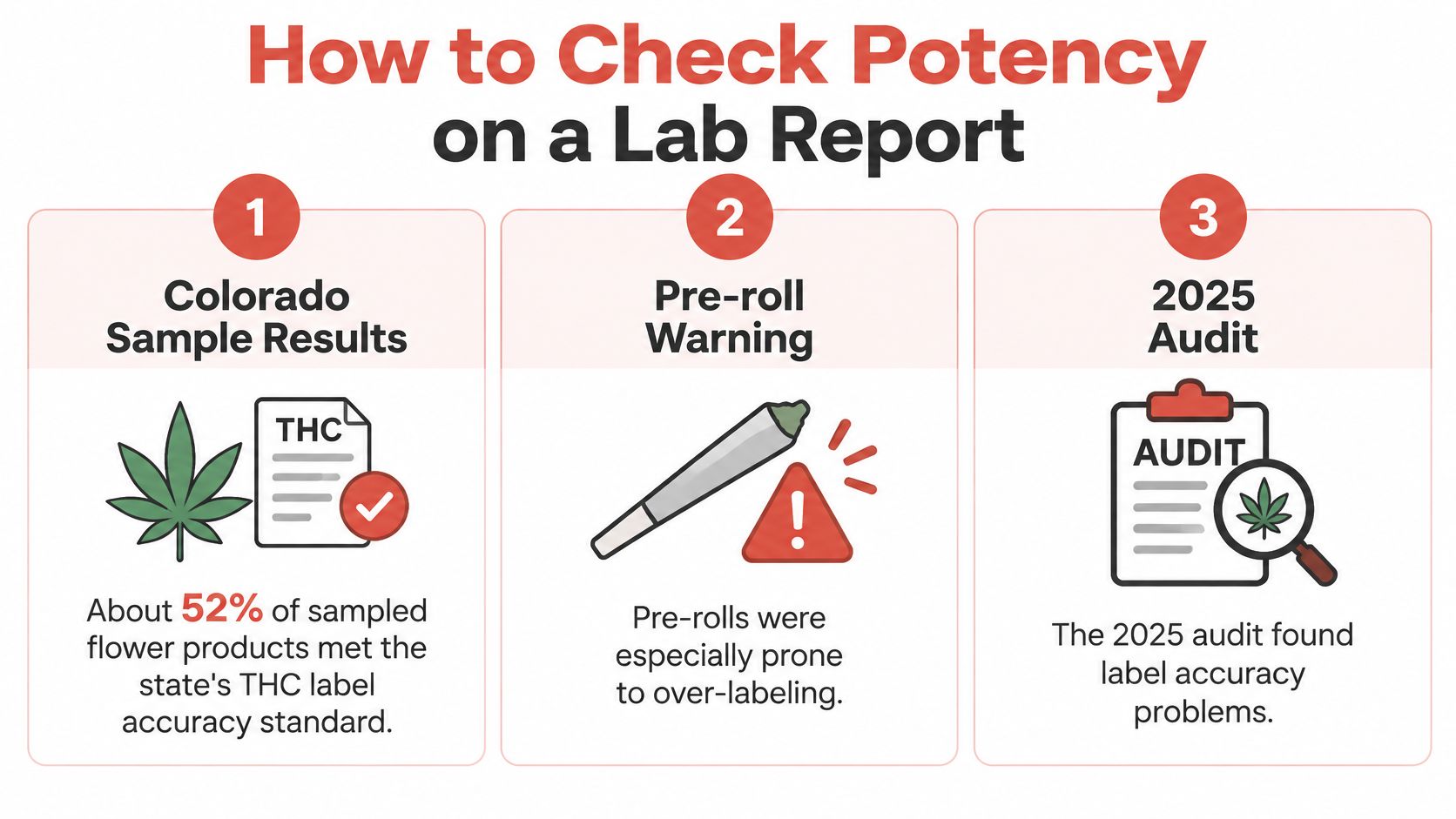
For a hypothetical calculation, 20% THC in 0.5 grams of material equals 100 milligrams of THC in that material: percentage multiplied by grams multiplied by ten. That isn't a claim that smoking it delivers that entire amount into your body, and it isn't a suggested dose.
Total THC on a cannabinoid report describes potential THC content, including the contribution of THCA when applicable. THC per serving describes the amount assigned to the portion you're consuming.
This distinction is particularly important with THCA flower because heating converts THCA into THC. A low Delta-9 THC figure by itself doesn't establish a low-intoxication product.
Use the certificate of analysis reading guide to identify the relevant fields. A matching report helps establish what's in the batch; you still need to decide how much of that batch to use.
Starting doses and wait times by format
| Format | Starting dose to test | Typical onset | Wait before taking more |
|---|---|---|---|
| Inhaled flower or vape | One small inhalation | Faster feedback than an edible | Pause until you can assess the full response; don't take repeated puffs automatically |
| Edibles | The smallest clearly measured, low-THC serving | Delayed; effects can continue building after you first notice them | Wait through the expected peak, not just the first noticeable effect |
| Sublingual tincture | The smallest measurable labeled serving | Follow the product's instructions; swallowed portions can behave more like an edible | Allow the full product-specific effect to develop |
| Low-THC CBD product | Smallest labeled serving | Determined by the delivery method | Assess the complete response before considering more |
These are harm-reduction starting principles, not clinical prescriptions. There's insufficient support for a universal starter dose across these formats, especially for someone with a history of THC-related panic or paranoia.
Take the planned serving once, then put the product away. Record the time before doing something else, because relying on memory makes it easier to lose track.
For inhaled products, pause rather than matching another person's pace. The amount of THC in a hit isn't fixed, and cartridge potency doesn't tell you exactly what a particular inhalation delivered.
For edibles, don't treat the first noticeable sensation as the final intensity. In the controlled oral-THC study described by the National Academies, effects peaked later after ingestion, which is why taking more while the first serving is building can overshoot your plan.
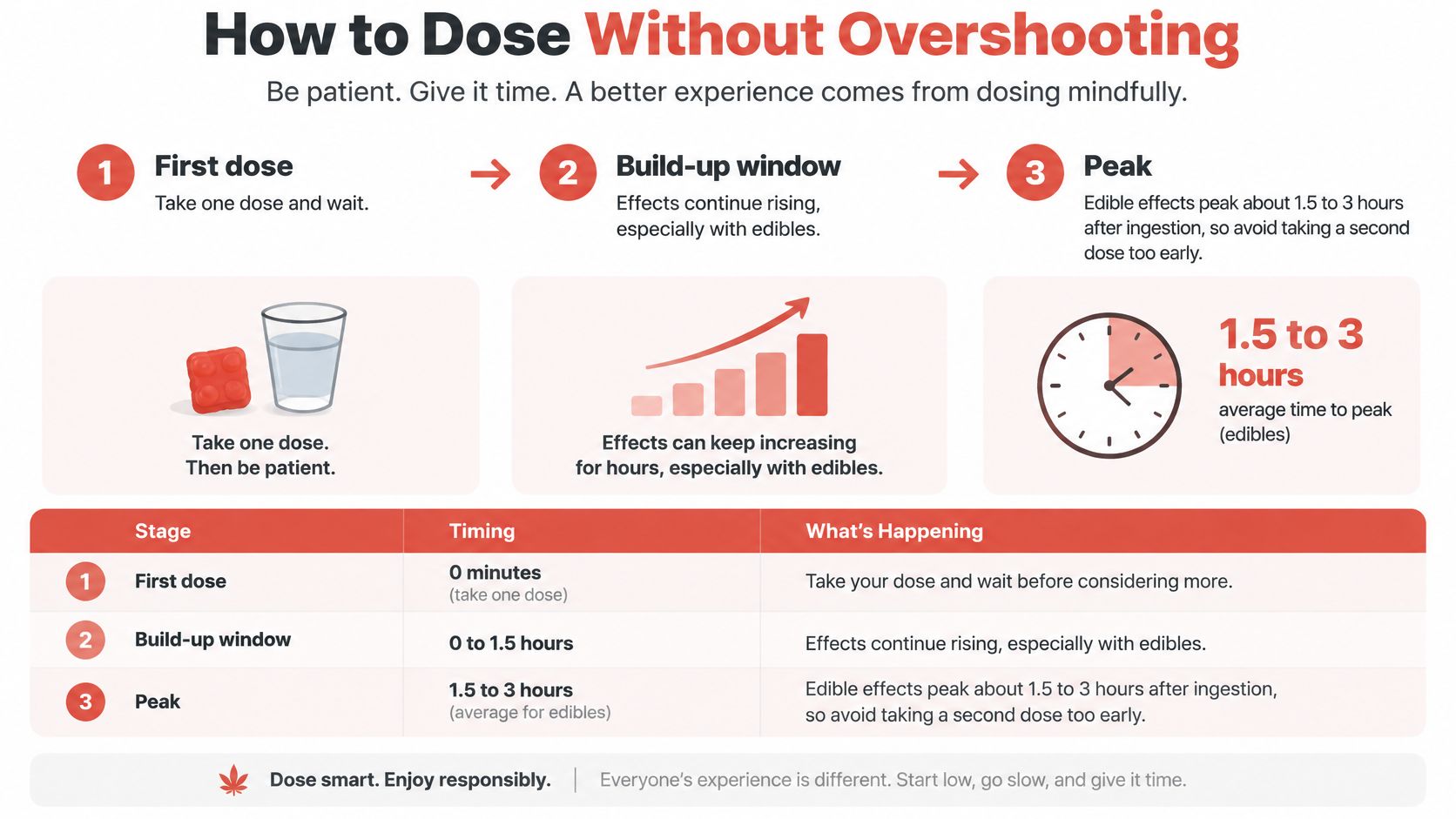
The timeline is a reminder to wait, not a countdown that requires another dose when it ends. If you're uncertain whether the effects are still increasing, don't add more.
Say an edible feels weak, so you use a vape while waiting. If paranoia appears later, you'll have trouble separating the edible's delayed effects from the inhaled THC. Waiting without adding another product gives you a clearer, more useful answer about your response.
For high-potency flower and concentrates, the central challenge is the opposite: exposure can accumulate quickly. A small inhalation followed by a genuine pause is more controllable than a sequence of deep pulls.
A product you've tolerated before can still feel unpleasant under different circumstances. The Cannabis and Cannabinoid Research journal collection provides context for treating cannabis reactions as more than a product-label question, but these contextual contributors are less directly measured than the THC dose evidence.
Don't interpret them as a ranked list of proven causes. They're practical factors to check before assuming you need another strain.
Start with what you can verify. Did you take the amount you planned, and did the product match its report? Did you consume another cannabis product while waiting?
Then review the circumstances. Were you sleep-deprived, using stimulants, drinking alcohol, or somewhere unfamiliar? Did the reaction resemble a known panic trigger?
A difficult reaction isn't a personal failure, and you don't need to prove you can tolerate cannabis.
A log can identify a pattern, but it can't diagnose the cause. If paranoia keeps returning, stop experimenting and discuss cannabis use with a clinician rather than repeatedly adjusting products on your own.
Warning signs and what to do
| Symptom | What it may indicate | What to do |
|---|---|---|
| Panic with racing heart or chest pain | An acute intoxication reaction, or another medical problem | Stop use; seek emergency care for chest pain |
| Confusion or hallucinations | Severe intoxication or a psychosis-like reaction | Stop, move to a safe place, and get medical help |
| Paranoia that lasts beyond the day | A potentially persistent reaction | Stop use and contact a clinician |
| Anxiety that returns on sober days | Recurrent anxiety rather than an isolated uncomfortable session | Discuss cannabis use with a clinician |
Stop first, then assess. Don't assume chest pain is harmless because you've consumed cannabis, and don't wait for a strain-specific explanation before seeking help.
Confusion, hallucinations, or an inability to stay safe also call for medical attention. A sober person should stay with you if possible, and you shouldn't drive yourself for care.
Feeling temporarily worried after an overly strong dose isn't the same as persistent paranoia or losing touch with reality. For milder discomfort, stop consuming, reduce noise and stimulation, sit somewhere safe, and ask someone you trust to stay nearby.
The table isn't a diagnostic tool, and the absence of a listed symptom doesn't prove you're safe. If you're unsure how serious a reaction is, contact medical services or a poison information service for guidance.
People with prior panic disorder, psychosis-spectrum symptoms, or marked THC sensitivity should speak with a clinician before using cannabis. Repeated or disabling reactions deserve attention even when they eventually fade.
Choosing not to use cannabis is a valid outcome. There's no requirement to keep searching for weed that doesn't make you paranoid if THC consistently makes you feel unsafe.
Before opening the package, decide whether you want to use cannabis today. If you're already anxious about repeating a severe reaction, postponing the session is more useful than trying to engineer a perfect one.
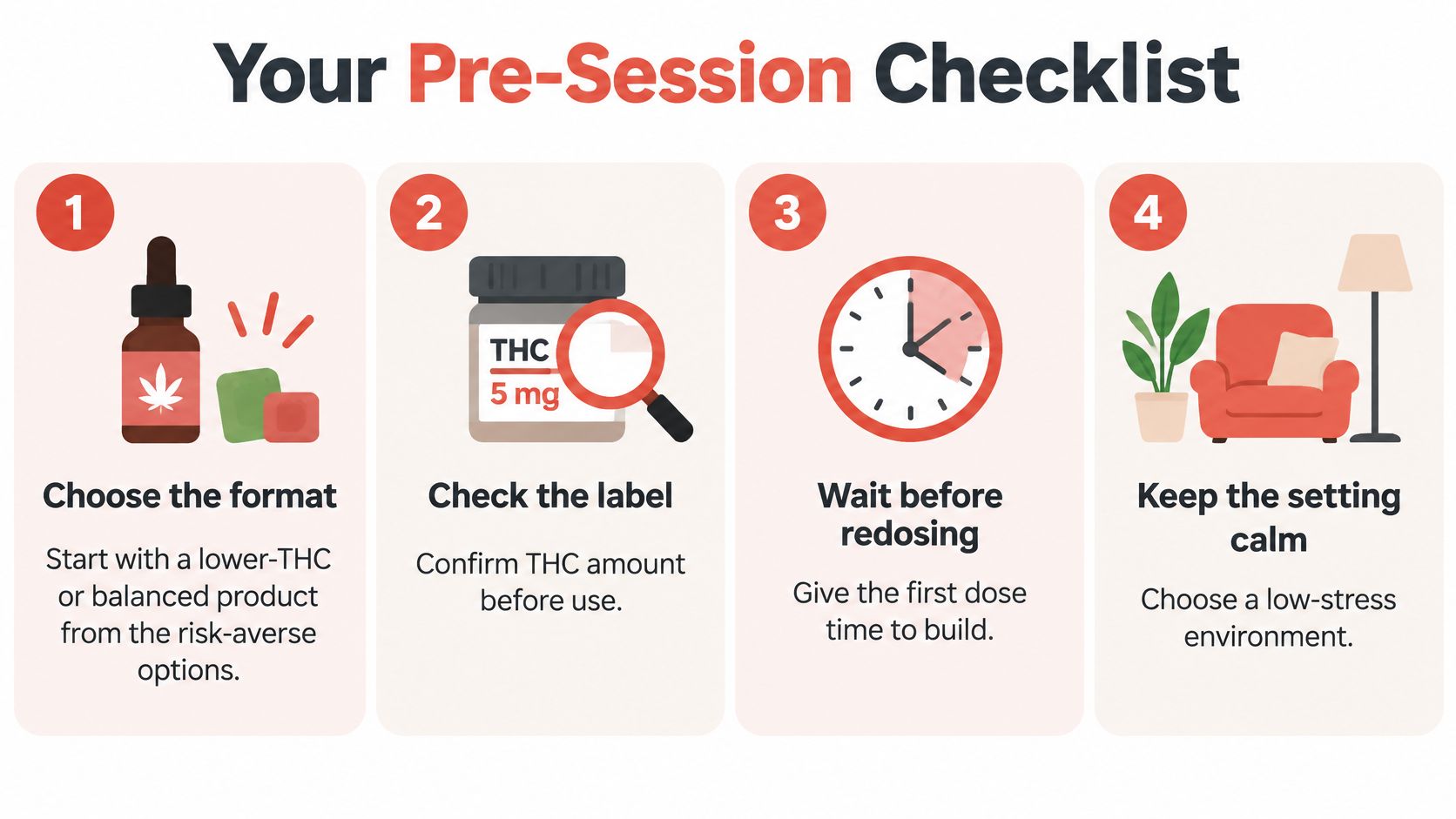
We supply every strain with a third-party Certificate of Analysis covering potency, pesticides, heavy metals, and Delta-9 THC compliance. That documentation supports an informed decision, but it doesn't predict your personal response.
A certificate describes the product, not how you'll feel. Your serving, the time you allow before taking more, and your willingness to stop remain essential.
At Melt, we offer lab-tested hemp-derived cannabis products with transparent reports to help you evaluate potency before choosing a serving. Visit to review the product information and batch testing, and choose according to your THC sensitivity rather than a promise of a paranoia-free high.
Your cart is currently empty.