



Free Shipping All Orders Over $95
Have you ever looked at a THCA label, seen a large percentage, and assumed it tells you exactly how strong the product will feel? That instinct makes sense, but the printed number describes the raw cannabinoid, not necessarily the THC your body encounters after heating. To answer “what is a high THCA percentage,” you need to follow the molecule through conversion, compare the result with total THC, and check how the product was tested.
A useful label is more than a single potency score. It should help you understand what is present before use, what may form during heating, how the product was measured, and whether the testing standard applies to the market where you plan to buy it. Once you see THCA as raw material rather than finished THC, the percentage becomes much easier to interpret.
What should you ask first after seeing a large THCA percentage: how high the number is, or how much THC it could produce?
The better question is how the raw THCA may translate into total THC, and what the laboratory report measures. A THCA percentage describes the concentration of one compound before use. The experience also depends on heating, product form, dose, terpenes, and testing method.
A coffee label offers a useful comparison. The cup size tells you how much liquid you received, but not how much caffeine reaches the drink. The beans, brewing process, concentration, and serving size all affect that result. THCA works similarly. Its printed percentage is one ingredient measurement, not a complete prediction of the finished effect.
Four details deserve attention:
Practical rule: Treat the printed THCA percentage as an ingredient label, not a promise about the finished experience.
This approach prevents two errors. The biggest number is not automatically the best choice, and unheated THCA should not be confused with the THC formed after smoking, vaping, or cooking.
THCA, or tetrahydrocannabinolic acid, is the acidic precursor to delta-9 THC. It occurs naturally in raw cannabis flower before heat changes its chemical structure. In that unheated form, it isn't the same intoxicating compound people usually mean when they talk about a cannabis high.
The easiest analogy is a locked safe. THCA contains the chemical starting material, but the molecule is still in a form that heat has not yet activated. Decarboxylation is the activation process. When heat removes the acidic portion of THCA, the molecule releases carbon dioxide and becomes delta-9 THC.
That distinction explains why a raw flower label can show substantial THCA while the product's delta-9 THC result remains low under a particular testing method. It also explains why the same material can produce a very different result after smoking or vaping. The label is describing the flower before the reaction, while the consumer is often experiencing the product after the reaction.
The “A” isn't decorative. It signals that this molecule is the acidic form of THC. Once heat changes it, the resulting delta-9 THC is the form associated with intoxication.
You can explore a more detailed introduction to this transformation in Melt's guide to what THCA is and how it works. The important takeaway is simple: raw THCA and heated THC belong to the same chemical family, but they aren't interchangeable when you read a label.
Product form matters, too. Flower intended for smoking or vaping is designed to undergo decarboxylation during use. An unheated preparation raises a different question because the conversion conditions aren't the same. That's why a responsible comparison always identifies the product form before treating the percentage as a prediction of effects.
The conversion math turns an abstract label into a practical estimate. During decarboxylation, THCA loses mass as it changes into THC, so the resulting THC amount is commonly estimated by multiplying the THCA percentage by 0.877. This is an approximation, not a guarantee of the amount absorbed by a person.
The calculation works like this:
For example, 25% THCA multiplied by 0.877 equals about 21.9% THC after full conversion. The same method produces about 17.5% from 20% THCA and about 26.3% from 30% THCA. These examples use the conversion factor described in this technical explanation of THCA flower potency.
| Label THCA | Conversion math | Approximate converted THC | Relative strength |
|---|---|---|---|
| 20% | 20 × 0.877 | About 17.5% | Noticeable potency |
| 25% | 25 × 0.877 | About 21.9% | Strong flower |
| 30% | 30 × 0.877 | About 26.3% | Very strong flower |
The formula for estimated total THC is commonly written as (THCA × 0.877) + delta-9 THC. That final addition matters. Two jars can both display 25% THCA but show different total THC values if one contains more delta-9 THC before heating.
A Certificate of Analysis may also report its own total THC result, so use the laboratory's stated figure when available rather than relying only on hand calculation. The estimate helps you understand the label, while the complete report gives you the product-specific result.
For more background on the heat-driven process, Melt's decarboxylation temperature guide can help clarify why the way a product is prepared affects the chemistry. The central lesson is that a high THCA percentage is best understood as a proxy for potential total THC, not as a standalone measure of finished potency.
What does “good” THCA flower mean in practice? There is no universal legal cutoff that answers it. Potency bands work better as comparison points, much like labels on a lab sample: useful for orientation, but not a promise about quality or personal experience.
A commonly used guide places 15% to 20% THCA in the good range, 20% to 25% as quite potent, and above 25% as very strong. Some guidance uses a broader 20% to 30% or higher range for high-THCA flower, as explained in this practical THCA percentage guide. The 0.877 conversion factor gives those raw THCA numbers a more practical context by estimating their THC equivalent after decarboxylation.
| THCA range | Approximate converted THC | Strength tier | Best suited for |
|---|---|---|---|
| 15% to 20% | About 13.2% to 17.5% | Good, balanced range | Consumers seeking a moderate starting point |
| 20% to 25% | About 17.5% to 21.9% | Quite potent | Consumers familiar with intoxicating cannabis |
| Above 25% | Above about 21.9% | Very strong | Experienced consumers who want to measure carefully |
These converted figures are estimates, not finished-product measurements. They do not include delta-9 THC already present, account for losses during combustion or vaporization, or show how much material someone consumes. For a product-specific answer, check the Certificate of Analysis and compare the laboratory's total THC result with the THCA figure.
That distinction will matter even more as federal testing moves in 2026 from delta-9-only measurement toward total-THC measurement. A high THCA label may therefore communicate potential potency differently as testing standards change.
A higher percentage does not automatically mean better flower. Cultivation, freshness, terpene character, moisture, and contaminant testing also shape product quality. A lower-potency flower with clear batch-specific laboratory evidence can be a sounder choice than a product displaying a larger number without supporting documentation.
Use the bands to narrow your options, then read the lab report and choose a strength that fits your experience and intended method of consumption.
A percentage doesn't enter your body by itself. The amount consumed, the way it's consumed, and the person's tolerance determine the experience. A small inhalation from a high-potency flower may deliver less total THC than a much larger amount of a lower-potency product, even though the high-potency label looks more dramatic.
When heated, higher-THCA flower generally has greater potential to produce pronounced intoxication. Consumers may notice stronger euphoria, a heavier body sensation, or more mental intensity. People who are sensitive to THC can also find that high-potency material increases the chance of discomfort, including anxious feelings or unwanted sedation.
The same label can affect two people differently. Tolerance, recent cannabis use, individual biology, food, setting, and the product's terpene profile all shape the outcome. Terpenes don't replace the potency number, but they help explain why two flowers with similar THCA and total THC results can feel distinct.
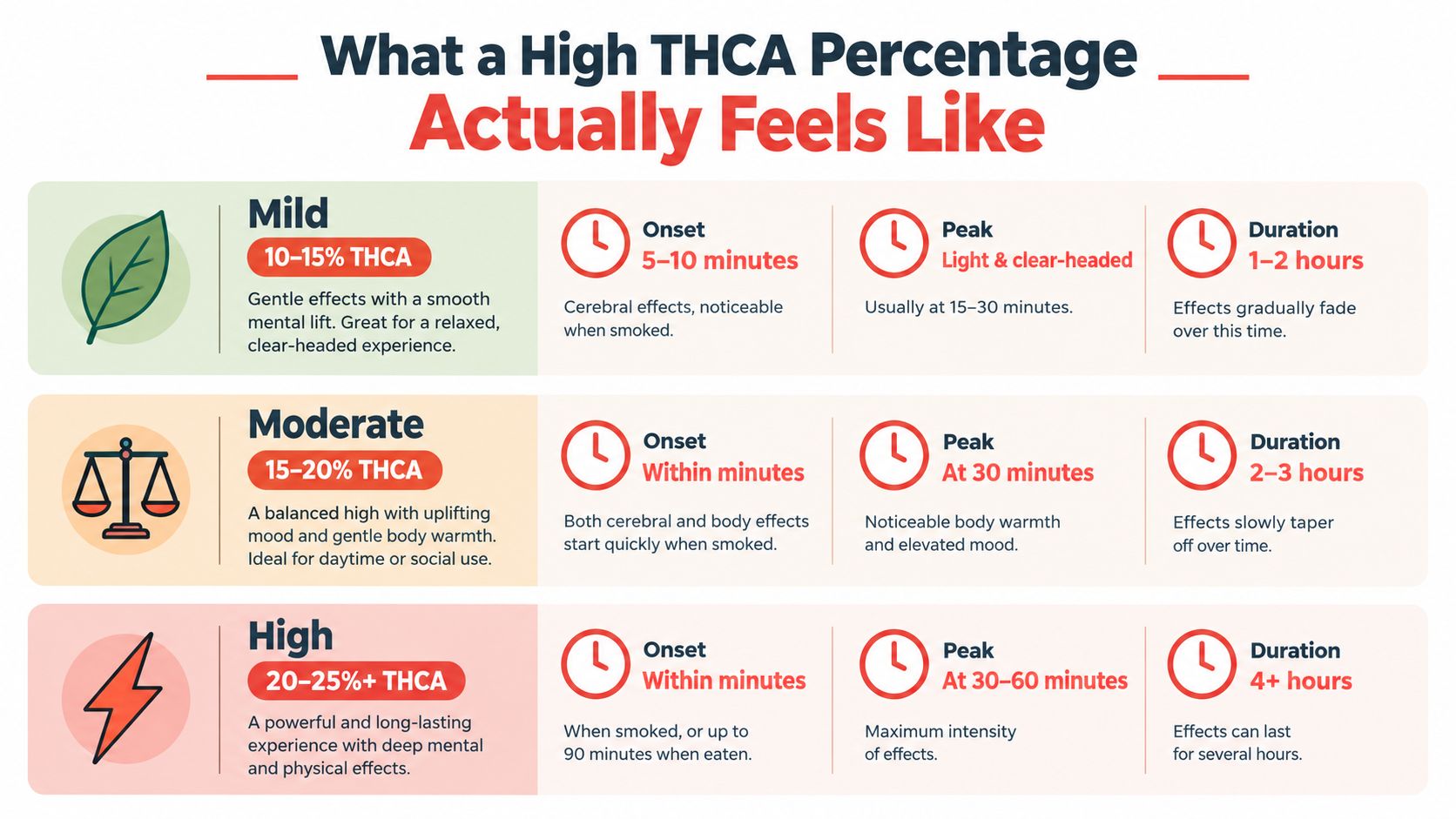
A practical approach is to reduce the amount when moving into a stronger potency band. Take a small inhalation, pause, and assess how you feel before taking more. Don't assume that a familiar bowl size remains appropriate when the flower's potency changes.
A calm setting, water nearby, and no driving or machinery make the experience easier to manage. If the effects feel too intense, stop consuming and give your body time rather than trying to correct the experience by taking another substance.
Edibles require extra care because they don't produce the same immediate feedback as inhaled products. Product form changes the timing and conversion process, so a flower percentage shouldn't be used as a direct dose comparison for a gummy or another preparation.
The useful question isn't “Is 25% high?” It's “How much of this product will I consume, and what does its total THC result suggest about that amount?”
A large THCA number doesn't automatically answer whether a product is legal hemp. It may only show how the product was measured.
The federal hemp framework historically focused on no more than 0.3% delta-9 THC by dry weight. Under a delta-9-only approach, a product could show low delta-9 THC while carrying substantial THCA, because the precursor wasn't counted in the same way. Once heated, however, that THCA can convert into THC, which creates a clear difference between the label's legal test and the consumer's real-world use.
That distinction is why total THC matters. Total-THC calculations include the potential THC from THCA as well as delta-9 THC already present. USDA hemp laboratory testing guidance shows why the testing framework, sample point, and measurement method matter when a product moves through the supply chain.
The federal definition is scheduled to shift toward total-THC measurement in late 2026, according to the regulatory summary in this hemp drug-testing and compliance explanation. That projected change means a product that appears compliant under a delta-9-only screen may receive a different classification under a total-THC approach.
States can also apply their own restrictions, and those rules don't necessarily move at the same pace as federal policy. A high-THCA flower may therefore be legal in one market, restricted in another, or treated differently depending on the product category and testing standard.
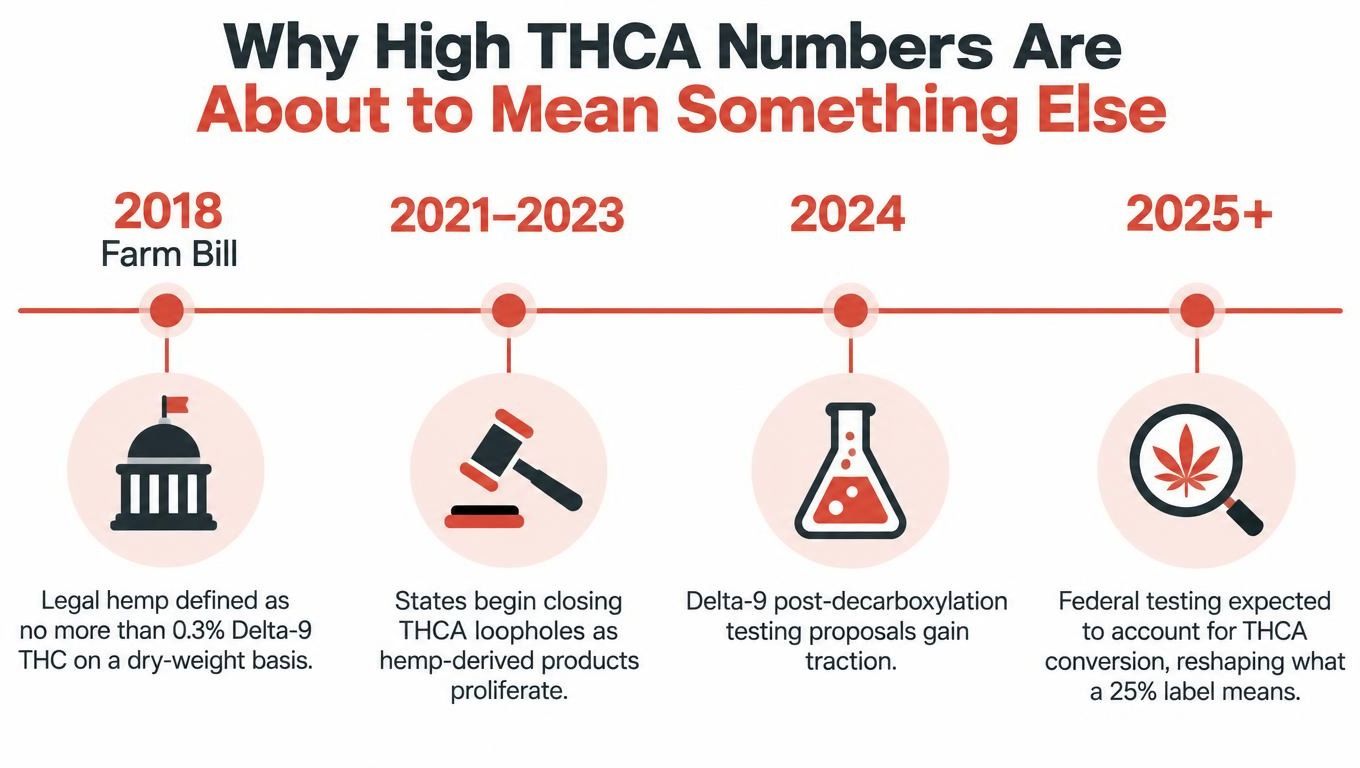
The practical conclusion is straightforward. Don't judge legal status from the THCA percentage alone. Check the current rules where you live, review a recent batch-specific Certificate of Analysis, and look for the total THC result rather than relying only on delta-9 THC.
A Certificate of Analysis is the product's laboratory record. It should let you connect the package in your hand with a specific batch, a testing date, a cannabinoid profile, and safety results.
Start with identity. Find the batch or lot number, the testing laboratory, the report date, and the product name. The package and the report should match. A QR code can be useful, but it shouldn't lead only to a generic company page or an unrelated report.
Look for these fields side by side:
The label's headline percentage should be close enough to the CoA to make sense. A large gap, unexplained rounding, or a report that lists only one attractive cannabinoid number deserves caution.
A useful report also includes safety screens. Look for testing related to pesticides, heavy metals, microbial contamination, mycotoxins, moisture, and foreign matter. These checks answer a different question from potency, but they're just as important to a purchasing decision.
For a more detailed walkthrough, use Melt's guide to reading a Certificate of Analysis. Walk away when the seller can't provide a batch ID, the report is missing, or the laboratory's credentials and methods aren't clear. A compelling THCA percentage can't compensate for an incomplete or unverifiable report.
Use one mental model every time you evaluate a product:
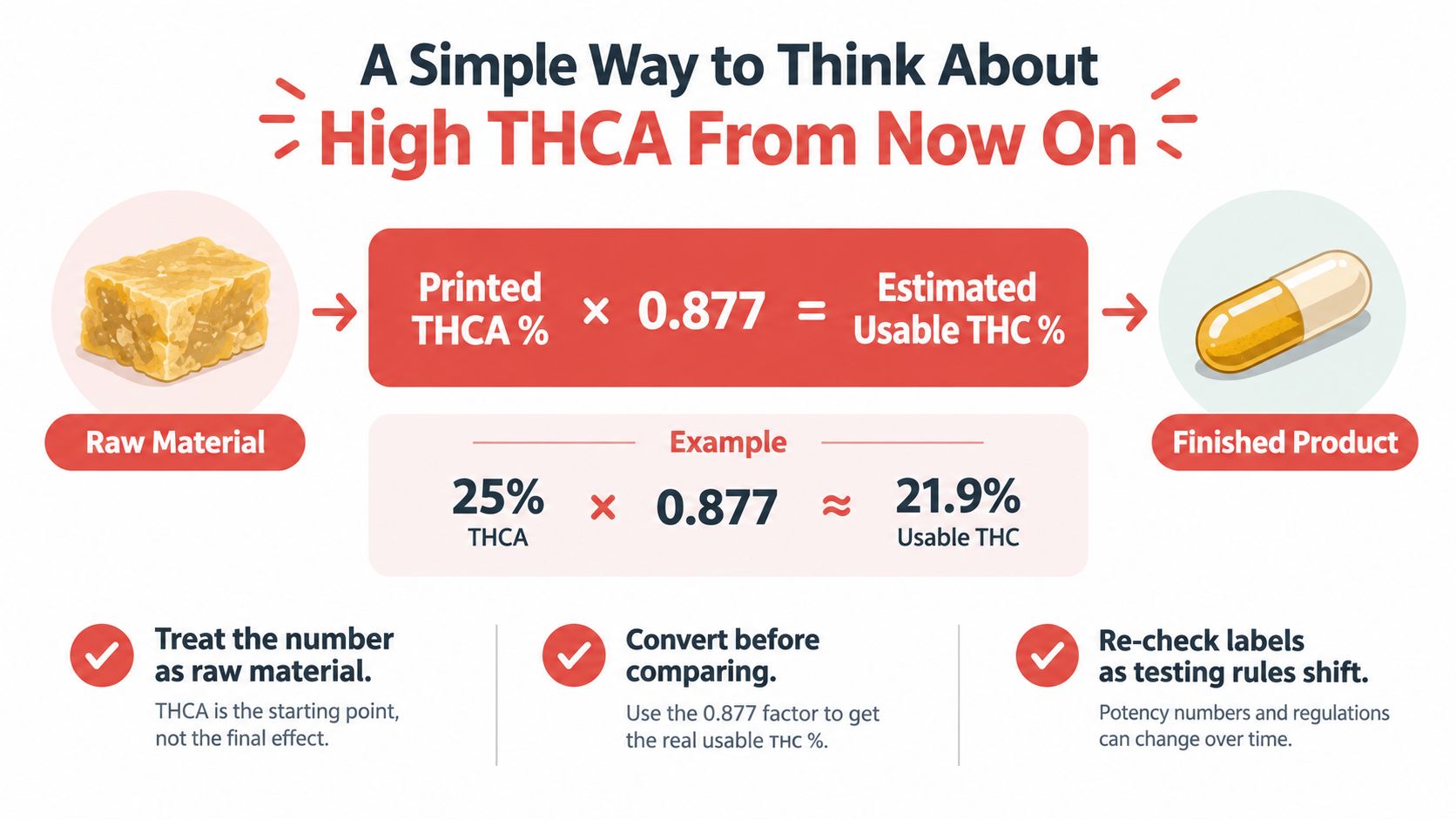
Printed THCA percentage × 0.877 = estimated THC after conversion.
Then check whether the laboratory's total THC figure includes delta-9 THC that was already present. This two-step process keeps you from comparing a raw THCA label on one product with a finished total THC result on another.
First, classify the raw material. A result in the 15% to 20% range fits the commonly used “good” benchmark. A result from 20% to 25% is generally described as quite potent, while results above 25% enter the very strong category.
Second, estimate the finished potency. Apply 0.877, then compare your estimate with the total THC shown on the CoA. A 25% THCA label works out to about 21.9% THC before considering any delta-9 THC already present.
Third, evaluate the product in context. Ask how you'll consume it, how much you intend to use, how familiar you are with THC, and whether the lab report is current and complete. The same percentage can produce a different experience when the dose, product form, or consumer changes.
Legality belongs in this checklist too. A delta-9-only result doesn't tell the whole story when regulators use or move toward total THC. Rules can change, and state requirements may differ, so confirm the current position before ordering or carrying a product across a border.
The reusable summary is simple: THCA is the raw input, 0.877 estimates its converted THC, total THC completes the potency picture, and the current testing standard determines how the product is treated legally.
If you want to compare THCA flower, edibles, and all-in-one products using clear cannabinoid information and third-party lab reports, explore the curated selection at Melt. Review the product details and Certificate of Analysis for the specific batch before choosing a potency that matches your experience and intended use.
Your cart is currently empty.